|
|

 |
|
|
|
|
|
New York Architecture Images-New York Architects Napoleon Le Brun |
||||
| New York works; | ||||
|
|
 |
||
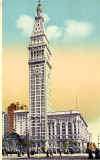
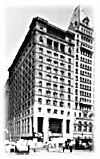
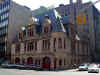
| 019 Metropolitan Life Insurance | 027 Home Life Insurance | 033 Engine Company No. 31 | ||
|
Born: 1/2/1821, Died: 7/9/1901
Napoleon Eugene Henry Charles Le Brun was born in Philadelphia, the son of Charles and Adelaide (Madelaine) Le Brun. Both of his parents were French-born Catholics and well educated; his father supported the family as a teacher, translator, and author. Young Le Brun was placed in the office of Thomas Ustick Walter (c.1836) where he remained until c. 1841, when he opened his own office. However, he does not appear in the Philadelphia directories until 1843, and then his office is listed at 188 Spruce Street. Le Brun's early commissions were churches, beginning with St. Patrick's (1841), the Seventh Presbyterian (1842), the Scot's Presbyterian (1843), the German Catholic church of St. Peter (1843), the Protestant Episcopal Church of the Nativity (1844), and his most important ecclesiastical commission in Philadelphia, the monumental Cathedral of SS. Peter and Paul on Logan Square (1846-1851; 1860-1864). The basic chronology and responsibility for the design of the Philadelphia cathedral had not been firmly established until the discovery by The Athenaeum of Le Brun's drawings for the structure. That discovery, however, permitted the story to be unravelled. According to Le Brun, his "original design [was] made in 1846, in September of which year I supervised the laying of the corner-stone, and continued to direct the work until 1851." Confirmation of this memory comes from a surviving plan dated 1846. The Archdiocese of Philadelphia was already looking for another architect prior to 1851, however. An elevation and plan by Thomas Ustick Walter, dated 5 April 1850, survives in The Athenaeum's collection, and it is known that John Notman was ultimately hired. From Le Brun again, "a disagreement between myself and clients then caused a suspension of my connection with the building for several years, during which time the preent facade was erected . . . according to an amended design by Mr. John Notman. This was his sole connection with the work." Notman had been dismissed for inflating costs -- and thereby his fees -- in 1857, and the building then passed to the hands of John T. Mahony. Le Brun does not give a date for his reappointment ("the walls . . . were not yet brought up to the roof level"), but his surviving drawings are all dated March, 1860, or later which suggests his reinstatement at approximately that time. "I was engaged to resume charge of the work, and carried it to completion in 1864, entirely according to my own designs and original plan . . ." Le Brun's other major contribution to Philadelphia architecture was the Academy of Music (1855) on Broad Street; on this design he partnered with German-born Gustav Runge. The partnership seems to have lasted throughout the project (c.1855-1857), but no other structures are known to have been designed them. Around the time of the Civil War, Le Brun moved his family to New York, where ultimately his sons Pierre L.(1846-1924) and Michel Moracin (1857-1913) joined him in business. The firm name was altered to reflect this expansion in the 1880s, first to N. LeBrun & Son in 1880 when Pierre joined and then to N. Le Brun and Sons in 1888 when Michel came along. In New York the new firm was associated especially with designs for the City fire department and with the beginnings of skyscraper construction (Metropolitan Life Insurance Building, 1890-1893). After the elder LeBrun's death, his sons continued the firm, designing the Metropolitan Life Tower in 1909. Written by Roger W. Moss. |
||||
|
links |
||||


