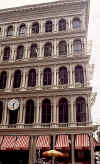
Though many critics of
F. Scott Fitzgerald’s The Great Gatsby have commented on the crucial
importance of the buildings in the novel, none has given full and specific
attention to those buildings’ particular architectural styles.1 This is
surprising, since, following a tradition in American fiction that reaches as
far back as Irving, Poe and Hawthorne, Fitzgerald in his masterpiece makes
architectural style a highly effective tool. On one level the styles of his
buildings form part of the vivid, impressionistic “local color” rendering of
American life of the twenties which gives the novel so much of its illusion
of reality. He displays an extraordinarily keen eye for the niceties of the
architectural modes of 1922 and indeed ranks with Howells, the early
James, Wharton and Cather as a recorder in fiction of American architectural
history. But, like theirs, his often satiric architectural description
functions on other levels too. The specific styles of his buildings, both
individually and in their carefully developed counterpoint, embody basic
aspects of his characters, reinforce his social analysis and help express
the characteristically American Europe-East-West tensions that are central
to the novel. Architectural style rises from mere local color to become a
highly effective connotative language through which Fitzgerald can not only
set his scene but also tell his story and represent his themes.
Image 01-
Nick’s
modest bungalow was a striking
contrast to the greatest mansions among which it was set. Especially popular
from 1900 to 1920, the bungalow was characterized by a low profile, a long
roof sloping down over a wide front porch, and a single wide front dormer.
In the East and especially along the seashore it was frequently shingled. It
had a homey look. Link-
http://www.essential-architecture.com/STYLE/STY-053.htm
Image 02- Chateauesque
mansion- Carey Mansion, Newport, Rhode Island.
Link-
http://www.essential-architecture.com/STYLE/STY-chat.htm
Image 03- Ochre Court, a large châteauesque mansion
in Newport, Rhode Island. It was built at a cost of $4.5 million in 1892. It
is the second largest mansion in Newport after nearby The Breakers.
Gatsby’s mansion,
described as a colossal “factual imitation of some Hotel de Ville in
Normandy, with a tower on one side,” can well be imagined as a slightly
satiric version of Ochre Court, the huge French-inspired mansion
built in Newport in 1888 for Ogden Goelet by Richard Morris Hunt. Ochre
Court too is directly on the sea, and its roofs at night have the “feudal”
touch that Nick enjoys yet derides in Gatsby’s house.
Central in the novel
looms Gatsby’s ”colossal” mansion at West Egg. The
significance of all the other buildings in the story is defined by their
relationship to it. We see it, of course, only through the satiric yet
slightly ambivalent eyes of Nick, for whom it is both an impressive though
absurdly anachronistic ”palace on Long Island Sound” (49) and “an
elaborate road-house” (64). Imagined to have been built about 1912, “early
in the ‘period’ craze” (89), it is a highly accurate caricature of the
elaborate Châteauesque Style developed in the late nineteenth century
by Richard Morris Hunt and Stanford White for the Vanderbilts
and other enormously rich families of New York City, Newport and Long
Island.3 (Figure 1) Its large central bay (89), its high tower set
asymmetrically on one side of its facade (5), its big postern (91), great
arched doors, square towers (65, 91) and ranges of French windows (147) give
it the eclectic, partly late Gothic, partly Renaissance, European flavor
characteristic of the genre. Nick, whose comments accurately represent the
sophisticated taste of the middle twenties, is amused by what he considers
its showy and vulgar anachronism but yet, especially at night, cannot help
being moved by its shadowy grandeur. Disparagingly, he calls it a “factual
imitation of some Hôtel de Ville in Normandy” (5), “factual” in his
remark probably implying accuracy in detail but not in whole impression.
Seen at night, its silhouette against the sky is “feudal” (92)—a word with
mixed connotations, savoring of foolish but generally harmless Sir Walter
Scott romance yet hinting also of a European class system. In the daytime,
however, he wryly notes that one can see that its masonry is “spanking
new under a thin beard of ivy” (5). Certainly its lavish marble swimming
pool (5) clashes with its pretence of antiquity.
Image 04- The Breakers,
Newport, Rhode Island. Link-
http://www.nyc-architecture.com/NP/NP-04.htm
Nick’s amusing account
of the interior could well be read as a satiric (though, of course, unfair)
guidebook description of the Vanderbilts’ “enormous” (89) Newport
cottages “The Breakers” and “Marble House.” From the high
and splendid great hall (168-169), where Gatsby has indecorously set up his
“road-house” bar, open the public rooms, each in its own pastiche of a
“period” style: “Marie Antoinette music-rooms and Restoration salons”
(92), a Versailles-like “long, many-windowed room which overhung the
terrace” (51), and, most spectacular of all, the Merton College
Library (92)—”a high Gothic library, panelled with carved English
oak, and probably transported complete from some ruin overseas” (45).
The last is, of course, a close parallel to the real Gothic Room in
“Marble House.” (Figure 2) Upstairs—here the parallel with “The
Breakers” is almost exact—there are “period bedrooms swathed in rose and
lavender silk,” “dressing-rooms and poolrooms, and bathrooms with sunken
baths”(92). Here, too, (as in several Newport mansions) are the owner’s
contrastingly simple bedroom and chaste Adam study (92-93). (Figure 3)

Image 05- Marble House,
Newport, Rhode Island. Link-
http://www.nyc-architecture.com/NP/NP-12.htm
(Used as Gatsby’s house in the 1974 film).
Image 06- Gothic Room from Marble House
In his Gothic
“Merton College Library” Fitzgerald parodies the penchant of Richard
Morris Hunt and others to embellish their great Châteauesque mansions with
impressive pastiches of Old World interiors made up in part from authentic
fragments imported from abroad. Here is the Gothic Room from Marble House,
the costly Newport “cottage” designed by Hunt in 1892 for William K. and
Alva Vanderbilt. (The fifty-room mansion required a staff of 36 servants,
including butlers, maids, coachmen, and footmen. The mansion cost $11
million ($260,000,000 in 2009 dollars) of which $7 million was spent on
500,000 cubic feet (14,000 m³) of marble).
Image 07- Plaza Hotel,
Manhattan. Tom and Daisy, along with Gatsby and narrator Nick Carraway (Sam
Waterston) later arrive at the Plaza Hotel, Fifth Avenue at 59th Street, for
what turns out to be a very stormy afternoon out.
Its high mansard, paired pavilions and rusticated base show how French
Châteauesque elements like those used by Hunt in Ochre Court were later
employed to give “class” to a hotel always known for its lavish
expenditures. The Plaza was designed by Henry J. Hardenbergh in 1907. It was
a favorite haunt of Scott and Zelda Fitzgerald. (Photo courtesy of the Plaza
Hotel.)
Link-
http://nyc-architecture.com/MID/MID056.htm
The great chateau,
however, also has rich symbolic significance. In its vast size, its
costliness and its ostentation, it is a commentary on what Nick regards as
the essential vulgarity and tasteless extravagance of the new wealth of the
period. Even more significantly, what Nick considers the aesthetic failure
of its derivative and anachronistic architecture—late in the novel he calls
it a “huge incoherent failure of a house” (181)—symbolizes to him the
impossibility of effectively recapturing the past. In his view, there is
something false in building a great Norman Hôtel de Ville in West Egg. The
chateau is not genuine; the stone behind its raw fringe of ivy is too new,
its period interiors too “factually” studied. The falseness of the design,
however, is not merely aesthetic or historical. It is a function of the
equally inappropriate and doomed desire of the rich brewer who built it to
Found in America a Family—a “house” in the European sense. Like the brewer’s
preposterous attempt to get the cottage-owners of West Egg to roof their
cottages with thatch (89), it represents a lack of understanding of American
reality and failure to sympathize with American ideals.

Image 09: Hammersmith Farm (Jacqueline Bouvier
Kennedy Onassis’s childhood home), used as the Buchanan mansion in the 1974
film. The 1974 version starred film legends Robert Redford at Jay Gatsby and
Mia Farrow as Daisy Buchanan. In the
1974 Great Gatsby movie, two mansions were used to portray Gatsby’s mansion.
In addition to Rosecliff, Hammersmith Farm was used, and to me seems a much
better recreation of Beacon Towers.
In addition to suggesting the inappropriateness of trying to
import an alien concept of aristocracy into the United States, the mansion
makes a comment on the spuriousness of an American “nobility” whose
“nobleness” rests on money alone. The rich brewer by building his
pretentious eclectic house had attempted to buy gentility. But true nobility
is not to be bought, even when the money spent for it has been earned
honestly. It is certainly not to be bought with corrupt money. The “house”
of Gatsby— both his actual mansion and his dream of an aristocratic life
with Daisy— rests in the end on Wolfsheim’s rackets. Like its architecture
(as Nick judges the architecture) it is a false simulacrum and fated to
fall. Architectural decadence, as Ruskin would remind us, grows out of moral
decadence; architectural style has connotations beyond itself.


Image 10: Rosecliff Mansion in Newport, Rhode Island (an imitation
of the Petit Trianon at Versailles,, used as the Gatsby mansion in the 1974
film). Rosecliff, located in Newport, Rhode Island was commissioned by
Nevada silver heiress Theresa Fair Oelrichs in 1899 and built by famed
architect Stanford White. Rosecliff was used for some of the exterior and
interior shots of Jay Gatsby’s West Egg, Long Island home.
In such use of symbolic architectural style The Great Gatsby,
though it seems so much a novel of the twenties, is clearly heir to an older
American fictional tradition. The “feudal” style of the central mansion is
“Gothic” not only in the architectural sense but also in the literary sense
of Poe and Hawthorne and Melville and James. The great halls and Marie
Antoinette music rooms and long galleries overlooking terraces are shadowed
by a brooding sense of mysterious evil. Like the House of Usher, the
House of the Seven Gables, and to a lesser degree Saddle Meadows,
Bly and the Bellegarde chateau at Fleurières, the house hides a
secret crime or a halfmad obsessive passion. Its relationship to the House
of the Seven Gables is especially close. That mansion too was built by a
man—Colonel Pyncheon—who sought to Found a Family in America. He too
failed, partly because inherited social status is repugnant to American
ideals and partly because he laid the foundations of his house on mercenary
crime— on the judicial murder of Mathew Maule in order to appropriate his
land.

Image 11: The overwhelming gilt ballroom, where Gatsby
dons his old army uniform to dance with Daisy Buchanan (Mia Farrow) is the
ballroom of Marble House, 596 Bellevue Avenue, Newport, built for the
Vanderbilts, just south of Rosecliff.
The fact that Gatsby’s
mansion functions in part as a symbolic representation of its owner is an
even more important parallel to the American Gothic tradition. In
Hawthorne’s novel the author-narrator, looking at the House of the Seven
Gables, sees in its facade the expression of Judge Pyncheon. The
House of Usher in Poe’s tale, in an occult way, images Roderick and
Madeline; the crack in its wall is the fissure in Roderick’s breaking mind,
the relationship between it and its image in the tarn figures that between
brother and sister, its fall is their fall and that of their ancient
“house.”4 So here, the architecture of Gatsby’s mansion represents Gatsby.
Superficially, it is rich, handsome, aristocratic, magnificent. It pretends
to be a building of heroic romance. It embodies his vision of himself as a
bold baron, perhaps a robber baron, wooing the fairytale “king’s daughter,
the golden girl” from her high “white palace” (120) to his noble castle. He
desperately wants Daisy to visit his house (80), and with infinite pride he
shows her through it, wishing her to see him in it and it in him. And, at
least for a time, she does. Alternatively, he sees himself as a gallant
young Lochinvar, faithful in love and dauntless in war, riding out of the
West to sweep up his beloved and in defiance of her bridegroom carry her
away (in a long gleaming yellow automobile) to his feudal keep. With only
slight irony the usually cynical Nick compares him momentarily to a Knight
of the Round Table following the gleam of the green light in quest of an
impossible Grail (49).

Image 12: Lands’ End
mansion, demolished last year. The movie might have been filmed around the
Newport estates, but F. Scott Fitzgerald based a lot of his novel on The
Gold Coast in Long Island, New York, more notably the Island’s Sands Point
and Great Neck area.

Gatsby’s opulent mansion in the
recent version of the film. Former St. Patrick’s Seminary, Manly, Sydney.
http://www.sydneyarchitecture.com/NOR/NOR01.htm
But, as Nick more
often sees them, the house and Gatsby are both fakes. The mansion is
no more a feudal keep or an old Norman Hôtel de Ville than Gatsby is an
Oxford graduate. True, its architecture does embody “factual” elements of
old styles and indeed the whole of an authentic Gothic library which, to
Owl-Eyes’ amazement, even contains real books.5 But Gatsby too has authentic
details: he did study at Oxford, he did receive a medal from Montenegro, he
does have a card from the Police Commissioner. “Factually,” in details, he
too is genuine. But, like the brewer’s, his “nobility” is based only on
money, money from the rackets. He has assumed a facade of British culture
and language, but in the daylight one can see through the ivy to the raw,
new stone beneath. Though he has given himself a new name, basically he is
still vulgar James Gatz, the man who sets up a speak-easy bar in his
baronial hall. Furthermore, just as to many architectural critics of
the twenties there always seemed a hint of false, impossible nostalgia
in even the greatest and most beautiful buildings of the Châteauesque Style,
so too Gatsby tries in vain to recapture those golden, romantic, almost
mythic days with Daisy in Louisville during the War. He really thought that
one could bring back the past, and for a few weeks the illusion seemed true.
But as Nick sees it, neither in architectural style nor in life is the past
really recoverable; any attempt to relive it is necessarily false: “You
can’t repeat the past” (111).

Image 08: Adam style (English
version of French Empire style) bedroom.
The “chaste” Adam
style in which Nick says Gatsby’s second-floor study was decorated is
here exemplified by an upstairs bedroom in The Breakers, the enormous
mansion built by Richard Morris Hunt for Cornelius Vanderbilt in Newport in
1892-1895. To Nick it symbolizes a basic innocence in Gatsby untouched
by the tawdry magnificence of the flamboyant style of his life.
Furthermore, the
mansion also images the ambivalence of Gatsby as traditional Gothic hero.
Like his enormous house, he is in some lights great—”the great Gatsby” of
the title. He is a man of great force, great determination, great
possibilities for good or evil. He stands alone; his singleness of purpose
sets him apart. “There was,” Nick says, “something gorgeous about him, some
heightened sensitivity to the promises of life . . . an extraordinary gift
for hope” (2). He is worth, Nick calls out to him in the darkness, “the
whole damn bunch put together” (154). There is also a tragic loneliness
about him, a loneliness like that of the magnificent house after all the gay
parties are over and it is shut up. He has an ideal by which he lives,
whereas the others around him have none. Effectively symbolized by the
simplicity of the decor of his bedroom—”the simplest room of all” (93)—and
private study, he has in his private recesses an almost innocent simplicity,
a refreshingly idealistic Western faith. Even his adulterous liaison with
Daisy in his eyes seems pure and good. Superior to the morals of ordinary
men, he feels married to her (149). When the inevitable denouement comes, it
is on one level tragic. In Gothic terms the novel might justifiably be
renamed the Fall of the House of Gatsby.

But despite its
magnificence and grandeur, Gatsby’s great mansion inherits many of the
sinister connotations of mystery and evil that characterize its many
forebears in Gothic romance. As it is ambivalent (old yet new, European yet
American, aristocratic yet vulgar), so from the very first pages of the
novel, Gatsby too as Gothic hero shares its sinister as well as its heroic
characteristics. There is a shadow, a mystery about him. Gossip has
it that he is a cousin of the Kaiser (33) or a nephew of Von Hindenburg
(61), that he was a German spy during the War (44), that he has killed a man
(49, 61). “I’m scared of him,” says Catherine; “I’d hate to have him get
anything on me” (33). He is a second cousin to the devil (61). He may be a
bootlegger or a racketeer. He receives mysterious telephone calls. Though
wealthy, generous and dressed by the best English tailors, he is associated
with Meyer Wolfsheim, the man who fixed the 95 World Series. Like so many
other Gothic heroes, he hides a secret and almost mad adulterous passion.
His lonely, perhaps blasphemous ritual of adoration, lifting from his
night-darkened lawn his hands in idolatrous supplication to the green light
across the bay, has in it much of the Gothic strangeness that imbues Poe.
Though “hugely” impressive in its way, the “Gothic” architecture of Gatsby’s
personality is no more “coherent” than that of his vast “ancestral” (154)
mansion. Nick, who at times catches glimpses of his lonely, mythic grandeur,
in summary remarks that he lacked the “fundamental decencies” (1) and
represented “everything for which I have an unaffected scorn” (2).

Image 13: Georgian Colonial
Revival
Link-
http://www.essential-architecture.com/STYLE/STY-GR.htm
Once the significance
of the architecture of Gatsby’s mansion is established, the symbolic
meanings of the styles of the other important buildings readily fall into
place. Prime among them is the Buchanans’ far less ostentatious, cheerful
red-and-white mansion symbolically facing Gatsby’s in fashionable East
Egg across the bay. In its architecture Fitzgerald gives a remarkably
accurate and vivid impressionistic picture of the Georgian Colonial
Revival style—what Mary Mix Foley calls “Millionaire’s Colonial”—that
in the early 1900s and even more in the twenties contested with Châteauesque
for supremacy in the wealthy enclaves of Newport and Long Island.6 Built of
red brick with white stone or wood trim, set on a “lawn [that] started at
the beach and ran toward the front door for a quarter of a mile, jumping
over sun-dials and brick walks and burning gardens,” covered with bright
vines, its French windows “wide open to the warm windy afternoon” (6-7), it
is an ideal example of a seaside mansion of the era, designed both to fit
into its natural setting and to recall American tradition. Its living spaces
are blended into the outdoors. In front is the sunny porch overlooking the
Sound (7) where on Nick’s first visit Tom stands to welcome him. Around
other parts are “a chain of interconnecting verandahs” with wicker settees
(17). Through a high hallway Tom leads Nick to a salon where he finds Daisy
and Jordan— “a bright rosy-colored space [recalling the rose garden
outside], fragilely bound into the house by French windows at either end.”
The windows were ajar and gleaming white against the fresh
grass outside that seemed to grow a little way into the house. A breeze blew
through the room, blew curtains in at one end and out the other like pale
flags, twisting them up toward the frosted weddingcake of the ceiling, and
then rippled over the wine-colored rug . . .

The room, darkened by
awnings, has a brick (Georgian) fireplace; Daisy and Jordan lie somnolently
on one of the great couches popular at the time (115-116). Dining room,
library, pantry and bedrooms are not particularized, but we can be sure that
they are open and, if not shaded by awnings, sunny and bright. Even the
grounds—the former garage a quarter of a mile down the road now made into
stables for Tom’s polo ponies (119-120), the gate, the long gravel drive
from the road (143, 146)— are brought sharply to life.

How different this
house is from Gatsby’s! Though it is, as Nick remarks, surprisingly
elaborate, and perhaps as costly as Gatsby’s, this is not a flamboyant,
imported, Gothic-Renaissance Beaux-Arts chateau. It is built of simple
brick, not of marble. It is long and low (probably two-story or two stories
and a half), clinging to the American soil. It does not pretend or blatantly
aspire like Gatsby’s vulgar castle. Instead of Gatsby’s formal terraces with
their great marble steps, here there are restrained brick Georgian walks and
(for a slight touch of European culture) an understated, sunken Italian
garden, “a half acre of deep, pungent roses” (8).
Inside, the high front
hall has nothing of the public “road-house” or “Hôtel de Ville” atmosphere
of Gatsby’s pretentious (Nick might say sham) baronial hall. There is no bar
here. Instead of looking down distantly on a marble terrace, the French
windows of the front room open directly on the lawn and the sea. For this
house, with its connotations of a dignified old American aristocratic
tradition, though lavish and large and not wholly authentic, represents
old money, restrained good taste, a geniune, native quality. It is
East Egg, not West Egg. It speaks a selfconfident social status that does
not need to shout architecturally yet likes to express its wealth. Though,
like Gatsby, Tom Buchanan comes from the West, with his older money and
Eastern education he has been able to buy into what Nick regards as a far
more genuine tradition. Even his pride in being the first man to turn a
garage into a stable (119) may suggest his clinging to an older, more
natural social ideal. Indeed, throughout the novel Tom is regularly
associated with animals, Gatsby with motor cars. Nick sees Tom and Daisy
as more genuine, though in their way they are equally as hollow as, or more
hollow than, Gatsby (certainly they are harder and more uncaring). Like the
architecture of their house, they belong. They are not mere pastiche.
Architectural style is
used, though less elaborately, to express the other characters too. The
modesty of Nick’s weatherbeaten little wooden house squeezed between two
great mansions in West Egg (5) says a great deal about Nick’s own modest
self-depreciation. He has a “shed” for his car, not a garage like Gatsby’s
nor a stable like Tom’s. His drive is rocky, his lawn, until Gatsby’s men
mow it, unkempt. His proud parvenu neighbors regard his small house—so small
that there is a distinct feeling of cramped space the day that Daisy and
Gatsby come to tea—an “eyesore” (5), as some of the rich owners of palatial
Newport “cottages” must have considered the occasional modest 1870s frame
houses that still remain on Ocean Drive or Bellevue Avenue. But though
small, though in comparison to the great stone chateau only “cardboard,” his
weatherbeaten house is only fifty yards from the ocean—much closer than the
Buchanans’, for instance. And, even more significant, it is a bungalow (3),
built in the bungalow style that flourished first on the West coast but
later swept across the country,7 (Figure 4) finding its greatest acceptance
early in the twentieth century in the Midwest. Unassuming, middle-class,
comfortable, democratic, completely naturalized to the United States
though of Asian origin, it carries with it in the novel strong connotations
of that homelike Middle West (Fitzgerald is doubtless thinking of St. Paul)
which Nick so vividly remembers from his Christmas vacations and to which at
the end of the story he returns. With great precision, it also represents
Nick himself.
Little is actually
said of the Fays’ house in Louisville, but that little gives a vivid
impression of Daisy’s background. On a street of flapping flags and wide
lawns, it has the largest flag and the widest lawn (75). One guesses
that it is white, for Daisy is the “king’s daughter” “high in a white
palace” (120). Probably it is in the neoclassic imitation-Southern
plantation style favored in Kentucky—and Zelda Sayre’s Alabama—at the
period, an aristocratic, traditional, revival American architecture with
many parallels to the Colonial Revival of Daisy’s and Tom’s later home.8
(Figure 5) To Gatsby, who “had never been in such a beautiful house before,”
it was utterly fascinating. “There was a ripe mystery about it, a hint of
bedrooms upstairs more beautiful and cool than other bedrooms, of gay and
radiant activities taking place through its corridors … ” (148). Like
Daisy herself, it represented to him a rich upper-class way of life that he
had never experienced. “Her porch was bright with luxury of bought
star-shine; the wicker of the settee squeaked fashionably as she turned
toward him and he kissed her curious and lovely mouth.” Into her home, into
the rich, full life that it represented, she could vanish, leaving
Gatsby—nothing (149). For as Gatsby is his pastiche chateau, so this house
is not only Daisy’s but also Daisy, representing not only her as an
individual but also the traditional, comfortable, patrician culture from
which she comes.

Image 16: The brief
flashback to their first meeting is at the white-pillared, Southern-style
Linden Place Mansion, 500 Hope Street, Bristol, about ten miles north of
Newport off Route 114. Impressive
white mansions and wide lawns such as these help to characterize Daisy
Buchanan. Their high-pillared
porches and Neoclassic style hint of a Southern tradition of plantation
aristocracy.
More satirically,
the apartment on West 158th Street images Myrtle Wilson. When one
recalls that a whole white “frosted wedding cake” adorns the ceiling of the
Buchanans’ crimson salon, the irony of Fitzgerald’s description of Myrtle’s
apartment as being in just “one slice of a long cake of apartment-houses”
(28) becomes amusingly clear: she gets only a slice of Tom! But Myrtle’s
apartment plays against Gatsby’s house too. Like Gatsby, she too, also with
great energy, is a social climber. Her huge set of French-inspired
tapestried furniture depicting “scenes of ladies swinging in the gardens of
Versailles,” like his Norman chateau with its long French-windowed gallery,
makes a pretense to French aristocracy. But it so crowds her little
top-floor apartment—”a small living-room, a small dining-room, a small
bedroom, and a bath” (29)—that it, and particularly its Sun King
connotations, become utterly absurd. Yet with “impressive” but somewhat
drunken “hauteur” (31), she plays, despite the little dog’s sick whimpering
and Tom’s brutal slap that breaks her nose, at having an artistic (Mr.
McKee’s photographs) and literary (the novels Simon Called Peter and Town
Tattle) salon just as, on a grand scale, Gatsby with his assumed British
mannerisms and Trimalchio-like entertaining plays his game. It is only
the difference in size and costliness between the vividly suggested, tawdry,
inexpensive top-floor apartment in unfashionable Washington Heights and the
magnificent roadhouse-palace on Long Island that changes Byronic or Gothic
tragedy into maudlin farce.
Image 18: the stare of Dr. Eckleburg in the valley of
ashes.
The architectural
intonations of Wilson’s garage are also cogent. Near the railroad
that takes Nick and Tom to New York, under the persistent and unnerving
stare of Dr. Eckleburg, stands utterly by itself in the Valley of
Ashes
a small block of
yellow brick sitting on the edge of the waste land, a sort of compact Main
Street ministering to it, and contiguous to absolutely nothing. One of the
three shops it contained was for rent and another was an all-night
restaurant, approached by a trail of ashes; the third was a garage—Repairs.
GEORGE B. WILSON. Cars bought and sold
(24).

Wilson’s garage in the Valley of Ashes (in the recent Baz Luhrman
GG)
Like Fitzgerald’s
other buildings, this too is a carefully observed bit of local color. Such
purely vernacular buildings of yellow brick 9 with cement colored
walls, little office (26) with raised threshold, and living quarters above
could be found in the dingiest, most hopeless parts of many Eastern cities
and towns in the early twentieth century. Even in terms of the taste of the
time, which valued many sorts of architecture that until recently we have
been prone to decry, such yellow garages and storefronts ranked at the very
bottom of the architectural scale. Fitzgerald is thus using this genre as
the very ultimate in shabby, irremediable tastelessness. The color yellow
itself, as Milton R. Stern has pointed out, stands as a debased or dirtied
form of the gold which Fitzgerald so often uses to help characterize both
“the golden girl” Daisy and Gatsby himself. It is also the same yellow of
the “fog that runs its back upon the window panes” of that other,
Prufrockian waste land of T. S. Eliot. The doomed Wilson, illiterate and
unsophisticated though he be, is an empty and hopeless Prufrock dwelling in
a dusty land of shadows, even though eventually his revolver does “Disturb
the universe” of the novel.10 Yet, ironically, he and his hopeless garage
hover at the edges of a great tragic story of love and death. Enveloped in
the romantic aura of the tale, the usually satiric Nick can almost come to
imagine that, like some dilapidated hovel in an Oriental Gothic romance,
“this shadow of a garage must be [only] a blind, and that sumptuous and
romantic apartments were concealed overhead” (25). One thinks of Gatsby’s
romantic assertion that he had “lived like a young rajah in all the capitals
of Europe—Paris, Venice, Rome—collecting jewels, chiefly rubies, hunting big
game, painting a little, things for myself only, and trying to forget
something very sad that had happened . . . long ago” (66). One fantasy is
hardly more incredible than the other.

Image 17: 1974 version- The Long Islanders’ jaunts into New York
take them across the Queensboro Bridge, jam-packed with period cars. It”s
just south of the bridge’s entrance, beneath the archway on 1st Avenue at
East 59th Street that boorish racist Tom Buchanan (Bruce Dern) indulges his
mistress Myrtle (Karen Black) by buying her a puppy.
Aside from the boat in
which Gatsby was fabled to live that “looked like a house and was moved
secretly up and down the Long Island shore” (98)—a touch of fantasy that
relates to Dan Cody’s peripatetic yacht— Fitzgerald uses three more
buildings. Two of these are in New York City. The first is the cellar
restaurant representing, despite the ironic Presbyterian nymphs of its
ceiling, the underworld in which Gatsby moves and feeds with Wolfsheim. The
second, a sharp contrast, is the fashionable Plaza Hotel overlooking
Central Park. (Figure 6) There, in the tea-garden, Jordan first tells Nick
what she knows of the war-time relationship between Gatsby and Daisy (75).
There, in the parlor of a “swell suite” (126-127), Nick and Jordan spend a
sweltering afternoon listening to Tom and Daisy quarrel as faint strains of
Mendelssohn’s Wedding March rise ironically from the ballroom below. Here
again, though Fitzgerald uses an actual building instead of designing his
own, architectural style is revealing. The Plaza’s rusticated bottom stages,
its high mansard roof, its side bays stretched out of all proportion by
their tremendous height, its uneasy combination of aristocratic Old World
elegance with modern skyscraper size and obvious commercial purpose give it
an ironic relationship to Châteauesque Style.11 Like Gatsby’s
mansion, it is both a palace and a roadhouse. But because it is patronized
by the “best” people, what Nick might see as the falsity of its architecture
does not matter. Here can meet the pretentious vulgarity of West Egg and the
old-wealth snobbery of East Egg. Here, indeed, Gatsby and Tom do
meet—tragically. The marble floor of the stylish hotel’s lobby foreshadows
the marble bottom of the spurious chateau’s anachronistic swimming pool.

Image 19: The location for filming of the Buchanan
House, in the 1974 movie, was actually in England at Heatherden Hall.

Image 20: The mansion thought to have been the inspiration for Jay Gatsby’s
abode, was Beacon Towers (demolished 1945). Built for Alva Vanderbilt
Belmont by architect Richard Howland Hunt in around 1918. Richard Howland
Hunt was the eldest son of Richard Morris Hunt , who had completed the
Biltmore Estate for the Vanderbilt family in 1895.
Thus the houses in the
novel, as W. T. Lhamon, Jr., has rightly pointed out, are not (as
Fitzgerald’s famous final passage might suggest) “inessential.” To the book
they are essential. With superb skill Fitzgerald has used the interplay of
their architectural styles to set his scene, represent his characters and
give structure to his action. But they do even more. Seen through Nick’s
often ironic eyes, architectural style reveals and comments on the social
structure, the taste and the moral values (or lack of moral values) of the
twenties. Fitzgerald’s satiric yet ambivalently wistful image of America of
his time is delineated with high effectiveness through it. Not to recognize
its importance is to miss much of the book’s art and import. Significantly,
however, Fitzgerald does not particularize the architecture of one important
structure. He leaves vague the specific style of the Midwestern home
to which at the end of the novel Nick finally returns. We are told only that
it is “the Carraway house” (177), the symbol of a continuing, unspectacular,
rooted,12 yet rewarding way of life. It is the paradigmatic “vernacular”
American home, perhaps only a fond memory or a wistful hope. Who can
specifically delineate a dream? What architectural style has it?
Fitzgerald’s artistry is as sure here in his omission as, elsewhere in his
great novel, in his superb connotative use of particular American
architectural styles.
Curtis Dahl,
Wheaton College American Studies, Vol. 25, No. 1:
Spring 1984.
Notes
1. The most explicit
comments are those by Milton R. Stern in The Golden Moment: The Novels ofF.
Scott Fitzgerald (Urbana, 1970), 211-241, and André Le Vot, F. Scott
Fitzgerald, A Biography, translated by William Byron (Garden City, New York,
1983), 149. In “The Essential Houses of The Great Gatsby,” Markham Review, 6
(1977), 56-60, W. T. Lhamon, Jr., discusses the complex symbolic patterning
of the houses but does not comment directly on specific styles.
2. F. Scott
Fitzgerald’s The Great Gatsby, Scribner Library edition (New York, c. 1953),
5. Succeeding references will be placed in parentheses in the text.
3. See Marcus Whiffen,
American Architecture since 1780: A Guide to the Styles (Cambridge,
Massachusetts, 1969), 141-145; and Mary Mix Foley, The American House (New
York, 1980), 199-203.
4. Melville, too, in
Pierre embodies possibly sinister characters such as Pierre’s father and his
ambiguous half-sister Isabel in architectural style. Faulkner uses a similar
technique in Absalom, Absalom.
5. Gatsby’s library,
quiet amid the tumult of the huge party, should be compared to the library
of the Yale Club in New York, whither Nick conscientiously retreats to
study, secluding himself from the rioters at the bar (57). Significantly,
the library in the Buchanan house is barely mentioned (16).
6. Foley, 210-211;
Whiffen, 159-165.
7. Whiffen, 217-221;
Foley, 220.
8. For a picture of a
characteristic upper-class street of the period in Montgomery, Alabama, see
Arthur Mizener, Scott Fitzgerald and His World (London, 1972), 40. Its color
may also be hinted by Jordan Baker’s allusion to Daisy’s “white girlhood” in
Louisville (20).
9. In the 1890s and
early twentieth century, spilling over into the twenties, there was a
fashion for building in yellow brick. At first, mansions, museums,
collegiate structures, even churches, were built of it, but by the twenties
it had lost all dignity and was used only for the humblest storefronts and
garages.
10. On the
connotations of gold and yellow in the novel, see Stern, 267-286; Robert
Emmet Long, The Achieving of The Great Gatsby (Lewisburg, New Jersey, 1979),
134-138; and especially Le Vot, 147-152.
11. See Norval White
and Elliot Willensky, AIA Guide to New York City, rev. ed. (New York, 1978),
216. Fitzgerald’s characterization of Gatsby’s Rolls-Royce as an (hotel)
“omnibus” bringing guests from the city to Long Island (39) also strengthens
the connection between the mansion and the hotel.
12. William A. Fahey,
F. Scott Fitzgerald and the American Dream (New York, 1973), 78, speaks of
the “rootedness” of Middle Western life. The Carraway house may be
reminiscent of the houses of Fitzgerald’s own youth: his grandfather’s house
in St. Paul with its cupola and shellbordered walk, his parents’ St. Paul
house in “a lonely sheltered spot” on tree-lined Irving Place, and their
clapboarded Buffalo house with its turret that resembled a witch’s hat. See
Andrew Turnbull, Scott Fitzgerald (New York, 1962), 4, 11, 13; and Mizener,
5, 88-89. 102