|
|

 |
|
|
|
|
| New York
Architecture Images-New York Architects Minoru Yamasaki |
|
|
location |
Yamasaki Associates, Inc. Arnie Mikon, FAIA, Principal 900 Tower Drive, Plaza Level Troy, MI 48098 Telephone: 248-267-5300 Fax: 248-267-5313 WEBSITE: www.yamasakiinc.com |
|
|
World Trade Center, at New York,
New York, 1970 to 1977, destroyed by terrorist attack on September 11, 2001.
St. Louis Airport, at St. Louis, Missouri,
1951 to 1956. |
|
Minoru Yamasaki
(b. Seattle, December 1, 1912; d. February 7, 1986) "Minoru Yamasaki was an American architect who achieved fame in the late 1950s with his sensuous, textile-like structures, and who later changed the Manhattan skyline with the two towers of the World Trade Center. "...Yamasaki studied architecture at the University of Washington, graduating in 1934. It was during the Great Depression, a bad time for architects, and the young Yamasaki moved to New York, looking for work... "Yamasaki used the hull-core structure again at his last pair of buildings. Completed in 1976, with Emery Roth as joint architect, the World Trade Center changed the New York skyline with two towers of great purity of form. The outer structure is steel, played straight until the towers reaches the ground, where the mullions merge in sinuous curves that once again remind one of the Gothic." — John Winter, in Randall J. Van Vunckt, ed. International Dictionary of Architects and Architecture : Volume 1, Architects, p1006 to p1008. The Creator's Words "The purpose of architecture is to create an atmosphere in which man can live, work, and enjoy." — Minoru Yamasaki, quoted on the Minoru Yamasaki Associates, Inc. web site. "There are a few very influential architects who sincerely believe that all buildings must be 'strong'. The word 'strong' in this context seems to connote 'powerful' — that is, each building should be a monument to the virility of our society. These architects look with derision upon attempts to build a friendly, more gentle kind of building. The basis for their belief is that our culture is derived primarily from Europe, and that most of the important traditional examples of European architecture are monumental, reflecting the need of the state, church , or the feudal families — the primary patrons of these buildings — to awe and impress the masses. This is incongruous today. Although it is inevitable for architects who admire these great monumental buildings of Europe to strive for the quality most evident in them — grandeur, the elements of mysticism and power, basic to cathedrals and palaces, are also incongruous today, because the buildings we build for our times are for a totally different purpose." — Minoru Yamasaki, in Paul Heyer, Architects on Architecture: New Directions in America, p186. |
|
|
A Life in Architecture. Minoru Yamasaki.
Weatherhill, September 1979. ISBN 0834801361. —
Architects on Architecture: New Directions in America. Paul Heyer. New York: Walker and Company, 1966. LC 66-22504. IBSN 0442017510. discussion, quotations, and photos, p184 - 195. — Out of print Contemporary American Success Stories : Famous People of Asian Ancestry : Pat Suzuki; Minoru Yamasaki; An Wang; Conni E Chung; Carlos Bulosan. Barbara J. Marvis. Mitchell Lane Pub., October 1993. ISBN 1883845068. Randall J. Van Vunckt, ed. International Dictionary of Architects and Architecture : Volume 1, Architects. Detroit: St. James Press, 1993. ISBN 1-55862-087-7. LC 93-13431. NA40.I48 1993. 720'.9-dc20. |
|
|
Pruitt-Igoe and the End of Modernity
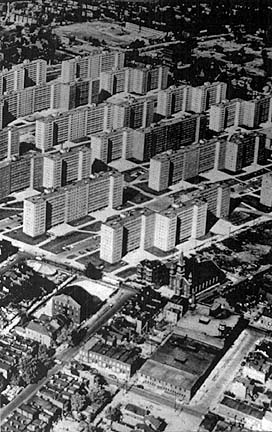
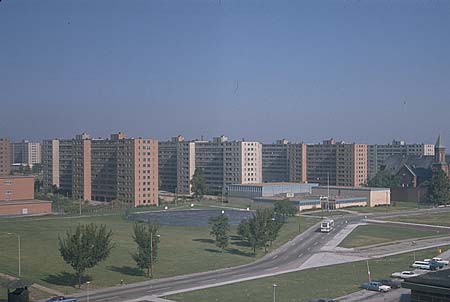
(Pictures from http://www.defensiblespace.com/book/illustrations.htm ) The federally funded Pruitt-Igoe housing project in St. Louis was designed by St. Louis architects George Hellmuth and Minoru Yamasaki in 1951. It was thought to be the epitome of modernist architechture--high-rise, "designed for interaction," and a solution to the problems of urban development and renewal in the middle of the 20th Century. Pruitt-Igoe opened in 1954 and was completed in 1956. Pruitt-Igoe included thirty-three, eleven story buildings on a 35 acre site just north of downtown St. Louis. --------------------------------------------------------------------------------------------- "These structures were no anomaly. Instead, the Pruitt-Igoe project was the product of a larger vision of St. Louis government and business leaders who wanted to rebuild their city into a Manhattan on the Mississippi. Other redevelopment schemes of the time, for example, placed middle- and high-income residents in buildings that actually rivaled Pruitt-Igoe in height and scale." "There is, moreover, no evidence that redevelopment plans intended to make an all-black, all-poor enclave at DeSoto Carr, which had been a poor area housing both whites and blacks before it was razed. An early scheme would have produced a majority of middle-income black residents. The final plan designated the Igoe apartments for whites and the Pruitt apartments for blacks. Whites were unwilling to move in, however, so the entire Pruitt-Igoe project soon had only black residents." ("Why They Built the Pruitt-Igoe Project," Alexander von Hoffman, Joint Center for Housing Studies, Harvard University: http://www.soc.iastate.edu/sapp/PruittIgoe.html).
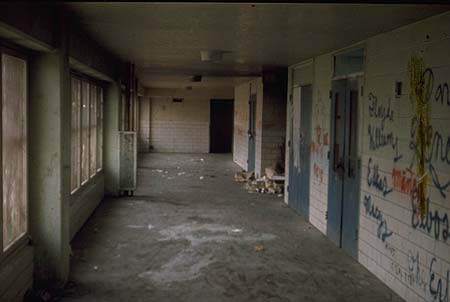
(Pictures from http://www.defensiblespace.com/book/illustrations.htm ) "The problems were endless: Elevators stopped on only the fourth, seventh and 10th floors. Tenants complained of mice and roaches. Children were exposed to crime and drug use, despite the attempts of their parents to provide a positive environment. No one felt ownership of the green spaces that were designed as recreational areas, so no one took care of them. A mini-city of 10,000 people was stacked into an environment of despair." "In his 1970 book "Behind Ghetto Walls," sociology professor Lee Rainwater condemned Pruitt-Igoe as a "federally built and supported slum." His study outlined the failure of the housing project, noting that its vacancies, crime, safety concerns and physical deterioration were unsurpassed by any other public housing complex in the nation." ""Pruitt-Igoe condenses into one 57-acre tract all of the problems and difficulties that arise from race and poverty and all of the impotence, indifference and hostility with which our society has so far dealt with these problems," Rainwater wrote." (PRUITT-IGOE HOUSING COMPLEX, By Mary Delach Leonard, Post-Dispatch, 01/13/2004)
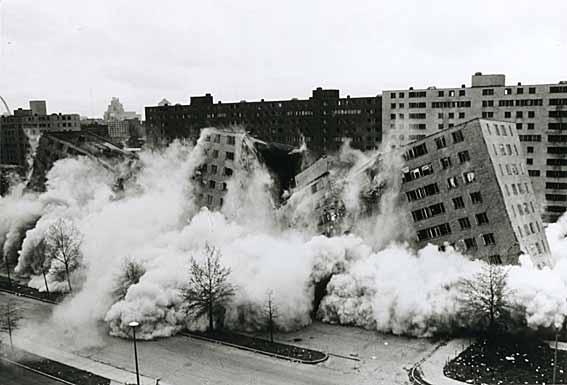
(Pictures from http://www.defensiblespace.com/book/illustrations.htm ) The first building was demolished on March 16, 1972 shortly after 3:00 PM. The demolition of the entire complex was completed in 1976. Today, much of the site still stands vacant, except for the school, Gateway Institute of Technology, located on Jefferson Avenue near Cass Avenue, at the western end of the Pruitt-Igoe tract. The failure of Pruitt-Igoe represents to many the failure of modernist thinking and high-tech solutions to social problems (rational planning built on objectivist models of human behavior). Useful Links:
With special thanks to the web site http://www.umsl.edu/~rkeel/ © 2005 by Robert O. Keel. |
|
|
site |
www.yamasakiinc.com |