|
|

 |
|
|
|
|
 |
New York
Architecture Images-New York Architects Raimund Abraham |
||||
|
The Austrian Architect Raimund
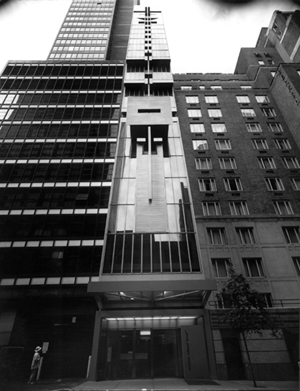
Abraham, born 1933 in Tyrol, Austria, lives, works and teaches in the USA since 1964. The book contains the complete work of the Architect Raimund Abraham. It has a three-part structure: 1) imaginary architecture, 2) projects, 3) realizations. Texts are by Raimund Abraham, Kenneth Frampton, John Hejduk, Wieland Schmied and Lebbeus Woods. With an introductory essay by Norbert Miller. The drawing of architecture occupies a central position in the evolution of his work but challanges the predominant notion of built architecture. Drawing demands an autonomous reality, manifestation of his architectural concept. |
||||
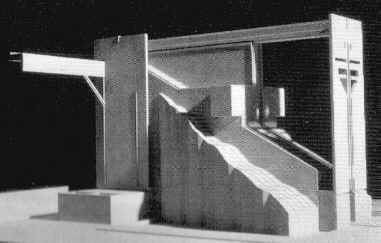
Church on the Berlin Wall, Germany, 1984 |
|||||
|
A Conversation with Raimund Abraham with Gregory Zucker Q: Earlier, we spoke about the difference between architecture and “buildings”. Could you explain what you meant? A: I consider architecture a discipline, not a profession. Considering the classic periods of architecture, architecture was more or less confined to the sacred and political power. Architecture represented a spiritual device and now it is considered that it should merely ornament our lives. I think the major break in history occurred at the beginning of the twentieth century. When the old social or the known social structures collapsed: no more monarchies and a new society emerged. With that new society entered an evolution in technology. You had new programs so architecture became synonymous with the new ideologies and the power of the worker in work more than celebrating the sacred, so, for example, you had the factories and workers’ housing. Now it appears that almost any domain can be expressed through architecture. Maybe this is true. Yet, for me architecture’s role is to elevate the profane with the sacred. If you succeed in making architecture, the sacred has to prevail. That means that in the most profane or the most pragmatic program, the program always has to succumb to this period of the sacred whether it is a small house, a cathedral or a temple. It is the nature of making things which I believe is the true foundation for any artistic discipline, whether it’s film-making, architecture, painting, or sculpture. This whole “making” is challenged by new technology. The technology is totally divorced from the “making” because ultimately you make things with your hands. When I met Jonas Mekas and other experimental filmmakers, I was inspired by the idea that you only need a camera to make a film. Similarly, you can reduce the making of architecture to a piece of paper and a pencil. Even if I don’t build, when I make an architectural drawing I construct it so I always anticipate the physicality, the decay, the atrophy of material in the metal so this has to do with making. There’s incredible precision. The beautiful mystery of architecture is rooted in the precision of how to put one stone on top of the other. It’s not the stone itself; it’s the cut in between the stones, the seam. The precision of the emphasis is the principle of structure. How they are joined or how they are divorced. As an architect it is very important that you distinguish between different realities. There’s the reality of the drawing and the reality of the building. So one could say, or at least it is the common belief that architecture has to be built; I always denied that, because ultimately it is based on an idea. I don’t ever need a building to verify my idea. Of course, what with a building is more its vanity and actual physical experience. But I anticipate; I wouldn’t even build it if I could not anticipate how it would be. Q: Once the building is actually built the public is forced to deal with it. How should architecture relate to the public? A: It has to relate to program. Without program you can’t have architecture, but the program has to be translated; it has to be challenged by the ideal of the discipline. So the program can never dominate. It’s a conflict, which, of course, does not exist in film because film is done and then it is shown to the public. It is self-contained, while architecture is not because when it is built it is the offered for use. It all depends on how you define “use’” philosophically. ‘”Use” can either be a celebration of function, which ultimately in its optimal implication would be a Fascist result because it would be completely covered by how the program had been implemented. So in architecture I think the program has to be reinterpreted. Even on a very basic level. For example, when the artists discovered the lofts in New York, completely new ways of living were offered because they had universal space. If you compare loft-living with an apartment where you have an entrance, you have a living room, a bedroom, and a bathroom, your life is defined by the nature of the rooms. Thus, the more, I’d say, bourgeois inhabiting those spaces becomes. It’s more oppressive because then life becomes a habit and I believe that architecture has a role of challenging that habit at all times. It becomes a creative force in your life. Architecture has that ability, otherwise it would just be too oppressive, too influential, and perhaps it would dictate the way you behave in space. In order to build something you have to violate the site. You dig a hole in the ground, which means you violate. That’s why the Indians only build teepees or build their permanent structures of stone on the rocks and never violated out of respect for the earth. So there is this conflict between the structure and the site. The reconciliation is that you create the formal conditions, a new equilibrium. The equilibrium you have intervened into and disturbed has to be reconciled. That is really the role of architecture. Q: And what about your project in China? A: Like many other sites in China, they have erased all traces of what was there before. So I had to create my own memory. Instead of intervening in a landscape, as I discussed before, I had to imagine the block, with houses, whatever function it had and then I carved into the block. So the block became actually an extension of the earth. And then of course the challenge was how to geometricize that. It was an emotional act from the first moment I held that chisel; that chisel bit the block, then I started to translate that emotional topography into a constructible geometric landscape. And so every single point in the landscape now is defined. Q: I see, but you’re dealing with a culture that has a very long history of architecture. A: This history is completely ignored by the present so-called ruling class. I feel like China wants to do, or is more or less successfully doing, what took the industrialized world, like America, a hundred years. They’re doing it in ten and, of course, there is a consequence. The culture is in danger. The only part of their culture that you can still sense is their food. The real conflict is between the land and the city. All this progress, this obsession with reaching the top level of progress in industrialization in the world leaves all the peasants behind. Eighty percent of China is made up of peasants. This is also the lifeline for the country and there’s no program of how to cope now with that conflict of the poverty in the country and the new wealth in the cities. It’s apocalyptic out there. Beijing was a horizontal city, only pagodas, and the architecture was visible or reached above the horizon of the houses. Now they just have left a small portion of it, which is now being gentrified; its becoming like a SoHo and so that’s what you witness there. Q: I am interested in hearing your critique of the project at Ground Zero, as well as hearing your explanation for the design you proposed. A: There was no hope from day one that the commercial world would really go for an architectural gesture that would be as radical as the event they claimed 9/11 was. Instead of saying, “Okay, now Mr. Silverstein, let’s get you some architects to build the most efficient commercial buildings there,” they tried to cover their intentions by saying, “Okay, now we need architecture.” From day one, the project was a disguised commercial site plan. It is very clear that when the pragmatic force starts to dominate that process, they will do whatever they want and then more or less declare the imprints of the two commercial towers as sacred because of the original event. I think that is blasphemy. It’s a fake…you see that’s what I called it at the beginning: the necessity of architecture to celebrate the sacredness; this is just the opposite. It’s fake sacredness. What I made was a metaphoric proposal. I just had three gigantic blocks which formed three walls, parallel walls on the side, and then I chose the moments when the event occurred, when the first plane and the second plane hit the towers. Then, when the first tower collapsed and when the second tower collapsed, simply as moments of an event. I located the sun vertically and horizontally for each of those time frames. I cut through those three walls in that angle of the sun. So, in a way, you caught the moment, a moment without any kind of a narrative reference. When you would be standing in that cut, at that particular moment in time, the sun would hit you. The architecture would celebrate and essentially revive that space and time, which became synonymous.
Special thanks to http://www.logosjournal.com/ |
|||||