|
|

 |
|
|
|
|
 |
New York
Architecture Images-Brooklyn Prospect Park |
||||||||||||||||||||||||||||||||||||||||||||||||||||||||||||||||||||||
|
architect |
Olmsted and Vaux | ||||||||||||||||||||||||||||||||||||||||||||||||||||||||||||||||||||||
|
location |
Prospect Park, Grand Army Plaza, Prospect Park W, Prospect Park SW., Parkside Ave., Ocean Ave., and Flatbush Ave. | ||||||||||||||||||||||||||||||||||||||||||||||||||||||||||||||||||||||
|
date |
Designed 1865. Constructed 1866-1873. Frederick Law Olmsted & Calvert Vaux. Various alterations. Scenic landmark. | ||||||||||||||||||||||||||||||||||||||||||||||||||||||||||||||||||||||
 |
|||||||||||||||||||||||||||||||||||||||||||||||||||||||||||||||||||||||
Across the East River from New York City
sprawled another great metropolis, Brooklyn. In the late 1850's,
Manhattan was linked to Long Island only by ferries, and the independent
City of Brooklyn had the third largest population in the United States.
A movement was afoot in Brooklyn to make a sizable public park, similar
to that in its sister city, and also a number of satellite parks. At the
solicitation of the citizens, the Legislature of the State of New York
passed an act on 18 April 1859: "To Authorize, the Selection and
Location of Certain Grounds for Public Parks, and also for a Parade
Ground for the City of Brooklyn." Fifteen commissioners were appointed
to choose suitable sites, and on 3 February 1860 they submitted their
recommendations. These included four major reserves: one was in Brooklyn
proper, the second at Ridgewood, the third at Bay Ridge, and the fourth
at New Lots. Three small local parks also were mentioned, one being a
block on Brooklyn Heights bounded by Remsen, Furman and Montague
streets, and Montague Terrace, to be set aside because of its
superlative view of the harbor.
The largest and by far the most important of the seven proposals was referred to as Mount Prospect Park. Its name came from the bill on which the reservoir was located, near the intersection of Flatbush Avenue and present Eastern Parkway. The commissioners stressed that it was expedient for the purity of the water to retain undeveloped ground around the reservoir; and, as with the recommendation for the small park on Brooklyn Heights, they made a case for the vista from Prospect Hill, which overlooked the eastern part of Kings County, Brooklyn, Jamaica Bay, New York, the harbor, the New Jersey shore, and the Narrows and adjoining slope of Staten Island. The park was to consist of 320 acres, bounded by Washington Avenue from Warren to Montgomery streets, then following the Flatbush township line south-southwesterly to a point now in Prospect Park about equidistant from the three sites of the Nethermead Arches, and Lullwater and Terrace bridges, then west-northwest along 9th Street to Tenth Avenue (approximately the site of the Tennis House), then along Tenth Avenue to 3rd Street (northeast corner of the Litchfield Villa lot), then over to Ninth Avenue (Prospect Park West), then north-northeast to Flatbush Avenue, a short distance along this thoroughfare (crossing what is currently Grand Army Plaza) to Vanderbilt Avenue, four blocks north to Warren Street, and back to the beginning at its intersection with Washington Avenue. The area designated took in most of the present grounds of the Brooklyn Botanic Garden, all of the Museum, Library and old reservoir, and almost as much land lying due north, plus about two-fifths of the final Prospect Park precinct. The committee justified the economics of the park venture with the argument that the increased value of real estate in the vicinity would bring in greater tax returns to counterbalance the expenditure. They buttressed it with the humanitarian appeal that: "The intense activity and the destructive excitement of business life as here conducted, imperatively demands these public places for exercise and recreation"; and they noted that, although not centrally located in Brooklyn, Mount Prospect Park would be easily accessible "to the masses of our people," either "on foot or the cheap railroad lines."
Located within both the first and final proposals for the park area is the site of the easternmost encounter of the Battle of Long Island of the American Revolution, on the east side near the old Brooklyn-Flatbush line. Here stood the great white oak, that had been cited by Governor Dongan as a marker on the boundary between the two townships, felled as a barrier across the narrow lane to impede the British. Many other trees had been cut to make rude fortifications along the summit of the wooded ridge above Valley Grove Pass, as colonial forces under General Sullivan lay in wait for the enemy's advance on the fateful morning of 27 August 1776. They were greatly outnumbered; and, after their first volley had been fired and there was not time for reloading, a rifle butt served as poor defense against pitiless Hessian bayonets in hand-to-hand fighting, with the result that the encounter turned into a massacre and rout on the part of the Americans. Later in the day, General Stirling sought the Hessians in Prospect Woods and yielded himself, rather than surrender to an English officer. The Maryland Monument, at the foot of Lookout Hill west of Terrace Bridge, and several bronze plaques north of the modern zoo commemorate the events. Having been an historic setting played an important, persuasive role throughout the lengthy process of the park becoming a reality.
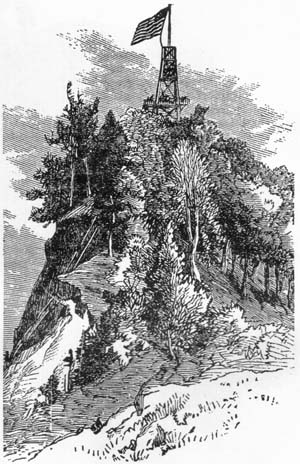
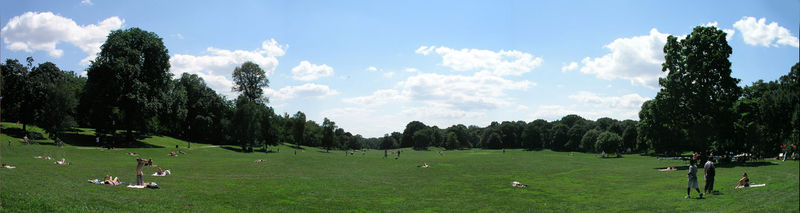
The State Legislature confirmed the recommendation by an act passed 17 April 1860, and through this document the right to acquire the designated land became law. Also, the officials of Brooklyn were empowered to issue bonds to cover the costs of the endeavor. A turnover in the roster of the Board of Commissioners occured during the year, with only one name surviving from those of the original fifteen selectees (that of Thomas G. Talmage), and the current seven members elected James S. T. Stranahan (1808-98) president, and R. H. Thompson secretary. In the person of the new President of the Board, Prospect Park gained its most ardent champion. Stranahan, who was a millionaire, served in this post without remuneration for 22 years and, upon leaving, he presented the City a check for $10,604.42 to cover a shortage claimed against the commission during his period of tenure. The first expenditure of the commissioners was to hire a topographical engineer, which specialist was Egbert L. Viele, the original Chief Engineer for Central Park. Viele examined the premises and composed a written report, in which he indicated his conviction that "the primary object of the park [is] as a rural resort, where the people of all classes, escaping from the glare, and glitter, and turmoil of the city, might find relief for the mind, and physical recreation." The city grinds down its dwellers, he says: "while on the other hand nature in its beauty and variety never palls upon the senses! never fails to elicit our admiration; whether displaying its wild grandeur in the vast solitudes of the forest, . . . whether bursting the fast of winter, it opens its buds in spring-time, or yielding to the chilling blasts it scatters its autumn leaves -- it conveys in all its phases and through all its changes no emotions which are not in harmony with the highest refinement of the soul." The tone of this prose poem, by a nineteenth century American, is not unlike that of the eleventh century Chinese, quoted at the beginning. Kuo Hsi recommended, as a substitute for direct communion with nature, a "landscape painted by a skilled hand." Viele exhorts the natural garden, which to "the weary toiler . . . supplies a void in his existence and sets in operation the purest and most ennobling of external influences." It was a great and wonderful philosophy of compensation transposed into modern terms and means. Viele calls his design of 1861 Plan for the Improvement of Prospect Park, eliminating once and for all the "Mount" in the title. He locates the main entrance at the junction of Flatbush and Vanderbilt avenues. Other entrances in the east section are at the corner of Warren Street and Washington Avenue, and midway along Washington Avenue. Entrances to the west section are at each of the lower corners, and another where 3rd Street and Ninth Avenue meet. The driveways wind through the grounds without definite direction, ascending to a climax on the Esplanade atop Mount Prospect, where carriages might pause 200 feet above sea level to allow their passengers to enjoy the spectacle. A flower garden, with meandering paths, adjoins the water-supply basin. The roads cross over Flatbush Avenue on viaducts at two places, one near the main entrance and the other by the reservoir, and under it by means of a tunnel at the south end. In the lowest corner, on 9th Street, is a botanical garden with intersecting radial and concentric curved walks. A small horseshoe shaped lake is indicated to the west, about where Swan Boat Lake later materialized. The chief meadow is between 3rd Street and Flatbush Avenue, anticipating the northern end of Long Meadow. Viele labeled this feature "The Parade," ignoring the previously published statement of the commissioners that they deemed it unsuitable to have a drill field inside a park of this species. The report concludes with technical data on drainage, manuring, trenching, planting, and building cracked-rock roads, as these were applicable to the situation. The work of conversion was estimated to cost $300,000, the largest item, $75,000, allocated for roads. The outbreak of the Civil War in 1861 paralyzed the Prospect Park project, just as it did many other contemporary endeavors in America. At least in this instance the delay proved to be a blessing in disguise, allowing time for reflection and determination. In the brief report of the commissioners made in January 1862, Stranahan declared that "Prospect Park in the city of Brooklyn must always be conceded as the great natural park of the country." The one constructive task that moved forward during the interim was making estimates of private properties designated within the scheme; and, because of the easing of the real estate market due to the lack of security accompanying the conflict, it was recognized as "a peculiarly favorable period for making payment to the landlords." The report three years later stated that compensation would amount to $1,357,606, and that remittances already were in progress. Decent houses thus acquired were to be rented until the ground they stood on was ready to be improved for the park, whereas shanties and their squatter tenants were "being quietly removed." A very important item in this report was the appendix, involving a reconsideration of the boundaries by an expert engaged for the purpose. The survey had been put into the capable hands of Calvert Vaux (1824-95), the British architect who joined forces with Andrew Jackson Downing in 1850 and worked on the landscaping of the Smithsonian Institution and part of the Capitol grounds in Washington prior to Downing's drowning in the sinking of the steamboat Henry Clay two years afterward. To his late friend and associate Vaux dedicated a collection of his own architectural designs brought together in a book entitled Villas and Cottages, published in 1857. As we have seen, the following year Vaux collaborated with Olmsted on the plan that won the competition for Central Park and was appointed Consulting Architect. The next eight years of experience in the Manhattan park well qualified him for giving sound advice on Prospect. Calvert Vaux did not approve of the tract being divided by Flatbush Avenue. The overpasses were awkward and an expense that could be applied to better advantage purchasing additional contiguous land. He favored concentrating on and extending the western section, because the reservoir, in the other division, could not be landscaped attractively. Yet he felt it would make a worthwhile supplement to the park, because of its elevated promenade. The primary deficiency in the existing grounds was a place suitable for a large lake, which would be a valuable asset, especially because ice skating on it would prolong the usefulness of the park into the winter. He complained that the land dug in Central Park was too small and estimated that the lowland north of Franklin (Parkside) Avenue in Brooklyn could accommodate an articial body of water 50 or 60 acres. This would require a vast annex to the south, in Flatbush; but "the amount relized for the sale of the north-easterly section would go far to defray the cost of the proposed addition, if it would not pay for it entirely." Another feature established at this time was that the principal entrance ot the park would "unquestionably be near the point where Flatbush . . . is intersected by . . . Ninth avenue." An accompanying sketch plan, dated 4 February 1865, indicates an elliptical plaza at the north end, the shape, size and location of which accord with what exists there today. The preliminary report on boundaries led, later in 1865, to the reengagement of Vaux, together with his partner Olmsted, to create a whole new plan. Of the two men, Frederick Law Olmsted (1822-1903) was the better informed on growing plants and landscaping in general. Olmsted was a native American, born in Hartford, Connecticut, and he had learned the rudiments of rural skills as a little boy visiting relatives in the country. Later, at home, he frequented the Harford Public Library, perusing such books as Sir Uvedales Prince's An Essay on the Picturesque and William Gilpin's Remarks on Forest Scenery, both published at London in the early 1790's. At fourteen Olmsted apprenticed to a topographical engineer and learned surveying; at twenty-one he became a seaman and shipped aboard the Ronaldson to Hong Kong; at twenty-five he finished a course at Yale and took up scientific farming, first at Gilford and then on Staten Island, where he spent much of his time in landscaping and yet was successful as a farmer. He was thirty-five when he assumed the role of Superintendent in Central Park, and the next year he devised the Greensward plan with Vaux, who was two years his junior. Olmsted had been in California in 1865, when the survey was requested, and that Calvert Vaux had made it alone indicates that both men were proficient at landscape gardening, but, generally, Olmsted is considered the genius in composing scenery and Vaux in planning architectural accents. The plan for Prospect Park conceived by Olmsted and Vaux in 1866 was accompanied by a lengthy essay, which the Board summarized for the Brooklyn Common Council as follows: The ground features of the plan are simple and easily comprehended; but the Commissioners wish to direct attention particularly to three regions of distinct character embodied in it, in each of which, it will be observed, the suggestions of the natural condition of the land are proposed to be developed. They are, first, a region of open meadow, with large trees singly and in groups; second, a hilly district, with groves and shrubbery; and third, a lake district, containing a fine sheet of water, with picturesque shores and islands. These being the landscape characteristics, the first gives room for extensive play grounds, the second offers shaded rambles and broad views, and the third presents good opportunities for skating and rowing. With this thumbnail description in mind, let us look at the plan itself. First of all, the landmark that had given title to the park, Prospect Hill, was outside the confines. In outline and paramount features, the design is the archetype of the garden that was eventually objectified. The irregular shape is six-sided, coming to a point at the north extremity on an oval plaza. The northeast side is bounded by a stretch of Flatbush Avenue; the east limit steps in and continues almost directly south along what is now Ocean Avenue. The southeast base is Franklin (Parkside) Avenue, ending at present Park Circle, foyer to the southernmost entrance. The southwest side is framed by Coney Island Road (Prospect Park Southwest), which curves into 15th Street. This meets Ninth Avenue (Prospect Park West) at right angles, the intersection embellished by another circle (Bartel-Pritchard). Ninth Avenue or Prospect Park West returns us to the place of beginning. Of the seven drive entrances, all but one are at or near one of the corners of the configuration, the exception being on the upper west side at 3rd Street. It is of interest that only one other has been added, that on Ocean Avenue, and it is without elaboration. An element not to be realized is the overpass crossing Flatbush Avenue to the reservoir lot. The report proposes a Parade Ground across Franklin (Parkside) Avenue, although it is not indicated on the map. The park proper contains 526 1/4 acres. Its compact, arrowhead shape is more appropriate to a natural-landscape garden than the elongated regular rectangle of Central Park, in which one is always conscious of the surrounding city. The final limits of the Brooklyn precinct had been chosen by the landscape architects themselves, and the area was not encumbered by reservoirs, neither did it require division by transverse roads. The boundaries enclosed less land but the space could be put to more effective use, as in the case of the tremendous sweep of meadow nowhere possible in the New York park. It was attained with less labor because the western end of Long Island had escaped the glacial upheavals and was free of the harsh protrusions of jagged rock found on Manhattan. A brilliant innovation in the Brooklyn park is the ridge of heavily planted earth just inside the walls, that makes an effective screen blocking out the urban scene and permitting an instant illusion of being in the country. A glance at the 1866 Olmsted-Vaux plan for Prospect Park and comparison with the contemporary scheme for Central show what a tremendous simplification and unification has been achieved in the Brooklyn design. The three elements mentioned in the commissioner's summary roughly dispose themselves into approximately equal thirds of the park. The open meadow occupies a long strip adjacent to the northwest boundary on Ninth Avenue. Thrice labeled here "The Green," after 1870 it became known as Long Meadow. Beginning inside the principal entrance on the Plaza, the crescent-shaped lawn, covering 75 acres curves toward the center of the park and out again to the entrance at 15th Street and Ninth Avenue (Bartel-Pritchard Circle). The West Drive winds through the trees framing the concave side of the crescent. Wooded hills, constituting the second element, occupy the region running through Prospect Park east of Long Meadow. It is a very irregular and varied section, taking on almost the character of a mountain defile in the stretch north of the Nethermead, between the Green and East Drive, and that of a stony valley with a brook in the Ravine extending from the Lily Pond above the Lullwater to Swan Boat Lake. The source of water is an artificial spring immediately to the south, at the base of Quaker Hill. The ground rises steadily to the summit of adjoining Lookout Hill, the highest prominence in the park, at the head of the peninsula jutting out into the Lake. Woods, or at least arrangements of trees, border other features of the park and weave them all together into a coherent whole. The third element is the Lake or, more generally, water, of which the 60-acre lake is the most conspicuous member; included are the narrow lagoons leading to the Lullwater, the stream in the Ravine with its assorted pools, and the spring that feeds the entire system. The Lake overspreads most of the south triangle of the reserve and its tributary reaches far inland. We have here the constituents of the Chinese landscape, as may be seen in any painting of scenery done in the Far East. The Chinese term for "landscape" is composed of two words, shan and shui. The first means "hill" and the second "water." The characters for these words appear at the beginning of this essay, as the heading for the translation for the Kuo Hsi quotation, the third character in the title being hsun, "treatise." The drives meander inside the perimeter of Prospect Park, encompass the Lake, Lullwater and Lily Pond, and traverse the woods from Willink Entrance on Flatbush Avenue over Breeze Hill and around the Nethermead, between Lookout Hill and Quaker Hill, to the 16th Street Entrance on Coney Island Road (Prospect Park Southwest). Walks and bridle paths (referred to in early accounts as "rides") tend to follow the contours of the drives, but these also branch out considerably more, enmeshing many parts not accessible to the drives. The carriage roads were of crushed rock and had an average width of 40 feet, increasing to 60 at the principal entrance. A narrow roadway ascends Lookout Hill to the paved plateau on top, described as "an oval court for carriages, three hundred feet long and one hundred and fifty wide." A terraced platform adjacent was to be provided with seats and awnings, and a small building "for the special accommodation of women and children, and at which they might obtain some simple refreshment." An elaborate Eclectic stone tower was to have been built here too, affording an even better vista of the bays and surrounding lands to the west, and a bird's-eye view of demonstrations on the Parade Ground to the south. A second, and larger, concourse for carriages was to the east of the Lake, and next to it was a space labeled "Concourse for Pedestrians," a promenade that developed in 1870 and will be discussed below. Due west, on what came to be called Breeze Hill, was a lesser stopping place for carriages, permitting a panorama over the inlet of the Lake. Midway between here and the Lookout, at the head of the inlet north of the Peninsula, was to have been built the Refectory, with broad arched terraces overlooking the water. The name of Terrace Bridge close by recalls the project which, like the proposed structures on Lookout Hill, expired before realization. The Refectory was to have been the "principal architectural feature in the park," like a well-appointed inn in the country. Even though other minor aspects changed on maps issued within the next few years, the Refectory and Lookout persisted as long as Olmsted and Vaux had anything to do with the park. Afterward, when nothing came of the restaurant, Well House Drive was laid out from Terrace Bridge around the corner of the shore to West Lake Drive.
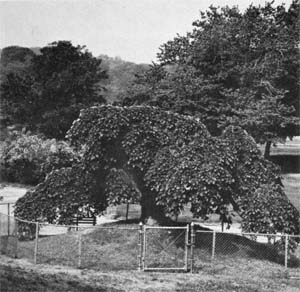
The upper reaches of the park were to present "a display of the finest American forest trees." Among native deciduous varieties in Prospect Park are to be found: American elm, the oaks and maples, yellow poplar or tulip tree, ash, red mulberry, wild cherry, dogwood, Kentucky coffee tree, sassafras and Osage orange. American conifers include the white pine, blue spruce, hemlock, and the bald cypress from southern swamps. On "the interior slopes of the Lookout and Friends' Hill" there was to be "a collection, arranged in the natural way, of the most delicate shrubs and trees, especially evergreens, both coniferous and of the class denominated in England American plants, such as Rhododendrons, Kalmias, Azaleas and Andromedas." The shore of the Lake was to be planted in "picturesque groups of evergreen and deciduous trees." From the beginning, many plants were introduced into the park from other parts of the world, some of them constituting gifts. Among the trees from Europe were: the sycamore maple (the leaf of which was taken over as the emblem of the Department of Parks), Norway maple, European lindens, English oak, English elm, Scotch elm, English hedge maple, European beech, European hornbeam, horse chestnut, and Austrian pine. The single most noteworthy example is the Camperdown elm near Cleft Ridge Span, a Scotch elm grafted on a normal elm and prized for its contorted horizontal branches. Set out in 1872, it was already considered a landmark when Louis Harman Peet published Trees and Shrubs of Prospect Park in 1902. Asian trees include the scholar or pagoda tree, ginkgo, tree of heaven, Chinese elm, Chinese tree lilac and magnolia. Among oriental evergreens are the Himalayan pine, Japanese Tanyosho pine or umbrella pine, and oriental spruce. A tree-moving machine was devised in 1867, enabling a good-sized specimen to be taken up, together with a large portion of soil around its roots, braced, and wheeled upright to be put into the earth at a different location. Numerous trees standing in Long Meadow were removed and placed elsewhere by this device. In 1872 there were 284 trees thus transplanted. The park maintained its own nursery, in which an average of 30,000 trees and 25,000 other plants were kept on hand, and during the first two years of building Prospect Park, over 73,000 trees and shrubs were set out from this stock. After considering trees, a word regarding the survival of wild life in this area should be in order. Of greatest importance are the birds. These little winged creatures need two simple requirements, cover and sustenance. Trees and other plants just discussed fill these needs and therefore attract the birds. Migrants are semi-annual visitors to Prospect Park, first lighting on Lookout Hill and following the ridge northward and then eastward, crossing Quaker Hill to the Pools and threading their way throught the Ravine, and leaving the park either at the Vale or Lily Pond. At one time there were numerous birds on the Peninsula, but the removal of the shrubbery and clamour from the skating rink opposite, in season, have ended their sojourn here. At the eastern end of the Ravine is an established community -- bullfrogs, who sometimes supply impromptu entr'actes during the Goldman concerts in the Music Grove on warm summer evenings. The other notable subhuman societies are the squirrels in the trees and the fishes and crustaceans in Prospect Lake. The presentation of the Report of Olmsted, Vaux and Company in January 1866 was the official birth certificate of Prospect Park. The plan was printed and distributed among the citizens of Brooklyn and, although there were a few die-hards who clung to the retention of the eastern sector, on the whole they responded with "a hearty approval of the design," and "no material objection was made to any of its prominent features." Frederick Law Olmsted and Calvert Vaux officially were made Landscape Architects of Prospect Park on May 29th and given complete responsibility for everything that was to transpire in the venture. They were asked to prepare details of their plan and to organize a working force. The Board appointed Joseph P. Davis engineer in charge, and John Bogart and John Y. Culyer his principal assistants. The surname of the last caused some confusion in the appearance of Vaux's given name in print, sometimes coming out as a hybrid between Calvert and Culyer. The typographical error most appropriate to a landscape architect was "Culvert." The Legislature of the State of New York passed an act on 30 April 1866 sanctioning the change in land designation. An interesting problem arose over the Quaker Cemetery, located between Eleventh and Twelfth avenues and 9th and 14th streets, completely enveloped by the recent acquisition. The matter was discussed at length and finally settled by the Friends' retaining the southern two-fifths of the lot, or that portion interlaying 11th and 14th streets, to which they were assured direct passage through the reserve from the 16th Street entrance at all times. The ten-acre cemetery is still being used for burials but, as Quakers do not approve of ostentatious memorials or markers except for the fence enclosing it, one is hardly conscious of there being a graveyard in the park.
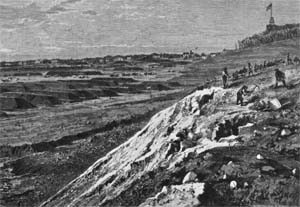
The first task preparatory to building Prospect Park was draining the land wherever necessary. Then construction began at the upper terminus. The processes involved were tearing down unwanted structures and removing the debris from the site, putting in drain and sewer lines, grading, building roads, bridle paths and walks, taking up trees and putting them elsewhere, and setting out new plants. These activities gradually proceeded southward along the east side of the park. The manual labor started in June 1866 with a crew of 300 men. Although declining during the winter months, the number of employees increased to a peak in October 1867, when 1,825 were on the payroll. After this, there was a leveling off, with an average of about 1,100 in the warm months of 1868, close to 1,000 in 1869, 750 in 1870, back up to 1,100 in 1871, and than a gradual reduction to about half this number in the depression year of 1873. Visitors to the park were a nuisance to the work crews during the construction period. Especially after the upper reaches of Long Meadow and the Woods were done and the scene of activities was the southern half of the reserve, people came in droves and destroyed much of the early planting through tramping on it. An average of 100,000 persons visited the park monthly during the summer of 1868, and by 1871 the count had increased to 250,000. But it was understood that the park is for people; and, for their use and enjoyment, benches of wood slats on iron framework were provided as soon as possible. Over 200 were installed in 1868, half of them 7 feet in length and the others 5 or 4 feet long.
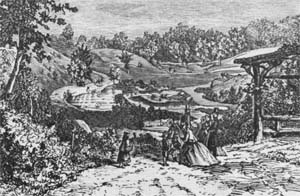
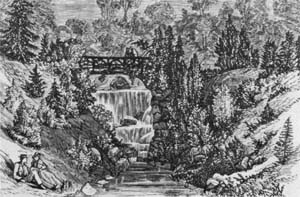
The most appropriate structures in Prospect Park, for tying in with the landscape, were the rustic shelters, those with posts and lattice railing of rough tree trunks, and shingled or thatched roofs. These were of various oblong and polygonal shapes. Four were spaced along the east shore of the Lake, of which only one survives, the rectangular, hipped-roof Landing Shelter near the Carriage Concourse. These were viewing stations for western sunsets over the water. A five-sided rustic shelter stood on the spur at the south end of the Lake, nearest Park Circle, and an octagonal example stood on a high point in the Ravine, overlooking the bridle path spanned by Boulder Arch. A rustic arbor 111 feet in length was on the east side of the Lake, and another shaded a portion of the walk north of the Children's Playground. The Playground, developed in 1867, was provided with a lawn for various games, including croquet, a pool for the sailing of toy boats, a maze, and a heptagonal summer house. The first carousel was erected here in 1874. It was moved to Picnic Woods (west side of Long Meadow, back of Litchfield Villa) in 1885, and the Rose Garden was laid out in 1895 on the site of the Playground. The adjoining Vale of Cashmere bad just been renovated a year or two earlier, with additions of pedestals bearing urns, some connected by balustrades, and a fountain sculpture in the pool, making for a strange combination of rustic and classic elements. One other early building belonging to the rustic group was the picturesque Thatched Shelter, that stood midway between the second location of the carousel and Meadowport Arch. It had an H-plan and a steeply pitched roof pierced by dormers. The shelter also was called the "Swiss Thatched Cottage" and the "Indian Shelter." It burned in 1937. Several rustic bridges were in the park. A large one of 35 feet was the Binnen Bridge over the waterfall near the old boathouse on the Lullwater. Smaller examples were at the west end of the Ravine, lending a remote atmosphere. There were also more than 50 rustic seats of sassafras and cedar, and 800 rustic bird houses.
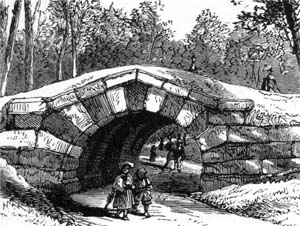
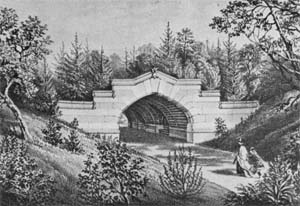
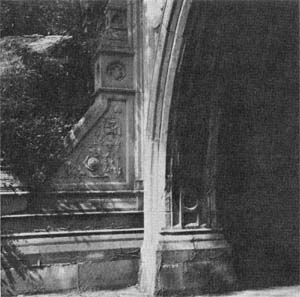
The first permanent structures were the arches on the upper and east sides of Prospect Park. These were pedestrian underpasses, allowing visitors to cross under the roads thus avoiding the hazards of traffic. The tunnels were provided with seats to serve a second function as comfortable rain shelters. The first two built were East Wood Arch under East Drive above the Willink Entrance approach, and Endale Arch near the entrance on the Plaza. The masonry of both is composed of alternating blocks of yellow Berea sandstone from Ohio and reddish brownstone from New Jersey, and the interior vaults are of brick lined with planks.
East Wood Arch is the simpler, with a low raking parapet above a semicircular arch, a single cross-vault inside with benches at each end in shallow recesses. Endale Arch -- sometimes referred to as Enterdale Arch in early reports -- has a stepped superstructure rising to a raked coping wth a carved flower at the apex, and a pointed arch. These features, together with the banded stonework in two colors, show Syrio-Egyptian influence. There are two cross-vaults, originally with benches in their recesses, in Endale Arch. Planting on top of the tunnels masks passing vehicles. Both tunnels were started in 1867 and completed the following year.
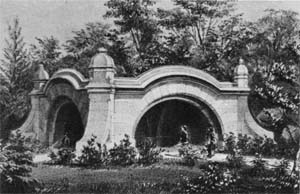
Meadowport Arch, balancing Endale on the west side of Long Meadow, was begun in 1868 and finished in 1870. Instead of cutting under the roadway perpendicularly, like its predecessor, it is set on a 45-degree angle. This permits a double portal at the lawn end, forming two faces of a square pavilion set diagonally into the embankment. A single bay of semicircular cross-vaulting is buttressed at the corners by piers that sweep outward at the base and are capped by octagonal bonnets with finials. The cornices arch in curves concentric to the extrados of the wide openings, a feature of seventeenth-century Mogul architecture in India, such as the Pearl Mosque in Delhi. The voussoirs alternate in smooth and rough-surfaced blocks of Ohio sandstone. A bench filled the recess facing the east arch but, as in the other examples, it has been removed. The northwest end of the wood-lined tunnel has a single face of similar design.
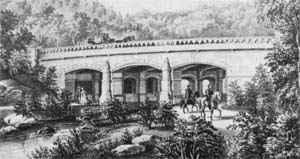
Contemporary with Meadowport Arch is Nethermead Arches, at about the geometric center of Prospect Park. Three segmental-arch spans, four bays deep, constitute a bridge for Central Drive. The three sections serve as underpasses for pedestrians, equestrians, and the Ravine brook between. Nethermead Arches was built of Ohio sandstone with Quincy granite trim. A plain molding constitutes a necking below the springing of the arches, and cylindrical buttresses on square plinths and with pinnacles are set in front of the piers. A parapet pierced by trefoils makes a railing for the upper carriageway and terminates in a monumental pedestal at each end. The inner vaults are faced with hard brick laid in patterns and open laterally into one another.
The last of the underpasses was built in 1871-72. Called Cleft Ridge Span, it is at the east end of Hill Drive, near the Camperdown Elm. Unlike the others, this tunnel is built of molded blocks of concrete, known as Beton Coignet, consisting of sand, gravel and Portland cement. Three colors are used, a brownstone red, ochre, and pale gray. The relief pattern of the sheathing inside the vault is rich and satisfying. The external design is eclectic and somewhat precious in detail. Buttresses flanking the round arches are accented with urns at base and summit, once containing plants. These have suffered from erosion and mutilation, especially on the south side of each facade. The French process provided a less expensive material than stone. Olmsted-Vaux plans of the late 1860's and early 1870's indicate that there were to have been additional pedestrian arches under or over the drives on the west side of the park, but only the ones described were built, all completed while the designers were still in charge.
Perhaps the most practical building in the park was the Well House, built in 1869 on the lake side at the foot of Lookout Hill. It is a rectangular building of banded croton brick and gray Ohio stone, with stone quoins and stone lintels over the windows and Tudor-arched doorway, and overhanging hipped roof. It housed the steam machinery and boiler, that were connected with the pumping engines 60 feet below grade. The engines could raise 750,000 gallons of water a day into the reservoir built into the west end of the hill.
From here the water flowed out of a simulated spring at the base of Quaker Hill and down a gully into Swan Boat Lake, thence through the Ravine to the Lullwater and into the Lake. The source of water was a well 70 feet deep and 50 feet in diameter at the bottom, the walls battering in 10 feet at the top. It was in front of the boiler house, and a square smokestack 60 feet tall was attached to the rear corner. The digging of the Lake was accomplished in intervals. The last section was finished and filled with water 20 August 1871. The original use of the Well House came to a close with the advent of city water into the park about the turn of the century, after which the smokestack was torn down and the well covered over. Lookout Hill reservoir was filled in during the 1930's.
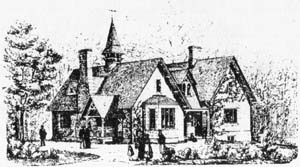
A building of all stone walls erected in 1869 was the Dairy and it was similar to its equivalent in Central Park. It stood in the Midwood, just north of Boulder Bridge over the bridle path. The Dairy was composed of two parallel wings having gables with bargeboards at each end in front, and a connecting unit with a dormer and cupola atop the steep roof. It contained a large public room and smaller ladies' retiring room, both with fireplaces, and facilities on the first floor. Quarters for a family in residence were upstairs. The Dairy supplied light refreshments, including milk, chilled or warm from the cow, because cattle, and sheep as well, were pastured on the Green. The old menagerie was built to the north and east of the Dairy after Olmsted and Vaux had left the scene of tho park. The entire group was razed following completion of the new zoo in 1935, the loss of the Dairy, at least, being regrettable.
It is significant that the small area in Prospect Park conceived along the formal lines of European gardens -- as opposed to the vast balance, which is in the natural Chinese-inspired, English-park mode -- although labeled "Concourse for Pedestrians," was otherwise left blank on the original plan of 1866. That it was intended as a haven for music is indicated by the words "Music Stand" alongside the small island off shore. The region referred to was elaborated in 1870. Olmsted and Vaux testified that they followed an Old-World precedent in their scheme here. "Promenade concerts are common in many European pleasure grounds," they said, and "may be divided into two classes: those universal in German towns, common in French, and less so in British, where the audience is standing, walking, or sitting upon chairs, and frequently at tables at which refreshments are served, and those in which the greater part of the audience is in carriages," as in Italy. They proposed to combine the two types in Prospect Park. The Pedestrian Concourse is situated between two carriage concourses. The latter take care of listeners preferring the Italian manner, whereas the former required renovation to accord with north-European tastes. The middle section was divided into two plateaus by a curved terrace concentric to the shore line and centered on the music stand on the islet. Trees were planted in uniform rows in the lower space; and beyond the stone piers and railings and stairs, on the upper terrace, there was laid out a fan-shaped system of walks radiating from the music source, with fountains at the intersections and a casual growth of trees in the interspaces. This henceforth was known as the Concert Grove. Sculptured likenesses of musicians were placed here, the group including busts of von Weber and Grieg on the east side, Mozart and Beethoven on the west, and that of Thomas Moore, poet, composer and concert pianist, in the center. The United German Singers of Brooklyn presented the images of their countrymen, won as competition prizes during the 1890's.
At the farther end was built a typical Vaux chalet called the Concert Grove House. It resembled the contemporary Dairy, only it was frame instead of stone. The building housed a restaurant and comfort station.
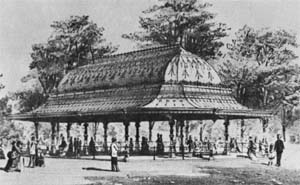
Fifty feet to the south was erected a shelter called the Concert Grove Pavilion, completed in 1874. The Pavilion consists of eight cast-iron posts, modeled after Hindu columns of the early medieval period (8th-12th centuries), supporting a complex hipped roof with rounded corners, measuring 40 by 80 feet, having patterns on its surfaces and a cresting along the ridge. Tables and chairs were placed under this oriental parasol for service from the restaurant. Thus in providing a pleasant retreat for strolling, parking space for carriages, benches, and seats around refreshment tables, the concert compound met all the listening delights of the Europeans; and it went even further: the music was available to boating parties drifting on the Lake. In its formality and function, Concert Grove in Prospect Park is the counterpart of the Mall in Central Park. However, Concert Grove has none of the axial rigidity of the Mall. Instead of being elongated and dividing the park, it is compact, and its radial plan is dynamic, thereby being better suited to the natural landscape theme of the garden as a whole.
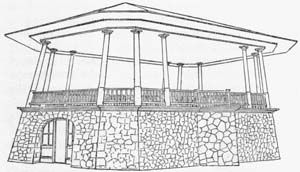
Apparently the acoustics around the insular Music Stand were satisfactory only over the water, and concerts soon moved out of the area. A temporary music pavilion was set up in the Lullwood in 1871, and the permanent Music Pagoda was built near the Lily Pond in 1887. This octagonal structure has a high battered podium of rough stonework, above which rise slender posts slanting inward and connecting with the flaring roof. The form suggests an ancient Chinese city gateway. With the establishment of the new Music Grove at the north edge of the Nethermead, its predecessor became known as the Flower Garden. Concert Grove House was demolished in 1949, and Concert Grove Pavilion later was vulgarized by the insertion of a brick snack bar in the middle. The skating rink built in 1960 obliterated Music Stand Island and a stretch of the shore.
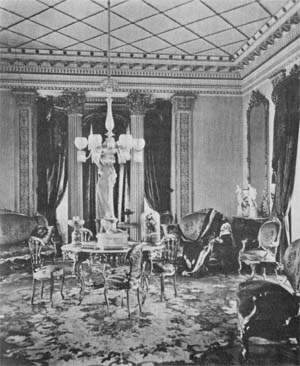
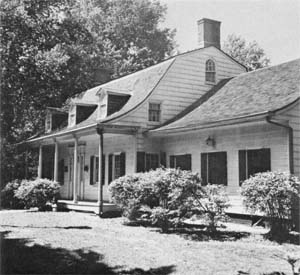
A curiosity dating from the Olmsted-Vaux period was a kiosk known as the Camera Obscura, situated at the west end of Breeze Hill. It provided -- as its name signifies -- a dark chamber, in which was a white table five feet in diameter. On the table was projected an image reflected from a revolving mirror-lens arrangement in the roof. The view necessarily was limited to the vicinity. The Old Fashioned Garden later occupied the site. Another oddity of the early era was the Circular Yacht, a sort of water carousel, propelled by sails and oars, that revolved without really going anywhere. As one would expect, the Circular Yacht was not prominently displayed on the Lake but set afloat on the Pool, eventually dammed and enlarged into Swan Boat Lake. Neither of the novelties survived into the twentieth century. The cost of the park during the seven-year administration of Olmsted and Vaux was tremendous. The land alone had cost more than $4,000,000. Improvements amounted to upwards of $5,000,000, the equivalent of almost $25,000,000 in terms of the market value of the dollar today. Prospect Park was the largest single investment made by the City of Brooklyn up to that time, and it is unlikely that any, before or since, has reaped such high dividends in profits of intrinsic value. Olmsted and Vaux's sway of influence went beyond the park confines to related axes and areas. That most closely connected with Prospect Park is the plaza at its main entrance. The elliptical plaza received encouragement in 1867 through the gift to the City of a bronze statue to be erected here. Modeled by the late Brooklyn sculptor, H. K. Brown, it was a standing likeness of Abraham Lincoln, nine feet tall. The figure wears a cape and holds a scroll of the Emancipation Proclamation, the right hand pointing to the words, "Shall Be Forever Free." Probably the first memorial to the assassinated president, it was the gift of the War Fund Committee of Kings County. Elevated on a 15-foot granite pedestal, it was placed on the platform at the north side of the Plaza. The Lincoln statue was dedicated 21 October 1869, and two years later a fountain was put into operation in the center of this open area. The designers widened Vanderbilt and Ninth avenues to 100 feet, and also broadened 15th Street, Coney Island Road (Prospect Park Southwest) and Franklin (Parkside) Avenue. Sidewalks contiguous to the park were to be gaslighted for public strolling "after the gates [of Prospect Park] are closed at night." Olmsted and Vaux pointed out that natural landscape parks in the midst of large cities could not be made safe after dark by lighting them with contemporary equipment and that their "use for immoral and criminal purposes more than balances any advantages" that might be derived from them. The exception was in winter, when the frozen lake was illuminated and temporary houses erected to accommodate the numerous skaters who came there. In summer the external promenades, they felt, took care of the need for nocturnal exercise. The separate Parade Ground was for a different sort of diversion, for observing rather than participating on the part of the public. The State provided for the tract in 1868, and the landscape architects submitted a plan at that time. The 40-acre field adjoins Park Circle, its longer side extending along Franklin (Parkside) Avenue. The larger part of it became a "Green Sward," or lawn, for drills, and at the irregular west end was a graveled area for spectators. The first scheme called for a couple of small structures to be built here, but in 1869 a single long building was constructed instead. It was a wooden affair of exposed framing in the manner of the Concert Grove House, with steep, picturesque roofs. The central pavilion was two-storied, for officers' quarters, and open shelters to either side each extended out 50 feet to a terminal block; that at the south end was a lavatory and that at the north a guard room. The Parade Ground now has become an athletic field for bowling on the green, football, baseball and tennis. Olmsted and Vaux recommended that the city-owned land alongside Prospect Hill Reservoir -- no longer considered for inclusion in the park -- could be utilized for "Museums and other Educational Edifices." After Eastern Parkway was laid out, the Brooklyn Museum was built to the east of the reservoir in the mid 1890's and, on the other side, a section of the Brooklyn Public Library was built about the same time but was replaced by the present building, which was under construction from 1912 to 1941. The balance of the area to the south, between Flatbush and Washington avenues, became the Brooklyn Botanic Garden in 1910. The Administration Building, built a few years later, like the Brooklyn Museum, was designed by McKim, Mead and White. During the depression year of 1873, Frederick Law Olmsted and Calvert Vaux dissolved partnership. It was not a permanent break, because 15 years later they were to collaborate again on a plan for Morningside Park, above 110th Street in Manhattan. Vaux quitted Prospect Park and took up the practice of architecture, building the first pavilion of the Museum of Natural History on Central Park West at 79th Street in 1874, and the first wing of the Metropolitan Museum of Art in Central Park on Fifth Avenue at 83rd Street several years later. Both of these structures can be found today, at the rear of the present groups. Olmsted, in 1873, was appointed Commissioner of the New York Department of Public Parks, and, in Brooklyn, due to the financial crisis, his former position was dissolved and he was retained only as consultant. He kept his post in New York until the beginning of 1878, at which time he left for Europe. Upon his return to America, the center of his activities shifted to New England, and in 1883 he established his home in Brookline, Massachusetts, and his practice in Boston. As for Prospect Park, the team had made its memorable contribution in devising a magnificent and appropriate design and in directing its development up to the time of the depression, and it fell into the hands of others to further, to maintain, and to change -- sometimes to spoil -- the masterpiece that Olmsted and Vaux had created. For the next 18 or 20 years, however, the general tenor of improvements in Prospect Park was channeled in the Olmsted-Vaux tradition. The oldest existing building put up after the designers had severed all connections with the park was utilitarian, and it fitted in with the plan of moving the commissioners into nearby Litchfield Villa. Reference is made to the two storied brick stable built in 1882 on the west side of the park opposite 7th Street, in the center of the present shop group, southwest of the quadrangle. The walls are divided into three bays on the ends and six on the flank, originally with large windows or doors in the first story. The low hip roof was covered with slate. The stable provided for 20 horses and storage of a quantity of hay. A carpenter shop was erected west of it about the turn of the century, a "Queen Anne" style building with half-dormers breaking through the eaves, skylights in the flat middle plane of the roof, segmental arches to the voids, and brickwork set in checkered and chevron patterns. A neighboring structure erected about coeval, with the stable was the great Conservatory, that attracted visitors from as far away as Boston for the Easter lily display in the form of a cross. Its function was taken over by the Brooklyn Botanic Garden greenhouses built in the latter half of the second decade of this century; and, although renovated in 1929-30, the Prospect Park Conservatory was razed in 1955 because its upkeep was considered an unnecessary expense. Public facilities in the park were first provided for ladies at the Dairy, finished in 1869, and later in the appendage to the Promenade Drive Shelter (site of the Peristyle) off Parkside Avenue (men could use the lavatory on the Parade Ground), and for both sexes in Concert Grove House. In 1872, six iron urinals were imported from Glasgow. Of the three set up for immediate use, two were at the Plaza entrance and the other near the 3rd Street entrance. They were supplied with running water and connected with the sewer. The earliest masonry building erected exclusively as a comfort station is between East Wood Arch and the later Boathouse. This "men's closet" -- as it was referred to in the Commissioners' Report of 1888, when it was under construction -- is built of stonework resembling that of the contemporary Music Pagoda, which has been discussed. The building has arches of red brick over doors and windows; it is cruciform in plan and somewhat depressed into the ground to render it inconspicuous, and it is crowned by a moderately steep hipped roof. The two foremost bridges in Prospect Park date from 1890. The first of these replaced Lullwood Bridge, the foundations of which were laid in 1868, and the superstructure built two years later. It had a middle span of 30 feet and two outer spans of 13 feet each, all of oak. The replacement is known as Lullwater Bridge, and it has stone abutments and a single arch of steel. Reliefs ornamenting the sides have been stripped off and the railings simplified. It is for pedestrians only, having steps at each end.
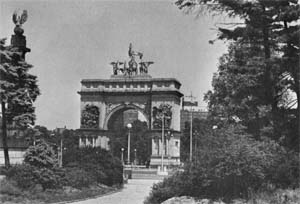
The second and greater structure is Terrace Bridge, which carries the traffic of Hill Drive across the straits connecting the Lake and Lullwater. As its name signifies, Terrace Bridge was meant to be an integral part of the landscaping about the unrealized Refectory. A photograph of the first temporary span here, taken in the early 1870's, shows a rickety open framework of timber. The later permanent bridge of 1890 is substantial, having abutments of brownstone. It has buttresses and bonnets to the piers suggesting forms of Meadowport Arch, and circular plaques on the sides of the stonework inscribed with the date of erection in large numerals. The roadway over the gorge is carried on six steel arches side by side, the outermost enriched with spandrel panels. A parapet the length of the bridge is pierced by a row of little lobed arches. The scale of Terrace Bridge was prophetic of a grandeur that was to appear at and modify Prospect Park over the next 35 years. During the early 1890's, the Soldiers and Sailors' Monument to Civil War Union forces was erected on Grand Army Plaza. The architectural design was by John H. Duncan, who, a few years before, had designed and built Grant's Tomb on Riverside Drive in New York, and the sculpture by Frederick William MacMonnies (1863-1937), a native of Brooklyn, who had apprenticed to Augustus Saint-Gaudens for four years before going to the École des Beaux-Arts in Paris to complete his studies. Taking the form of a Roman triumphal arch, the monument was abreast of the times by being in the latest Neo-Classic style, then crystallizing in the renowned "White City" -- the exhibition halls of the World's Columbian Exposition held in Chicago in 1892-93.
As we have seen, the great elliptical plaza figured in Vaux's sketch of 1865, and it subsequently became the setting for the Lincoln statue and a fountain. The materialization of a triumphal arch with quadriga on top and army and navy groups below was not out of place here, and it was complemented by a pair of Doric shafts, capped with bronze eagles, stationed to either side of the park entrance, also by Duncan and MacMonnies. To further the impressiveness of the Plaza, the architectural firm of McKim, Mead and White was called in to expand the scheme. The three men had served on the Architectural Commission for the World's Columbian Exposition and designed Agricultural Hall and the New York State Building; and, incidentally, they had become associated with MacMonnies and Olmsted at the fair, the sculptor having fashioned the Columbian fountain, and Olmsted having conceived the landscaping. Messrs. Charles Follen McKim (1847-1909) of Pennsylvania, William Rutherford Mead (1846-1928) of Vermont, and Stanford White (1853-1906) of New York set up two more identical pillars, at the Flatbush Avenue and Prospect Park West corners, thus achieving four evenly spaced uprights. They devised curved sections of pierced wall of granite, each ending in pedestals supporting bronze urns, to form a unifying background. Inside the park, near the outer columns, were built two 12-sided pavilions of the Tuscan order, also of granite, containing semicircular benches, and slab screens in six intercolumniations at the back. These pavilions have low-pitched pyramidal roofs capped by bronze finials. The elegant ensemble was completed in 1895. Meanwhile, Frederick MacMonnies had modeled the lifesize bronze figure of James S. T. Stranahan that was installed on a pedestal to the east side of Main Entrance Drive in 1891, honoring the man who had taken the greatest interest in the park, and it is fitting that Mr. Stranahan attended the dedication.
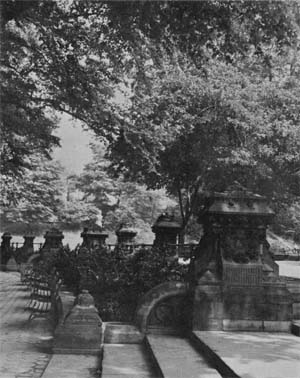
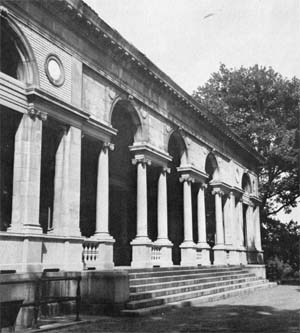
The second most important portal to Prospect Park is on Park Circle, at the south corner, nearest the Lake. The principal motif here is a pair of bronze lifesize equestrian groups, each composed of two horses and a male nude rider, by MacMonnies. Called The Horse Tamers, we are reminded of Coustou's Horses of Marly, the eighteenth century sculptures in the Place de la Concorde, Paris. The horses in Brooklyn are wilder; their ruthless spirit challenges the tamers to remain mounted without benefit of saddles, and the tortured outlines of the forms approach the chaotic. Like the Grand Army Plaza figures, these pieces were modeled in Paris and cast at the LeBlanc-Barbedienne Foundry. The architectural setting on Park Circle again is by McKim, Mead and White, consisting of 19-foot granite pedestals embellished with reliefs in both stone and bronze, walls concentric to the circle interrupted by pedestrian entrances flanked by broad urns, and square end pavilions with corner piers and distyle Greek Ionic columns in antis in each side, covered by low pyramid roofs. The architects proposed four tall granite columns surmounted by bronze eagles to be stationed in back, but these were not included in the 1896-97 construction. The contemporary Willink Entrance, on Flatbush Avenue near the junction of Ocean Avenue and Empire Boulevard, was named after the family whose old home stood in this vicinity. McKim, Mead and White flanked the drive with twin granite turrets, 20 feet tall, having waist-high bases, plain cylindrical shafts, bonnets enriched with imbrication, and bronze urn finials. Wall segments of base height, with benches set in front of the four sections, terminate at circular sentry boxes, spaced 200 feet apart, and, from these, convex walls curve out to the street. The round boxes originally had hinged doors and glazed windows. They relate to the octagonal granite police kiosks in the park, such as those near the Grand Army Plaza, Park Circle and 3rd Street entrances. The gateway at 3rd Street and Prospect Park West is guarded by a pair of bronze panthers modeled by Alexander Phinnister Proctor. The sculptured animals were set on tall rectangular granite shafts in 1897. Perhaps the most inviting entrance is that at the obtuse angle of Parkside and Ocean avenues, also by McKim, Mead and White. A curved granite colonnade of two sections is divided by the driveway, and a walk enters park from the center of each unit. Square end piers are coupled with round Roman Ionic columns, and two pairs of similar columns are between. Screens run along the park side, with benches in front. The colonnades support an open timber trellis clad with wisteria. The curve of the plaza continues beyond Ocean Avenue, forming a half-circle, but does not cross Parkside Avenue. This entrance was realized in 1904. A companion to this pergola, built by the same designers and at the same time, is the Classic Peristyle, below South Lake Drive and across from the east end of the Parade Ground. It superceded Promenade Drive Shelter, of the late 1860's, a 200 by 35-foot frame structure covered by a canopy and appended to which was a small comfort station. The new pavilion consists of a low platform and a colonnade, with square corner posts and alignments of Corinthian columns between, four in each end and ten on the flank. The supports are of limestone up to the capitals, which, with the entablature, are of whitish terra cotta. Architrave blocks are wedge-shaped, like voussoirs: of a flat arch, and the frieze is filled with a continuous relief of luxuriant foliage. Attic blocks, on axis with the columns, and intervening balustrades surmount the console cornice. The Peristyle sometimes is called the Grecian Shelter, which is a misnomer inasmuch as all of its features are in the Renaissance manner.
The monumental gateways opposed the Olmsted-Vaux tradition by introducing architectural features at the entrances, originally elaborated only by rows of evenly spaced trees -- continuous with those of the promenades that encompass the park -- and two small rustic pavilions on the Plaza to serve as shelters for people alighting from or waiting for cars. The McKim, Mead and White gateway additions at least faced out, relating themselves to the city beyond, whereas the Peristyle is wholly inside the park, thus representing a different viewpoint. it was succeeded by three larger structures in the same manner. They were the work of the architectural concern of Helmle, Huberty and Hudswell. Frank J. Helmle (1868-1939) had come from Ohio and studied at Cooper Union and the Brooklyn Museum School of Fine Arts. In 1890 he joined the staff of McKim, Mead and White, and the next year formed a partnership with Ulrich J. Huberty. Their first building in Prospect Park was the Boathouse, on the east side of the Lullwater. It was built in 1905 to replace the old wood shed boathouse around to the north, at the mouth of the brook. Like the upper parts of the Peristyle, the new Boathouse was built in its entirety of white mat-glazed terra cotta, the roof covered with red tile. An arcade along the water front has engaged Tuscan columns set before the piers, and an entablature with triglyphs is surmounted by a balustrade. The design was borrowed from the lower story of Sansovino's Library of St. Mark, of the sixteenth century, in Venice. The first story originally was open. Double staircases rose from the middle of the building to landings on the east wall, whence twin flights came together at a higher landing and a single flight continued to the second floor inside a semicircular well. The stairs embraced a boat-renting office on the main floor, and there was an enclosed kitchen at the north end, and a soda fountain and ladies' rest room at the south. The second story was a dining hall, served by dumbwaiters in the two east corners. French doors opened onto the balustrated terrace. Twenty bronze lampposts with dolphin motifs are spaced along the broad flights of granite steps descending to the landing and continue around the ends of the building. A flimsy open shed intruded upon the landing terrace in 1915.
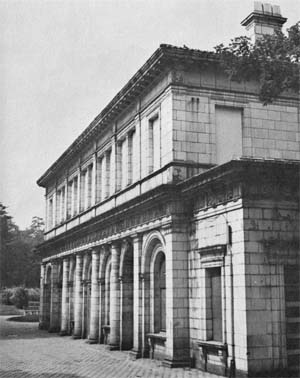
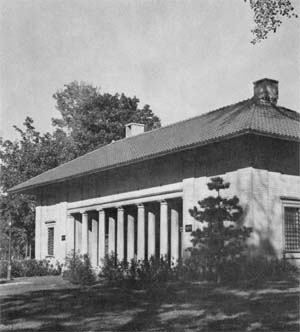
The second Helmle and Huberty building is the Tennis House, constructed in 1909-10 on the west side of Long Meadow, halfway between Swan Boat Lake and the park shops and stables. It provided lockers for participants in the growing sport of lawn tennis, earlier using the basement of the 1885 carousel in Picnic Woods. Built of limestone and yellow brick, on granite foundations, and with terra-cotta vaults and a red tile roof, the Tennis House, like the Boathouse, is classic in style and achieves an intimacy with the park through being predominantly open. The characteristic motif is the triple void, the centermost arched, a favorite with the influential sixteenth century Italian architect, Andrea Palladio, whose name it bears. The casino quality of the Tennis House is not unlike that of the elegant mid-eighteenth-century Palladian Bridue in Prior Park at Bath, England, an entirely fitting accent for a natural landscape, according to high British taste of the period. Only to a slightly lesser degree can the same English monument be compared with the two preceding pavilions in Prospect Park. Although the original designers would not have approved of their existence in this idylic retreat, at least there is basis for a respectable argument to be used in their defense.
The third detached building in Prospect Park by the Helmle firm is the Willink Entrance Comfort Station, built in 1912. Like the Tennis House, it is constructed of limestone and yellow brick and has a red tile roof. Wash rooms at either end are connected by a vaulted breezeway supported on each side by Tuscan columns in five pairs, set one behind the other. Twin chimneys rise hipped roof and deep eaves overhang the Willink Comfort Station is less classical than its forerunners and forecasts the expiration of the the style from Prospect Park. Later buildings, at most, were to show isolated related details, and these not in very good scale with the buildings to which they were attached. Even during the quarter of a century preceding the First World War, there were improvements put into the park that were in no wise Neo-Classic. Two examples were erected on the Peninsula, and both had a strong flavor of Olmsted-Vaux park architecture about them. The first one was on the south shore, equidistant between the Landing Shelter and Well House. It was the Model Yacht Club House, in which miniature ships were kept for sailing on the Lake. It was a cruciform frame building, with an octagonal superstructure providing clerestory lighting at the crossing. This unostentatious clubbouse was built in 1900, and it burned in 1956, together with its cherished contents. Only the landing terrace in front remains. The miniature-boat enthusiasts were relocated in the abandoned Well House. The second structure was directly across the Peninsula, or midway between the Model Yacht Club House and Terrace Bridge. Here was a low, sprawling shelter with gently sloping roofs and deep overhanging eaves, including a long breezeway between end pavilions, the gables of which jutted through the hipped roof. Despite the difference in roof pitch, the style of the structure related to that of Concert Grove House. Its rustic parts were of cedar and the roofing was of chestnut slabs. Although built 15 years after its companion, the shelter disappeared first. Both are regrettable losses to the park. During the second decade of the century the stable quadrangle was built between the existing utility-conservatory group and West Drive, on a line with 6th Street. Although the largest structure erected in Prospect Park up to this time, its simple lines, low masses and semi-isolation make it an acceptable addition to the complex. Its brick walls are articulated with arches; a porte-cochere leading into the courtyard and a small belfry lend interest to the design.
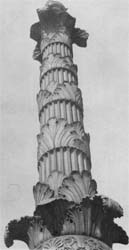
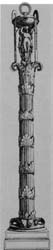
Two fine classic monuments, that will reward our consideration before leaving this era, are located on the west perimeter of the park. The first is at the entrance on Bartel-Pritchard Circle. It consists of a pair of giant pillars of such uniqueness as to be a noteworthy landmark. The source of inspiration was the little-known Acanthus Column of Delphi, a votive shaft dating from the beginning of the fourth century B.C. In using it for a model, Stanford White made the most of its best features and improved its proportions, achieving a more substantial foundation and a less topheavy summit. The result is an exquisite form, which, if one did not know of its antique archetype, one would attribute it to a stroke of genius on the part of a designer of the classic-eclectic period. Set on a high square plinth, each shaft is banded at the base, above which is a campaniform carved with a frieze of Greek anthemion. Four girdles of acanthus leaves alternate with four fluted drums and the whole is crowned by a flaring acanthus capital. A bronze tripod of utmost simplicity is atop the shaft; the sculptured caryatids supporting the urns in the original are eliminated without any suggestion of incompleteness. Stanford White conceived the pillars in 1906, the year he was killed, and one is prompted to look upon the granite uprights as a testimonial to his impeccable artistry.
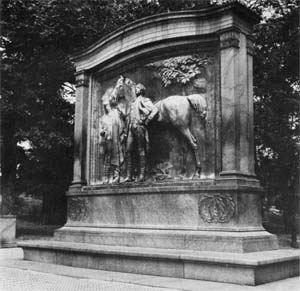
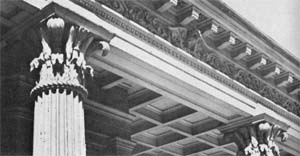
Six blocks to the north, facing 9th Street at Prospect Park West, stands the stele honoring the Marquis de Lafayette, French statesman and soldier, who took up the cause of American freedom during the Revolution. The Lafayette Monument presents a lifesize image of the general in the round engaged to a low-relief background representing horse and groom. The bronze plaque was the work of Daniel Chester French (1850-1931), sculptor of the colossal Republic at the Chicago Fair, of the two allegorical figures of New York and Brooklyn from the Manhattan Bridge now at the entrance to the Brooklyn Museum, and later he was to execute the seated marble portrait in the Lincoln Memorial in Washington. His tribute to Lafayette is elevated on a granite podium and enframed by Corinthian pilasters styled after the order of the first-century B.C. Tower of the Winds at Athens. These columns have an unusual capital of a single row of acanthus leaves above which rises a ring of flattened grasses clinging close to the campaniform. The Athenian example has no base, but the pilasters of the Lafayette Monument have normal footings. It was dedicated 10 May 1917; the ceremony included Mme. Louise Homer singing La Marseillaise and The Star-Spangled Banner, accompanied by her husband at a small piano provided for the occasion.
The United States had been several months at war when the patriotic demonstration was made coincident to the dedication of the Lafayette Monument. As in the Civil War period, little happened in Prospect Park throughout the First World War. The initial addendum afterwards was -- as might be feared -- a memorial to those slain in the service of their country. Called the Honor Roll Memorial, placed by the side of the Lake between Music Island and the Landing Shelter, it features a semicircular granite wall bearing six bronze tablets inscribed with the names of Brooklyn victims of the war. An heroic group in the center represents the winged Angel of Death and the Soldier. A pedestal is in front, seats are to either side, and a circular altar stands in the middle. The shrine was erected in 1920. Arthur D. Pickering was the architect, Augustus Lukeman the sculptor with Daniel Chester French as associate. Although the magnitude and design of the memorial are inoffensive, it is a reminder of the tragic consequences of violence that would have a more sympathetic setting in a cemetery; and it ushered in an era of building in the park in which the basic concepts, in one way or another, were as inappropriate as here and likewise should have sought sanctuary elsewhere. In 1927 a new and larger Picnic House was built to replace the older one on the same site, on Long Meadow behind Litchfield Villa and just north of the old carousel. The raised-basement type building of red brick has a projecting entrance block with frontal steps between antepodia, a Palladian arch to the recessed entrance set on a pair of insignificant Ionic columns and crowned by a harsh gable. Details are thin and poorly conceived of manufactured stone. Fenestration is oversized, and the hipped roof, covered with red tile, is steep and heavy. A large assembly hall is on the main floor, and rest rooms, utilities and a lunch counter are in the basement. The architect was J. Sarsfield Kennedy. Picnic House now serves as a Golden Age Center. It resembles a rural schoolhouse of the roaring twenties, an awkward, prosaic, cubic pile, which the graceful sweep of Long Meadow could very well do without. West of the colonnade at the Ocean Avenue Entrance, near Parkside Avenue, stands a severely rectangular little comfort station with the classic divisions of basement, first story and parapet clearly defined. The central portal is higher, with urns set atop corner piers and an arched doorway. Fenestration is restrained. The building has the virtue of being small, and some attempt has been made to relate it in style to the early twentieth-century buildings in the park. The architect was Kennedy, and it was built in 1930.
Situated north of the Lefferts house on Flatbush Avenue, the Zoo is a group of red brick buildings with limestone trim constructed by Works Progress Administration funds in 1934-35 to replace the menagerie that was in the vicinity of the Dairy, beyond East Drive. The Zoo is entered through open shelters and down curved stairways, with terraces left and right, including a restaurant beyond on the south side and a comfort station on the north. The animal houses form a hemicycle concentric to a semicircular Seal Pool, the domed Elephant Rotunda on axis opposite the entrance, and two bird cages beyond. Bear pits along the Flatbush Avenue side have sunken barrier moats to permit a view of the animals without the obstruction of bars. Bas reliefs on the exterior of buildings illustrate scenes from the adventures of Mowgli, the hero of Kipling's Jungle Books. They were carved by Hunt Diederich, F. G. R. Roth and Emele Siebern. The frieze mural inside the Elephant Rotunda was painted by Allen Saalsberg. The ensemble resembles the zoo in Central Park, which was designed and built earlier by the same architect, Aymar Embury, II; and, although the Zoo in Prospect Park is smaller, it is the better integrated composition -- another instance in which the Brooklyn park benefited from experience gained in the Manhattan preserve, if one can accept the zoo as a benefit to the park. The first zoo in Central Park had come into existence as an adjunct to the Museum of Natural History, then housed in the Arsenal, and the new zoo was a better organized institution on the same site. The Zoo in Brooklyn was an imitation of the latter, and its advent meant the forfeiting of the Wild Fowl Pond and small east greensward. These were on the site of the original Deer Paddock, described in 1868 as "a bright, sunny little meadow, with sparkling water, lost in the distance under trees . . . set off for the pasturage of deer . . . [and] so arranged that, while the visitor cannot enter it, he will not notice any artificial obstruction." It was explained elsewhere that a delicate iron paling, camouflaged by undergrowth, surrounded the range. As has been noted, Mr. Olmsted had sheep and cattle grazing free on the meadow. He refrained from developing the "Zoological Ground" indicated along the west boundary of the park in the earliest design, saying it would "be placed under the control of a special corporation," and that the subject would "be recurred to." Of course the Litchfield Villa remained in the middle of the designated area and, before the termination of the tenure of the landscape architects, the designation of this spot as a zoological ground had been effaced from the plan. Olmsted could not reconcile the imposed confinement of animals in iron cages with a pleasure garden for human beings seeking escape. Aymar Embury, II, also designed the Band Shell located off Prospect Park West between 10th and 11th streets. It was built in 1939, and consists of a platform projecting in front of an arching sounding shell of concrete, with lower walls of well laid Flemish-bond red brick, relieved only by copings of cast stone, extending out symmetrically and having shallow recesses to each plane. A half-round paved play-dance area of 125-foot radius forms a forecourt to the building, which is 88 feet across. It contains lockers, dressing and rest rooms for the musicians or performers, public lavatories, park maintenance and supply rooms, and chair storage space tinder the stage. The Band Shell is seldom used, the Goldman Band performing at Music Pagoda near the Lily Pond. The Band Shell is innocent of architectural embellishment and looks as out of place in this simulated rural setting as a colossal overturned piano box of equal dimensions. The Carousel near Willink Entrance is the fourth of its kind in Prospect Park. The first (1874) was at the Playground and was moved to Picnic Woods to become the second (1885). It was replaced on the same site by the third in 1915, this one designed by Carl T. Berger of Philadelphia and built at a cost of $10,000. The present Carousel was constructed in 1952 for $75,000. Whereas its predecessors were built of wood, the fourth Carousel has banded yellow and red brick walls. It follows their precedent, however, in being octagonal and having hipped roofs, a clerestory here furnished with colored glass. Segmental arched doors have overhead rolling steel shutters. The horses of the merry-go-round came from the old Coney Island carousel of the McCullough brothers. Designed by the staff of the Parks Department at the Arsenal, the carousel building captures the spirit of park architecture better than any of its contemporaries, though a projecting cornice would have given it a more acceptable profile and allowed interesting shadows to play on the walls. In 1959 the south end of Long Meadow was disfigured by two concrete and brick bleachers, and wire-mesh fences encircling a baseball diamond. The intrusion was inexcusable, showing complete ignorance of the basic purpose of Prospect Park. An even greater catastrophe befell the park in 1960, with the wrecking of the south side of stately old concert Grove, including filling in the shore line and obliterating Music Stand Island. The desecration was prelude to the formation of a 140-by-200-foot skating rink, surrounded by high metal fences and joined to a squat, sprawling skaters' shelter, with exposed freezing machinery at the northwest corner. The shed is made of zinc alloy, tinted plate glass, cement plaster, anodized aluminum, and brick and precast concrete panels. The structure is what one would expect to find serving as a snack bar on a busy freeway, and its self-conscious geometry and artificial materials could not look more out of place than in this sylvan setting. It was planned by Hopf and Adler and cost $857,000. Nowadays, wandering down into the lower terrace of Concert Grove, one is not only confronted by this unsightly fabrication but offended by loudspeakers blaring forth canned music of the most tawdry sort -- a far cry from the original scene here, of people strolling, sitting on benches, in carriages, in boats, at tables under the oriental shelter, all listening to live music from an orchestra stationed on the island. It seems incredible that Prospect Park, at this late date, could have been considered an undeveloped lot, miraculously left untouched by an expanding metropolis, and therefore in need of being put to some well intentioned use. Even during the incumbency of the original designers, there had been those who had no concept of the overall purpose and significance of a natural garden and who attempted to blazon their personal interests before the public on park land. Olmsted, writing about such encroacbments attempted in Central Park during the early 1870's warned that if they were not firmly opposed, the result would be the park's "conversion into a great, perpetual metropolitan Fair Ground . . . a desultory collocation of miscellaneous entertainments, tangled together by a series of crooked roads and walks, and richly decorated with flowers and trees, fountains and statuary." As an anecdote for this piecemeal destruction, he issued the following dictum, capitalized for emphasis: THE ONLY SOLID GROUND OF RESISTANCE TO DANGERS OF THIS CLASS WILL BE FOUND TO REST IN THE CONVICTION THAT THE PARK THROUGHOUT IS A SINGLE WORK OF ART, AND AS SUCH, SUBJECT TO THE PRIMARY LAW OF EVERY WORK OF ART, NAMELY, THAT IT SHALL BE FRAMED UPON A SINGLE, NOBLE MOTIVE, TO WHICH THE DESIGN OF ALL ITS PARTS, IN SOME MORE OR LESS SUBTLE WAY, SHALL BE CONFLUENT AND HELPFUL. The quotation offers the key to the real distinction between the buildings of the pre-World War I and those of the postwar periods. Let us recapitulate: the Olmsted-Vaux regime lasted from 1866 to 1873, and it was followed by an interim of similar duration sympathetic to the aims of the designers. Then a new viewpoint took hold in the early 1890's and for a quarter of a century the hegemony was held by Classicism. Here we already have two conflicting styles: the first rustic, somewhat quaint, and casual; the second refined, clearcut, and formal. But the fact remains that the individual examples of both have style, they have scale, they serve uses consistent with park purposes, and, most important, each was very carefully designed for perfect harmony with its setting. Constructions built after 1920, by contrast (and here let us make an exception of the Carousel), either have no style at all, or else, as in Picnic House, it seems incidental and like a compromise on a bulky form. Of course there is no intrinsic value to a building's having style. The seventeenth-century imperial Katsura Villa in Japan has none -- in the Western concept of the term -- but it does have exquisite design, excellent craftmanship, and warmth in the choice of materials, making it one of the greatest specimens of architecture in the world, and it accords perfectly with its own contrived rustic landscape environment. But the style-less constructions in Prospect Park are graceless enclosures framed into harsh geometry and discordant with the natural beauty of the place. Besides, their uses are of dubious character. There is no excuse for having an assembly room, a place of detention for animals, a roofless concert hall, a ball park, or an artificial skating rink within a landscape garden, when all could be located and serve the public equally well outside, and by so doing allow that garden to preserve its verdant identity. The Classic Peristyle, Boathouse and Tennis House send people out to enjoy the natural advantages of the park -- boating, or to play games on the lawn -- and may be looked upon as centrifugal in spirit; whereas Picnic House, the Zoo, the Band Shell, the Baseball Diamond Bleachers and Skating Rink are centripetal, they suck them into their specially conditioned interiors, which are not the park at all but extraneous attractions, and those surrounded by knit-wire fences exclude all but participants. As one might expect, the pouring of money into such illegitimate constructions as these from the 1920's up to 1960 was accompanied by a withdrawing of funds from maintenance, thus allowing deterioration of the grounds and planting gradually to spoil those portions of the park that had escaped defacement by the structures. There can be no question about it: the great feature of Prospect Park is its varied and well integrated landscape, and no segment of it should ever be isolated for tangential usage, or estranged by disuse, any more than a square of canvas should be cut out or painted over in a great landscape painting. For Prospect Park is no less a masterpiece than a landscape by Kuo Hsi, Pieter Bruegel, or George Inness, and surely no museum or collector owning paintings by these masters would dream of neglecting them or permitting anyone to make changes to them. With no more justification can neglect or incongruous changes be permitted in Prospect Park. As Olmsted said, the park is a "work of art . . . framed upon a single, noble motive, to which the design of all its parts . . . shall be confluent."
Prospect Park is host to several important historic monuments never intended to have been in a public garden. The largest is the Litchfield Villa, standing on its present site since some years before the park was proposed. The Viele plan went up to and around the back of the property, but it was included within the boundaries established by Calvert Vaux in 1864. It was originally part of the old Cortelyou estate, purchased in 1852 by Edwin Clark Litchfiield, whose grounds for the residence were bounded by Ninth and Tenth avenues, and 3rd and 5th streets, containing about seven acres. Alexander Jackson Davis, considered the foremost architect of his day, the creator of many of the house designs appearing in the books by the landscape authority Andrew Jackson Downing, mentioned earlier, was given the commission to build a residence that would be a setting suitable to the wealth and social position of the railroad magnate. As was customary on larger commissions such as this, Davis submitted several schemes for the Litchfield house. One filed among the Davis papers in the Metropolitan Museum of Art is castellated and several others are Italianate. All have asymmetrical massing, the Gothic Revival version with Tudor arch at the entrance and battlemented walls, the Italian-villa designs with round arches, towers, balustrades, and low-pitched roofs with overhanging eaves. Litchfield selected a version in the Italian mode.
The Litchfield Villa, completed in 1857, is set on a terrace sustained by a stone retaining wall held together by iron clamps. The main entrance, in the west front, is at the base of a square tower of four stories, adjoining which is a broader, three-storied polygonal pavilion with a flat deck on top, and a curved bay window and balcony at first and third levels. Columned porches are to either side, that on the left encircling the south end of the villa. Cylindrical turrets flank the north end of the composition. The walls are of brick, and they were stuccoed, scored and painted to resemble stonework. Porch supports are an American order featuring corn and wheat motifs on the capitals, recalling Latrobe's corn columns in the senate foyer of the Capitol in Washington. Windows contain diamond-shaped panes bordered by bands of stained glass in patterns.
The vestibule opens into an octagonal rotunda lighted from above by a circular well. A double staircase rises in the extension to the south, beyond which is the drawing room. Called by the Litchfields the Gold Room, it was furnished and decorated in the Rococo manner. Here one still finds exquisite plasterwork, conspicuously missing elsewhere in the house. Twin Corinthian columns once stood in the recessed bay window. The space flows into conservatories at front and back, actually glazed sections of the encircling piazza. Opening directly off the rotunda and drawing room in front is the octagonal reception room, with a fine caryatid mantelpiece of white marble and lighted by the bow window near the entrance. The small arched windows to either side are modern, replacing earlier niches. The dining room behind is similar in shape and size. Across the vestibule is a circular library lined with cabinets for books, and beyond it a small map room at the base of the northwest turret. Two chambers and conveniences complete the first-story accommodations. It is said that Mrs. Litchfield was a semi-invalid, accounting for the location of the chambers here. She was the former Grace Hill Hubbard and the villa was named after her, Grace Hill, sometimes written by members of the family "Gracehill." Kitchen and store rooms were below stairs, and food was sent up on a dumbwaiter in the service stairball opening off the northeast face of the rotunda. The second floor of the rotunda has a balustrade around the open well and skylight above. The chamber over the dining room also is skylighted, from the apex of the domed ceiling. A ticket window is in the door, and the Litchfield children used this room as a play theatre. Servants' rooms were in the north wing of the villa, which is three-storied. The room at the top resembles a tiny chapel. A billiard room is on the third floor over the reception-room chamber. It is reached by a stairway in the tower, another flight ascending to roof-terrace level, whence one gets a view equal to that from Lookout Hill. The villa cost $150,000 to build. The grounds were landscaped by H. I. Ehlers of Newport, Rhode Island, constituting the earliest gardening on the park site. Although all the Olmsted-Vaux plans ignore everything bere except the location of the residence itself, it is interesting that the contours of the drive to and around the villa today are as Ehlers planned them. Authority to purchase this and neighboring property to the south was granted by the State Legislature 24 April 1868, but a couple of years elapsed before they were actually acquired, accounting for work progressing along the east side of the park first. West Drive cuts across the northeast corner of the original plot, through the stable site. Notwithstanding the intrusion, the Litchfields continued to reside at Grace Hill on an annual lease from the city of from $3,500 to $2,500 until 1882, the year following Mrs. Litchfield's decease. In 1883 the building became the headquarters of the Park Commissioners, and it has continued to serve primarily for offices to date. A branch library and little theatre have occupied rooms in it briefly. In 1911-13 a dependency was added at the back, connected by an extension to the porch. The architect for this two-storied brick pavilion was Frank J. Helmle.
On 13 February 1918 the oldest building in Prospect Park was moved from its original site on the east side of Flatbush Avenue between Maple and Midwood streets and given to the city. The story-and-a-half frame house was set on new foundations facing Flatbush Avenue north of Willink Entrance. It was the home of Lieutenant Peter Lefferts, begun in 1777 to replace his great-grandfather's house, burned by American soldiers under General Sullivan during the preceding summer because it had been captured and was being occupied by the British. The destruction of the old house had occurred on 23 August 1776, three days before the Battle of Long Island. The later residence had acquired an addition at the back and was remodeled inside, but it was restored at the time of its relocation in the park. The building holds great architectural interest, illustrating the final phase of a Dutch type proper to Long Island. The early houses here had steep roofs with end gables, dual-leaf "Dutch" doors and casement windows, like those replaced in the Jan Martense Schenck house (ca. 1675) in the Brooklyn Museum. By the close of the seventeenth century the roof tended to become lower pitched and curved outward at the base, making deep overhanging eaves at front and back. Early in the eighteenth century the double-pitched or gambrel roof appeared, windows became the sash variety and the plan more complex, exemplified in the Nicklaes Schenck house (ca. 1757), also in the Brooklyn Museum. The last stage was the development of the overhangs into porches, with platforms raised off the ground and the roof supported by slender colonnettes. These, the arched dormer windows, clapboard siding, and the doorway with its thin paired supports, carved sunbursts, paneling, and leaded-glass transom and side lights are no longer Dutch but typical features of American Federal architecture. The plan of the Lefferts House consists of a transverse hall divided by an arch and having the staircase at the rear, with two rooms to either side. The principal interior on the left is united by a wide, curved opening in the partition, stylistically suggesting an early nineteenth-century improvement. There is no fireplace in the rear section, which probably originally was a spare bedroom. The present mantel in the front is a replacement, a mid-nineteenth-century flreplace of marble standing here before the house was moved. Extant plasterwork on the ceiling is of the same period. Chairrailing is conspicuously missing. Adjoining the kitchen wing, this would have been the place for formal dining. The parlor across the hall is more consistent in style. It is encircled by a chairrail, and the rings linking the corners of the bead moldings on the recessed aprons under the windows are repeated around the ceiling. The plaster centerpiece in this room is significant, if it be original. A scallop pattern embraces 16 stars, the obvious interpretation of which is that they represent the number of states existing at the time the work was executed. The sixteenth state was Tennessee, admitted to the Union in 1796, and Ohio was next, admitted in 1803; thus one is led to believe that the Lefferts house was completed within this interim of seven years. It would have been after the decease of Peter Lefferts in 1791, when the property had passed to his second wife, Femmetje Suydam Lefferts. Behind the parlor, but entered only from the hall, is a chamber with a corner fireplace. Most of the chairrailing in this room is not of the period, fragments of the original surviving as window sills. The staircase rises in three flights around an ample well. A groove is cut into the soffit of the stairway for the swinging in of the back door. Upstairs, one should note the sloping vault forms over the dormer windows. There are four bedrooms on the second floor. The back room on the left has a door to the space over the kitchen, where a gangway-type stairs ascends to the garret above the main block of the house. The only upper bedroom with a fireplace is that at the front over the dining room. None of the closets, of course, is original. The service ell is divided into a number of small rooms as caretaker quarters, and the big cooking fireplace has been bricked up. It is difficult to ascertain the early layout. However, the enclosed stairway by the side of the back door seems authentic, and perhaps the entire area between it and the fireplace constituted one large kitchen. This part of the house may have been built in 1777 and the larger mass constructed -- or at least completed -- later. It is said that use was made of the foundations and some of the lumber and hardware salvaged from the older house after the fire, and indeed a few wroughtiron strap and H hinges and primitive latches on doors in the ell support the tradition. The Lefferts house is furnished with period pieces of the mid-eighteenth to the mid-nineteenth century, a few articles having come from the Lefferts family, such as the big grandfather's clock in the parlor. Since 1920 it has been maintained as a museum by the Fort Greene Chapter of the Daughters of the American Revolution. . . . South of the Lefferts house and midway between the Willink Entrance and Carousel stands a Flatbush toll booth believed to be the last of its kind in existence. In style it belongs to the middle of the nineteenth century, and it may date from 1854, when what is currently Flatbush Avenue was opened from the Village of Flatbush to Prospect Hill, or, more likely, from 1855, the year of the inception of the Brooklyn, Flatbush and Jamaica Plank Road Company. The pavilion stood on the west side of the pike, between present Winthrop and Fenimore streets, until 1893, when the Flatbush Road Company -- successor to the Plank Road concern -- went out of existence. Given to the last Flatbush Road Commissioner, John Moore, the booth was removed to the backyard of a dwelling at the corner of Tilden Avenue and 28th Street. Some 40 years later, the relic came to the attention of Joseph N. Neff, President of the Chamber of Commerce, through whose efforts it was rescued and presented to the City of New York by the Flatbush Chamber of Commerce. Thus, in 1925, like its historic neighbor seven years earlier, it was given sanctuary in that part of Prospect Park proper to its native township. The Toll House is an octagonal frame structure with vertical-board siding. Alternate faces are pierced by a door and three shuttered windows, and it is crowned by a concave hipped roof with overhanging eaves. The building contains a single room. In 1932, in celebration of the 200th anniversary of the birth of George Washington, a replica of Mount Vernon, his home on the Potomac, was built on the Peninsula at the base of Lookout Hill. Old photographs reveal that the replica was a faithful copy of the Virginia mansion, as it looked at that time, even to the Chinese-lattice railing atop the portico, later removed in restoration. The architect was Charles K. Bryant and it was constructed by Sears, Roebuck and Company. The lakeside version was taken down after the Washington bicentennial festivities, as it should have been. With Prospect Park having arrived at its own centennial, our attention focuses on that part of it best adapted to celebrations -- Grand Army Plaza. The first fountain had been installed here in 1871. Its single jet of water must have commanded much attention when there was nothing else on the Plaza but trees and the Lincoln statue; but with the erection of the awesome Soldiers and Sailors' Monument and companion colossal columns and polygonal temples on the south side in the mid 1890's, the older features were reduced to mediocrity. Consequently, the Lincoln figure was transplanted to the center of the lower terrace of Concert Grove in 1895 -- not a very happy move for the Concert Grove -- and the fountain was replaced by a more versatile equivalent in 1897. The new fountain had a center jet encircled by a ring of subsidiaries, and the height and shape of the spurting water could be regulated with precision. Moreover, the aquatic display was illuminated, and illuminated in color. There had been no colored lights at the recent Columbian Exposition at Chicago, nor was a world's fair to employ polychrome lighting until the Pan-American Exposition at Buffalo in 1901, so that a water display with rainbow illumination was a spectacular innovation at that time. The electrical engineer for the Brooklyn fountain was F.W. Darlington of Philadelphia, and the cost was $24,500. The fountain on Grand Army Plaza was undermined by and became a casualty to the subway a little over a decade later. After an empty center for some years, the present Bailey Fountain was built during 1928-32. Eugene Savage was the sculptor of the current group. The two principal bronze figures, a male and female nude, represent wisdom and felicity. This fountain cost $100,000. Frederick Law Olmsted, then a venerable gentleman of 75, was consulted about the 1897 fountain. He replied that it should not be put inside the park, whereas it was all right to put it in the Plaza, where its predecessor had been. That his advice was sought was a concession to tradition, a most important factor, the following through of which is responsible for the perseverance of so much of the status quo of the park. It was also in 1897 that the people of Brooklyn caused a bandstand to be rebuilt on Music Island, and an orchestra was ferried out to revitalize old Concert Grove with music. The citizenry proceeded to promenade in what they were contemplating renaming the "Italian Gardens" and bask in the nostalgia of past grandeur; but since the recent renovation coeval with the installation of the Lincoln statue, the young London plane trees (now so magnificent!) were sparse and the peripatetics basked mostly in the hot sun. After this, they were content to return to the shade of the woods around Music Pagoda and leave the Flower Garden to thrive quietly in the sun. The music lovers of the gay nineties might have held their concert in the cool of the night, as lamp posts already had begun to appear within the boundaries of the park, although probably only along the principal drives. However, it was not until 1914, due to a surge of vandalism prompting the installation of many additional standards, that the park was considered adequately lighted at night. The lights that were put in, for the most part, are those that exist today, the design of the present handsome cast-iron lamp post by Henry Bacon having been adopted in 1907. On 20 October 1917 Brooklyn celebrated the 50th anniversary of the opening of Prospect Park, and the ceremony took place at the triumphal arch on Grand Army Plaza. The original event had occurred on 19 October 1867, but inasmuch as the 19th fell on a Friday in 1917, it was decided to hold the commemoration on the following Saturday afternoon at 3:00 o'clock. The nation had been at war over six months, and the festivities were appropriately brief. They were presided over by the President of the Brooklyn Civic Club and consisted of a few short speeches and musical numbers on the solemn side, including a grand march, Prospect Park, which had been composed by Luciano Conterno and dedicated to the Brooklyn Park Department in 1869. A single-sheet program was passed out. Besides the schedule of events it provided a simplified map of the park on the back and a description inside. Among other facts, the text stated that Prospect Park had cost Brooklyn $9,919,370 -- a million more than the total quoted when Olmsted and Vaux terminated their regime here 44 years earlier -- but that the land alone, exclusive of buildings, in 1917 was estimated to be worth $32,000,266. Having in hand a billet giving such satisfying information must have allowed everybody to return home happy, realizing that the city's money had been spent wisely and well. They should have been thankful that the park had been built when it was, and that its designers had been available to create such a masterwork. They also might have been grateful that, up to then, not one major error had been inflicted upon the finest natural landscape garden in America. In 1966 Prospect Park celebrated its 100th anniversary. Festivities began with a birthday party on June 2nd, a Thursday, chosen as the first convenient day after May 29th, a Sunday, which marked the exact century after Olmsted and Vaux were installed as Landscape Architects of Prospect Park. School children were given an afternoon holiday to attend, and senior citizens were bussed in. A parade assembled on Prospect Park West to march into the main entrance of the park. There were bands, horsedrawn carriages bedecked with flowers, antique automobiles with drivers and passengers in period costumes, high-wheeled and other bicycles, a six-car train, boy and girl scouts and a small troupe of American Indians in tribal dress. They paraded through the park to Music Grove, where presentations and speeches began at 3:00 o'clock from the Music Pagoda. Mr. Robert E. Blum, Chairman of the Prospect Park Centennial Committee, was master of ceremonies and introduced the speakers: the Hon. Abe Stark, Borough President of Brooklyn; the Hon. Robert Moses, Chairman of the Triborough Bridge and Tunnel Authority and for over 30 years New York Parks Commissioner; the Hon. Thomas P. F. Hoving, present Commissioner of Parks; and the Hon. John V. Lindsay, Mayor of the City of New.York. A model of the Centennial Plaque was unveiled. Designed and modeled by sculptor Neil Estern, it is a long panel containing likenesses of Messrs. Olmsted and Vaux in low relief to either side of an inscription ending, "The Park is Their Monument." Music was provided by a military band, Mrs. Morris Kirsch, soloist, and a borough-wide junior High school chorus. A mammoth cake was cut by Miss Prospect Park, pretty Cathy Condon, and slices passed out to the principals on the podium and senior citizens in the audience. Green and yellow balloons bearing the centennial dates were given to youngsters and souvenir brochures to adults. The event opened a summer of activities including concerts of jazz and classical music, opera and dramatic presentations, ballet, folk and square dancing, art shows, story hours for children, and guided tours through the park. At the time of its centennial, despite superficial sprucing up, Prospect Park looked much the worst for wear, in comparison to its appearance at the quieter celebration 50 years earlier. Neglect and ill-advised encroachments inflicted upon it since the surcease of the Brooklyn Park Commissioners and the centering of this office in Manhattan in 1934 were everywhere in evidence. But, to counteract these destructive forces, a group of enthusiasts stepped forward in 1966 and banded together as the ,a href="http://www.greenswardparks.org">Friends of Prospect Park. They are dedicated to the proposition that Prospect Park is the foremost art monument of Brooklyn, that it was designed for, approved by and belongs to the people of this city, that it is an important part of their heritage and, as such, it should be passed on to future generations unspoiled by inappropriate modifications. The nearby Brooklyn Museum, Botanic Garden and Public Library were planned as integral institutions, and to redirect the course of any one of these would be a stab at the vital heart of Brooklyn. They must remain functioning each in its own special way and all together as an organic unit. The vision that is necessary was expressed by the Hon. Robert Moses in his centennial address. Glancing backward he said: . . . the integrity of the Olmsted design of Prospect Park was faithfully, almost religiously adhered to by a succession of [Brooklyn] Commissioners, like my friend Raymond Ingersoll who is buried here in the Quaker Cemetery on the ridge. And looking forward he declared: This Park, under pressure of the millions, faced with disorder, destructiveness and defiance of authority which seems worldwide and inexplicable, needs more than a mere face lifting. It requires expensive, wholesale restoration and then better maintenance and more policing. He decried the attitude of those who vandalize parks and voiced the hope that: . . . the second century will repair the wear and tear of the first and serve increasingly the demands of the people. Finally, he expressed the sentiments of all who hold the park dear: Prospect Park is the immediate jewel of Brooklyn's crown. Let it shine on forever.  George Colbert and Guenther Vollath GLOSSARY Acanthus. A Mediterranean plant of which the spiny leaves served as model for classical decorative motifs, as on the capital of the Corinthian orderAntepodia. Projections in front of the podium, or basement, as cubic forms flanking a stairway Anthemion. A stylized pattern based on the palmette or lotus flower used in classic relief decorations Architrave. The lowest of three members of an entablature; a horizontal lintel carried from the top of one column or pier to another Balustrade (Latin balaustrium: a pomegranate). A series of upright forms supporting a railing Bargeboard. The decorated raking board of an overhanging gable Batter. To slope inward Bay. Any architectural unit or division Bead molding. A small half-round strip Bonnet. A false dome or rounded roof or superstructure Casino (Italian: little house). A building for amusement and recreation Chairrail. A wood molding affixed to the wall of a room at the height of the back of a chair for protecting the plaster Clerestory. A row of windows high in a wall Colonnette. A small, slender column Console. A bracket of classical form, usually scrolled at top and bottom Corinthian. The classic order with a campaniform capital decorated with acanthus leaves and volutes, supposedly originated at Corinth Cresting. An openwork ornament along the horizontal ridge of a roof, usually metal Cupola. A polygonal superstructure at the peak of a roof with windows in the sides; also called a lantern Distyle. Having two columns Doric. The common Greek order, distinguished by a heavy column without base, having a channeled shaft and capital made up of an echinus and square abacus; this type was developed in the Dorian or western region of Greece Ell. A wing or extension at the side or rear of a building Entablature. The horizontal part of an architectural order, supported on columns or piers, normally composed of architrave, frieze and cornice Extrados. The outer edge of an arch Federal. The neo-classic style of the late eighteenth and early nineteenth century in the United States Flemish-bond brickwork. A wall composed of alternating bricks laid sidewise and endwise, creating a checkerboard-like pattern Frieze. The middle section of the entablature, usually embellished with reliefs; any banded division painted or carved Gambrel roof. A curb or double-pitched roof of which the lower plane is more steeply pitched Gothic revival. The nineteenth-century romantic style inspired by English and European monuments of the late medieval period Hipped roof. A roof in which the sloping planes come together at the corners (hips), as opposed to one with gables Imbrication. An overlapping fish-scale motif, as of shingles in antis. Referring to supports stationed between antae, or piers Ionic. The classic order distinguished by volutes on the capital, come from Ionia, Asia Minor Kiosk (Turkish kiushk: pavilion). An open summerhouse Lintel. The horizontal beam or member bridging two vertical supports Mogul. The Mongol rulers of India (1526-1857) or pertaining to the style of that period Neo-classic. The revived phase of the classical contemporary with the World's Columbian Exposition at Chicago, 1892-93 Pagoda (Chinese pa-chiao-t'a: eight-cornered tower). An oriental tower Palladian. Pertaining to the sixteenth-century Italian architect Andrea Palladio; an opening of three parts, the centermost arched Pergola. An arbor with posts and horizontal trelliswork above, upon which vines are trained Peristyle. A range of columns surrounding a building or court Plinth. A square block at the base of a column Porte-cochere. A carriage entrance leading through a section of a building into an open courtyard Quadriga. A two-wheeled chariot drawn by four horses harnessed abreast "Queen Anne" style. A late nineteenth-century revival of the early Renaissance mode of Queen Anne's reign (1702-14), popularized by the English architect Norman Shaw Quoin. A projecting block at the corner of a building used decoratively Rides. In the early days used to refer to the bridle paths in Prospect Park Rotunda. A round or polygonal building or large ball usually crowned by a dome Saracenic. The name Saracen was applied by the ancients to the nomadic tribes on the Syrian borders of the Roman Empire, and the adjective came to be a general term for the Moslem style during the time of the Crusades Segmental arch. A less-than-full arch, one meeting the side supports in angles Soffit. The under side of a doorway or window lintel, or of a staircase Spandrel. The triangular space between the curve of an arch and its rectangular enframement Stele. An upright slab or pillar bearing an image or inscription Transom. A window over a door Trefoil. A three-lobed ornamental gothic motif Triglyphs (Greek: three channels). Blocks with vertical grooves, alternating with reliefs in the frieze of the Doric entablature Tudor arch. A low-pitched pointed arch in the late gothic manner Tuscan. The Roman Doric order, in which the column is more slender than in the Greek, having a base and smooth shaft Vault. An arched ceiling Vertical-board siding. A wall composed of adjacent, flush, upright boards, the joints of which are covered with narrow strips of wood Votive. Pertaining to an offering or dedication Voussoir. A wedge-shaped stone composing an arch Clay Lancaster |
|||||||||||||||||||||||||||||||||||||||||||||||||||||||||||||||||||||||
|
Once past Stanford White’s grand entrance, one sees Olmsted & Vaux’s
park much as they conceived it. They considered it a better work than
their first collaboration, Central Park, for several reasons, none of
which reflects on that earlier work. Principally, as this commission did
not result from a competition, with its inevitably fixed site and
program, they could change the program first given-and they did. Delay
of construction due to the Civil War aided their efforts. Almost half of
the land set aside for a park by the City of Brooklyn in the 1850s lay
to the northeast of Flatbush Avenue, the main artery to Flatbush, which
was still a town in its own right: it centered around the reservoir on
Prospect Hill (since filled in and used as a playground). Olmsted & Vaux
rejected a scheme in which Flatbush Avenue completely bisected the
proposed park, recommending instead that the allotted land be expanded
to the south and west. In severing the land to the northeast, they lost
the hill that gave the park its name, but they also got rid of its
reservoir (a major part of Central Park to this day) and provided, by
default, a tract on which related institutions (the Library, the
Brooklyn Museum, and the Brooklyn Botanic Garden) could be located
without consuming park space (as the Metropolitan Museum of Art does in
Manhattan). Another encumbrance considerably reduced here is the roads.
With a more compact shape-and without transverse cuts-Prospect Park
yielded much less area to wheeled traffic.
Enter between the east (left) pair of Doric columns. Note the statue of
James Stranahan (1891, Frederick MacMonnies, sculptor), whose personal
24-year-crusade is largely responsible for both Prospect Park and
Olmsted & Vaux’s other great contributions to Brooklyn: Ocean and
Eastern Parkways. Note also the pine grove along the walk; it is
replicated on the opposite corner, where the symmetrical entrance
composition merges with the park’s picturesque layout. Like all walks
entering this park, this one quickly loses visual connection with the
point of entrance, through its twisting route and the modeling of the
terrain’s topography.
Turn right at the first fork to Endale Arch, the first structure
completed (1867); a dramatic tuned transition takes you into broad
daylight and a ½-Mile vista down the Long Meadow. The arch is a bucolic
vault of Ruskinian Gothic in brick and sandstone, once festooned with
crockets, bosses, and finials, and lined with a wooden interior (only
traces of all this remain).
Once through the arch, note the corresponding but architecturally unique
Meadow Port Arch to the right, at the west entrance to the meadow: it is
a barrel vault rather than a Gothic one. Follow the path to the left
along the edge of the meadow. The recreation on the meadow itself is
deftly separated but still visible from the tree-dotted hillsides along
the encircling walks. The undulations of the meadow, sculpted by
Olmsted, offer a sense of place, and topographical variation allows
participants to perceive the mass of people present-impossible on flat
ground. This same trick is the basis of St. Peter’s Square in the
Vatican, a series of ups and downs within a vast dish that displays to
each participant the scale of the whole crowd.
About 500 feet ahead a set of steps rises to the left. Go a bit beyond
for a better view of the meadow, then back, up the steps, and across the
road. On the other side go left, then right at the next fork down a
curving walk to the Rose Garden (1895, designer unknown). This space is
lovely even without any apparent rosebushes these days. Turning right
across the center of the circle, take the steps leading down to the Vale
of Cashmere: meandering free-form pools with once-upon-a-time Classical
balustrades, now fallen. Deep in a hollow facing due south, the Vale
once supported a lush stand of bamboo (green year-round) and multitudes
of birds, some uncommon in New York.
Follow the brick path along the east side of the Vale (left as you
enter) straight out along the little meadow, from which there are
glimpses of the Long Meadow across the road. Continue over a modest
crest and down the wooded slope to Battle Pass. The park road at this
point follows roughly the alignment of the original road from Flatbush
to Brooklyn, and it was at this pass that Revolutionary volunteers put
up brief resistance against British troops advancing toward New York in
1776.
The Zoo: An optional and recommended detour at this point is to the
Prospect Park Wildlife Conservation Center (once known as the Prospect
Park Zoo), just to the south. The Center offers formal but intimate
confrontations with animals, and those in need of services will find
rest rooms and fast food. Its original neat semicircle of formally
planned, understated brick buildings (1935, Aymar Embury) was decorated
with basreliefs and murals by WPA artists, including Hunt Diederich, E
G. R. Roth, and Emele Siebern, representing scenes from Rudyard
Kipling’s Jungle Books. The takeover by the New York Zoological Society
has led to a different relationship between human and other animals,
retaining the shells of the original buildings, removing most of the
bars; it is an experience on paths, over a period of time, rather than a
display of caged tenants. (1990s. Goldstone & Hinz)
Of particular architectural interest is the central pavilion, an
octagonal blue-tiled dome of Guastavino vaulting with 24 oculi windows.
Once there were pachyderms under this pantheon, rhinoceroses, hippos,
and heffalumps-but the heffalumps were removed to the Bronx Zoo when all
of the City’s zoos were placed under that society’s aegis. To the west
along the park drive is a charming sculpture of a lioness and her cubs
(1899, Victor Peter).
At Battle Pass, cross the road and climb the stairs ahead to a plateau
that was once the site of the Dairy (1869, Calvert Vaux). Turn left at
the top of the stairs, and follow the brow of the plateau across the
bridle path, past the red brick service building, then right to cross
the high boulder bridge (very romantic rocky rock), passing over a
return loop of the bridle path. From the bridge, bear right, then left
up the steps, and then left again at a T-intersection along a walk that
skirts the knoll on which the John Howard Payne monument stands (1873,
Henry Baerer, sculptor). Climb to the crest for a sweeping view of the
Long Meadow. The red brick picnic house is directly across the meadow,
the more elegant Palladian Tennis House (1910, Helmle & Huberty) is to
its left. Return to the walk below, and take your first left on the walk
along the slope’s edge. At the next T-intersection go right and then
down the steps. Stop where the walk takes a sharp right for a view of
the fantastic boulder bridge crossed earlier.
Continue your descent into a deep rocky glen, through which a brook
gurgles happily. Turn left at the bottom, crossing a smaller boulder
bridge, and follow the path along the brook. Turn right at the end of
this walk, and pass through the triple Nethermead Arches (1870, Calvert
Vaux), where walk, brook, and bridle path separately pass under the
Central Drive. The arches are crowned with a trefoil sandstone
balustrade; the bridge is supported by barrel vaults of brick, granite,
and more sandstone. Continue along the brook, past some specimen trees
and into the Music Grove. Here a “music pagoda,” a faintly Japanese
bandstand, is the site for summer concerts. Cross Music Grove and bear
right on the walk that crosses Lullwater Bridge. From the bridge there
is a fine view of the white terracotta-faced, newly restored Boathouse
(1904, Helmle & Huberty). . From the other side of the bridge there is a
long view down the Lullwater, meandering toward the Lake. Note that the
sides of the Lullwater are hard-edged stone. At the end turn of the
bridge, turn left for a closer look at the Boathouse; note particularly
its elegant black iron lamp standards. The Boathouse is a pleasant
terra-cotta remembrance of Palladian architecture. From the Boathouse
take the path south past the Camperdown Elm, a weeping, drooping
Japanese Brobdingnagian bonsai of a tree: aged, gnarled, arthritic, and
eternal. Then turn left through the Cleft Ridge Span
(1872, Calvert Vaux), with its two-toned incised-tile inner surface
enriching this barrel vault.
Through this span is the formal Garden Terrace with the Oriental
Pavilion (1874, Calvert Vaux), now happily restored after a disastrous
fire. The view down this Beaux Arts-inspired garden to the Lake has
suffered more than the Pavilion, for the semicircular cove at the foot
of the Terrace is now filled by the Kate Wollman Skating Rink, a banal
place, one of three that originally scarred this and Central Park. No
matter how noble their intentions, recreational intrusions, particularly
those which inflict buildings foreign to the spirit of the landscape,
should be banned from the wondrous landscape art of such as Olmsted &
Vaux. In this garden, on axis, is Lincoln (1869, H. K. Brown, sculptor).
Follow Lincoln’s gaze to the high wire fence and exposed refrigeration
equipment at what was, until 1961, the edge of the lake. Lincoln seems
to gesture with his right hand: “Take it away:” To the left is the
Skating Shelter (1960, Hopf & Adler).
Turn left around this unhappy intrusion, and then pass a World War I
Memorial (1920, A. D. Pickering). Continuing around the edge of the
lake, you will find a landing shelter. This is a 1971 reconstruction of
the original (187o, Calvert Vaux), the sole survivor of many rustic
log-braced shelters that once bordered the lake, creating a kind of
mini-Adirondacks image. From here follow the path along the lake’s edge;
then bear left across the drive, and continue straight out of the park
through the Classical porticoes, crowned with redwood trellises (1904,
McKim, Mead & White), to the intersection of Ocean and Parkside Avenues.
For further views of the lake and a look at some of the park’s finest
Classical structures, don’t leave the park at this point, but instead
follow the walk along the park’s south side, between Parkside Avenue and
the drive, to the Croquet Shelter (1906, McKim, Mead & White, restored,
1967). This Corinthian- columned pavilion of limestone, with terra-cotta
capitals, frieze, and entablature, is supported within by Guastavino
vaults. But there are no croquet mallets here; those Anglophile players
have departed for Central Park. with thanks to "The AIA Guide to New York" |
|||||||||||||||||||||||||||||||||||||||||||||||||||||||||||||||||||||||
|
Prospect Park is a 585 acre (2.4 km²) public park in the New York City
borough of Brooklyn located between Park Slope, Prospect-Lefferts
Gardens, Kensington, Windsor Terrace and Flatbush Avenue, Grand Army
Plaza and the Brooklyn Botanic Garden and seven blocks northeast of
Green-Wood Cemetery. It is run and operated by the New York City
Department of Parks and Recreation, and is part of the Brooklyn-Queens
Greenway. The park was designed by Frederick Law Olmsted and Calvert Vaux after they completed Manhattan's Central Park. Attractions include the Long Meadow, a 90 acre (36 ha) meadow thought to be the largest meadow in any U.S. park; the Picnic House which houses offices and a hall that can accommodate parties with up to 175 guests; Litchfield Villa, the historic home of the previous owners of the southern part of Park; Prospect Park Zoo; a large nature conservancy; the only urban Audubon Center & a Visitor Center (at the Boathouse); Brooklyn's only lake, covering 60 acres (24 ha); the Prospect Park Bandshell that hosts free outdoor concerts in the summertime; and various sports and fitness activities including seven baseball fields. There is also a private Quaker cemetery on the grounds of the Park in an area known as Quaker Hill. (Actor Montgomery Clift is interred there.) History of Prospect Park The Battle Pass area, an etching circa 1792Approximately 17,000 years ago, the terminal moraine of the receding Wisconsin Glacier formed a string of hills and kettles in the northern park regions, part of the spine that runs along Long Island, and the outwash plain in the southern regions.[3] [4] The area was originally forested, but after two centuries of European colonization, much land was under cultivation. Significant stands of trees remained only in the peat bogs centered south of Ninth Street and Flatbush Avenues, a large bog north of Ninth Avenue and among the hills comprising the terminal moraine in the northern regions of the park. These stands consisted of chestnut, white poplar, and oak.[5] Now within the park, these stands have been recently popularized as 'The Last Forest of Brooklyn.'[6] During the American Revolution the Park was the site of the Battle of Long Island. In this engagement, American forces attempted to hold Battle Pass, an opening in the terminal moraine where the old Flatbush Road passed from Brooklyn to Flatbush. It fell after some of the heaviest fighting in the engagement, and its loss contributed to George Washington's decision to retreat. Mount Prospect, or Prospect Hill, near Battle Pass, rises 163 feet (49.7 m) above sea level.[7] and is a high point in Brooklyn. Because of its height, the City of Brooklyn built a reservoir on its summit in 1856. Preserving the Battle Pass area and keeping the lots around the reservoir free of buildings were two reasons for situating a large park around Mount Prospect.[8] Planning and construction The Dairy Farmhouse, ca. 1870, stood near the crest of Sullivan Hill, adjacent to Boulder Bridge and the Ravine. It was demolished in 1935.The original impetus to build Prospect Park stemmed from an April 18, 1859 act of the New York State Legislature, empowering a twelve member commission to recommend sites for parks in the City of Brooklyn. Of the seven sites mentioned in their February, 1860 proposal, a 320-acre (1.3 km²) plot centered on Mount Prospect was the most ambitious. Under 1861 plans prepared by Egbert Viele, this "Mount Prospect Park" was to straddle Flatbush Avenue and included the eponymous Prospect Hill and territory now occupied by the Brooklyn Public Library, Brooklyn Botanic Garden, and Brooklyn Museum. By the end of 1860, land had been purchased for Viele's plan, but the Civil War stopped further activity. According to Lancaster (1972)[8], the delay prompted some reflection; James S. T. Stranahan, then President of the Brooklyn Board of Park Commissioners, invited Calvert Vaux to review Viele's plans early in 1865.[9] Vaux found the division of the park by Flatbush Avenue problematic, thought that the park should have a lake, and urged for southward expansion beyond the city limits and into the then independent town of Flatbush.[10] Vaux's February 1865 proposal reflected the present day layout of the park: three distinctive regions, meadow, wooded ravine, and a lake, without the division by Flatbush Avenue. Vaux included an oval plaza at the northern end of the park: the prototype for Grand Army Plaza. The revised plan called for purchase of additional parcels to the south and west to accommodate Prospect Lake, but it left outside of park boundaries parcels already purchased east of Flatbush Avenue, including Prospect Hill itself. It would be incorporated as Mount Prospect Park in 1940. The change in plans was not without consequences. Land speculation was under way, and the stretch along Ninth Avenue (now Prospect Park West) was held by real estate developer Edwin Clarke Litchfield who in 1857 had erected his home, Litchfield Manor, on the east side of the avenue. The 1868 purchase of his holdings, the lots between Ninth and Tenth Avenues and from 3rd to 15th streets, including his manor, cost the Parks Commission $1.7 million USD, forty two percent of the overall expenditure for land. The lots, however, constitute just over five percent of the park's acerage. Ironically, much of this very expensive acerage presently houses the maintenance yards and is rarely seen by the public.[11] Despite the repercussions of Vaux's revisions, Stranahan championed the plan. Vaux recruited Olmsted and formally presented their proposal in January, 1866 and it was accepted in May, [8] with work commencing in June. The park commissioners opened the park to the public on October 19, 1867, while it was still under construction.[1] Work continued for another six years until it was substantially complete in 1873, though certain facets of the original design were never undertaken. With the financial panic of 1873, Olmsted and Vaux ceased significant operations in the park and dissolved their partnership.[8] Overall, the cost of acquiring the Park land by the City of Brooklyn was upwards of $4 million. The actual cost of construction of the Park amounted to more than $5 million.[8] Although designers Olmsted and Vaux enjoy twenty-first century fame, Stranahan was regarded by his 19th century peers as the true "Father of Prospect Park", a reputation established through his 22 year reign as Park Commission president (1860 - 1882), engagement of Olmsted and Vaux, overseeing complex, politically charged land acquisitions,[12] securing funding to build the park, and, after its completion, defending its design against unwanted changes, leaving Brooklyn perhaps its greatest legacy. His statue appears just inside the Grand Army Plaza entrance, sculpted by Frederick MacMonnies and presented to Stranahan in June, 1891.[13] Neoclassical phase 1901 map of Prospect Park (Parks Department 1902 Annual Report)In 1882, Brooklyn mayor Seth Low did not reappoint Stranahan; indeed, he replaced the entire park commission.[14] This signaled a change in park administration which grew to embrace neoclassicism.[9] With construction of the Memorial Arch at Grand Army Plaza, the park commissioners engaged McKim, Mead, and White to redesign the Plaza in a complementary, neo-classical way. By 1896, Grand Army Plaza sported four towering granite columns adorned with carved fasces and eagles at the base.[15] Granite fencing with decorative bronze urns replaced simple wooden fencing, and polygonal granite pavilions on the east and west corners of the park supplanted earlier rustic shelters. All the major entrances of the park gained similar neoclassical treatments. By the turn of the twentieth century, sculptures by Frederick MacMonnies graced the Arch and works by MacMonnies and Alexander Proctor graced many of the entrances.[9] Neoclassical structures appeared within the park as well. In 1893 and 1894, the Childrens' Playground and Pools in the northeast quadrant of the park were transformed by McKim, Mead and White into the Rose Garden and the Vale of Cashmere, each a formally arranged space. Stanford White's 1895 Maryland Monument, near the Terrace Bridge, was dedicated on the slopes of Lookout Hill. The 1904 Peristyle, 1905 Boathouse, 1910 Tennis House, and 1912 Willink Comfort Station, all designed by Helmle, Hudswell and Huberty, alumni and proteges of McKim, Mead, and White, spread neo-classical examples throughout the park.[16] The City of Brooklyn's merger with New York City in 1898 aligned the fortunes of Prospect Park with a larger park system. From World War I to the administration of Fiorello LaGuardia, investment in park infrastructure declined. New structures were limited to the Picnic House, (1927) which replaced an earlier rustic structure that had burned down in 1926, and a small comfort station at the Ocean Avenue entrance (1930), both designed by J. Sarsfield Kennedy.[8][17] New memorials were limited to the 9th Street memorial to Marquis de la Fayette (1917) and the Honor Roll Memorial (1920), near the present day skating rink. Prospect Park was in stasis, and it was run, year after year, with declining budgets, a malaise affecting all city parks. "By the 1930's," the New York Times observed, "generations of Parks Department officials had lived well and got rich by diverting maintenance funds, and the park showed the result of a half century of abuse and neglect."[18] Robert Moses and Prospect Park In January 1934, newly elected Mayor Fiorello LaGuardia appointed Robert Moses commissioner of a unified parks department, a new organization that eliminated borough park commissioners; Moses would remain Park Commissioner for the next twenty-six years, leaving a distinctive, and controversial, mark on all the city parks. Moses readily tapped federal monies made available to relieve Depression era unemployment. He assembled 1,800 designers and engineers centered at the Arsenal in Central Park. In addition, 3,900 construction supervisors in the field oversaw the work of 70,000 relief workers. In the years up to World War II Moses built the half million dollar Prospect Park Zoo (1935),[19] the Prospect Park Bandshell (1939)[9] and children's playgrounds throughout the park. World War II gave rise to a hiatus in this frenetic activity. During the war, Prospect Park hosted a portion of the city's antiaircraft defence. Three hundred soldiers manned batteries, underground ammunition dumps, observation towers, repair shops and barracks around Swan Lake in the Long Meadow. Disbanded in 1944, traces of slit trenches and sandbagged gun emplacements could still be found years after the end of hostilities.[20] Peacetime improvements would resume, but at a slower pace, after World War II. In 1959, the southern third of the Long Meadow was graded and fenced-off for ballfields, while the Kate Wollman Skating Rink, constructed in 1960, was the last Moses-era structure built in the park. The playgrounds, ballfields, and the skating rink reflected his commitment to modernity and athletic recreation, coupled with only a limited appreciation of the park as a work of landscape architecture.[8] Clay Lancaster, curator of Prospect Park in the 1960's and early critic of the Moses era, termed much of his work "centripetal". The zoo, bandshell, ballfields, and skating rink drew people out of the park and into specialized structures, "...which are not the park at all but extraneous attractions, and those surrounded by knit-wire fences exclude all but participants." [8] Many Moses era projects entailed the destruction of Olmsted and Vaux or neoclassical works. The Dairy Farmhouse, Concert Grove House, Music Island, the Old Fashioned Flower Garden, all the original rustic structures, the Thatched Shelter, the Model Yacht Club and the Greenhouse Conservatories had all been lost to accident or deliberate demolition by the time Moses left his Park Commission post in May, 1960. No park commissioner since Moses has exercised the same degree of power nor commanded the same level of budgets, nor has the position been particularly stable. Eight commissioners came and went in the twenty years following Moses. This instability, coupled with the 1970's city fiscal crisis, devastated the Parks department. Staffed by 6,000 personnel in 1960, the Parks department consisted of 2,800 permanent and 1,500 temporary workers by 1980. Much of Prospect Park suffered soil erosion and lack of maintenance caused the landscaping to deteriorate. By 1979, park attendance dropped to two million, the lowest recorded level in the history of the park.[9] A slow recovery In September, 1964, the Parks Department was within forty-eight hours of demolishing the Boathouse on the Lullwater. At the time the structure was underutilized; the boat concession only operated on weekends and the Boathouse was visited by fewer than ten people an hour, even in the busiest summer weekends.[22] It was not unusual in the Moses years and the decade after his departure, to quietly remove underutilized or redundant structures; it was regarded as economical and prudent management. In the previous decade, The greenhouses on the western edge of the park were considered redundant, given the nearby Brooklyn Botanical Garden and were demolished without much protest.[23]Much the same had been the case in previous decades. With the opening of the new zoo in 1935, The Dairy Farmhouse had been demolished along with the rest of the Menagerie, though it had predated the original zoo. The Concert Grove House had been demolished in 1949. Once the park's restaurant, it was replaced with a snack bar under the Oriental Pavilion.[24] But the late 1963 demolition of Pennsylvania Station in Manhattan had spawned a nascent landmark preservation movement,[25] and the 1905 Boathouse, designed by McKim, Mead and White protogés Helmle, Hudswell and Huberty, shared many features with the more well known railroad station, a McKim, Mead and White masterpiece. A preservation group, The Friends of Prospect Park, including in its membership, poet Marianne Moore,[26] built public awareness over disappearing historical structures and threatened flora within the park. Public pressure induced Park Commissioner Newbold Morris to rescind the decision to demolish the Boathouse in December, 1964.[27] Though saved, nearly ten years would elapse before resorations would begin on the structure under Commissioner August Heckscher.[28] Further restorations were required in the 1980s under Commissioner Gordon Davis to repair damage from a leaking roof. After twenty years as a visitors center and park ranger headquarters, the Boathouse was restored for a third time in 2000. It now houses the Audubon Center, the Audubon Society's only urban interpretive center in the United States. The Boathouse's fortunes over the last thirty years parallels the larger, and still ongoing, recovery of the park. In the 1980's, the Parks Department began forming partnerships with privately funded, non-profit organizations to help relieve shortfalls in park management. The Koch administration forged plans in 1980 to turn over the administration of the troubled Prospect Park Zoo to the Wildlife Conservation Society.[29] Around the same time, the Parks Department began entering into restoration projects with the Prospect Park Alliance, a local non-profit organization. In 1987, this organization secured funding for and oversaw the restoration of the 1952 Carousel. Through the 1990's, the Alliance oversaw the restoration of the Ravine, the 150-acre (0.61 km²) region which contains the headwaters of the park water system. The Alliance remains active in restoration projects and takes a balanced approach between historical preservation and patterns of modern use. Though disliked by some preservationists, Moses era playgrounds and the Bandshell are being retained because their venues are popular. Original rustic summer houses have been restored or recreated on the shores of Prospect Park Lake, along the Lullwater and in the Ravine. The Kate Wollman skating rink, unpopular with park preservationists but enjoyed by the public at large, will be replaced by two rinks in the proposed Lakeside Center, slated for construction in the nearby Concourse beginning in 2008.[30] These plans include restoring Music Island and the original shoreline, both obliterated by the construction of the original rink in 1960.[31][32] The Alliance managed a $9.8 million USD budget in 2007, with financial support largely coming from foundations, sales, rentals and fees, corporate and individual donations. Over 80% of the Alliance's expenditures were in support of park development projects. [33] Large sections of the park remain in disrepair however, but the downward decline has been checked. From a 1979 nadir, when only an estimated two million people visited the park, now over seven million visits occur annually. Yet additional funding, and time, will be needed before the park again fulfills the design set forth by Olmsted and Vaux. The Artistic Vision of Olmsted and Vaux As a work of engineering and landscaping Prospect Park was so revolutionary in its time that many considered the Park a work of art in itself. Others were critical of the idea of building a single, large park in the wealthiest section of Brooklyn rather than several smaller parks at different locations to serve a wider public. The idea of a single, large park won out, and its backers overcame their opponents in Brooklyn politics by having the park built by a state-appointed commission. Olmsted and Vaux literally engineered the Park to recreate in real space the pastoral, picturesque, and sublime aesthetic ideals expressed in hundreds of paintings. Breaking ground in June, 1866,[8] they created the large Long Meadow out of hilly upland pasture interspersed with peat bogs, they moved and planted trees, hauled topsoil and created a vast unfolding turf with trees placed singly and in groups to approximate the English pastoral style of landscape which had emerged in England in the previous century. Prospect Park's designers had recent precedents in the pastoral style in this country, notably Mount Auburn Cemetery near Boston and Green-Wood Cemetery a few blocks away in Brooklyn. By the 1850s and '60s, pastoralism was the thing in landscape design in eastern North America. Both Central and Prospect Parks are considered by landscape historians to be among the best examples of the type. The designers themselves felt they had greater success in Brooklyn than in New York because the Prospect Park site presented fewer obstacles than the Central Park site, where they had to contend with two reservoirs, a relatively narrow, rectangular site, and a requirement that four city streets cross over the site. The design formula at Prospect Park included elements of the picturesque and the sublime ideals as well, the picturesque represented by the Ravine and its series of pools, waterfalls, and defiles. Although the sublime ideal would be difficult to realize in the gentle Long Island topography, the designers wanted Lookout Hill to be a place of broad views out over Prospect Lake, the farmland beyond, and the bay and ocean in the distance. Trees have been allowed to obscure the view, however. The design also created a visual screen consisting of earth forms and trees around the perimeter to heighten the effect of seemingly limitless rural scenery by screening out views of buildings, traffic, and other aspects of the growing city around the park. The designers did not foresee the high-rise buildings built in the twentieth century which would to some extent spoil the effect. Ironically, at Central Park, views of park scenery in the foreground and skyscrapers in the background have long been iconic New York images. Horse riders on the Bridle Path in Prospect Park, 1912. Photo by Charles D. LayIn designing the watercourse Olmsted and Vaux also took advantage of the pre-existing glacier-formed kettle ponds and lowland outwash plains. A winding naturalistic stream channel with several ponds feeds a sixty acre (24 ha) lake. They crafted the watercourse to include a steep, forested Ravine — perhaps their greatest masterpiece of landscape architecture — all with significant river edge flora and fauna habitats. This was all done to give the urban dweller a "sub-conscious" experience of nature within the city as Olmsted believed it was possible and necessary to provide such nourishment for the general public in the overwhelming urban environments of his time. The Prospect Park Watercourse Perhaps the most fascinating of Olmsted and Vaux's creations is the Prospect Park watercourse. All the waterways and lakes in Prospect Park are man-made. Originally engineered by Olmsted and Vaux to be a series of picturesque tableaux as an oasis for urban residents, by the mid-twentieth century nature had taken its course and these artificial waterways and the steep slopes around them had lost their original design character. In 1994 the Prospect Park Alliance launched a 25-year, $43 million restoration project for the watercourse which, in 2007, is complete at least as far as the Boathouse.[6] If one follows the water from its source, the water in Prospect Park takes us on a course starting at the top of Fallkill Falls into Fallkill Pool past the Fallkill Bridge through the recently restored Upper Pool and Lower Pool, where migratory birds rest and marsh and other water plants can be found. Past the Esdale Bridge through Ambergill Pond one enters into a tree-covered area, then on to the smaller Ambergill Falls through Rock Arch Bridge, past the gorge area called The Ravine. The design called for the trickle of water to be heard throughout the forest and this effect lasts on to the Nethermead Arches through the Binnen Water where a variety of waterlilies can be found. The watercourse then moves on to the Music Pagoda Bridge where performances of music were often given. The waters then cascade beneath the Binnen Bridge to the Lullwater, upon the east bank of which stands the Boathouse, the current Audubon Center & Visitor Center. It then flows under the Lullwater and Terrace bridges to the Peninsula — an area managed both as bird sanctuary and recreational field. It flows past the Wollman Rink and enters the sixty acre (24 ha) artificially built Prospect Lake that includes several islands. Prospect Lake is presently home to over 20 species of fish and hosts an annual fishing contest; visitors may explore the lake in pedal boats, available at the Wollman rink, or the Independence, a replica of the original electric launch which took day-trippers around the lake a century ago. Ice skating, popularized in Central Park, was a key reason for including Prospect Lake in the design of the park's watercourse. Prospect Lake was much larger than any lake in its New York City predecessor, but very shallow, so as to develop an ideal skating surface.[citation needed] In the late nineteenth and early twentieth centuries, red balls raised high on trollies signified that the ice was at least four inches thick in the Lullwater.[34] Unfortunately, climate change and safety concerns have ended skating on the lake, perhaps forever. The venue moved to the Kate Wollman rink in 1960, and will move again to the Lakeside Center around 2010.[30] This trip along the watercourse demonstrates the revolutionary approach of Olmsted and Vaux in their re-creation of various types of natural water formations; not only did they plant a variety of trees, bushes and other plants, but they moved rocks, boulders and earth to simulate a variety of natural environments for the pleasure and stimulation of Brooklyn’s nineteenth century urban dwellers. The Ravine District With the watercourse moving through it, a 146-acre (0.59 km²) section of the Park's interior at the center of Brooklyn's only forest is known as the Ravine District. Olmsted and Vaux saw the Ravine as the heart of Prospect Park and the centerpiece of mountainous tableaux similar to the Adirondack Mountains. The perimeter of the area is a steep, narrow 100 foot (30 m) gorge. The watercourse goes through the Ravine en route to the Boathouse. Still recovering from decades of overuse that caused soil compaction and erosion, the Ravine and surrounding woodlands have been undergoing restoration since 1996. As of 2003 the Ravine has been partially restored; the restored section is open to the public. Recreation The Prospect Park Track Club, formed in the early 1970s, organizes regular training runs and races in and around the park. The Prospect Park Women's Softball League has been playing softball games on summer evenings in Prospect Park for over 23 years. Horseback riders from Kensington stables are often seen on paths in the park. Pedalboating is open to the public on the lake. The Bandshell hosts frequent concerts, most notably the Celebrate Brooklyn! Performing Arts Festival, a series of summer concerts founded in 1979. Traffic v. recreation A contentious debate is underway in city government concerning the role of automobile traffic in the park. One side argues that if the ability of cars to use Prospect Park as a thoroughfare were reduced, traffic on either side of the park would be increased. The other side argues that the park is designed to be a haven from the type of city stress that automobiles represent, and that having them use the park sacrifices the safety of those using the park for recreation. Current (fall 2004) regulations state that automobile traffic is allowed to use the park only 7-9 a.m. and 5-7 p.m. on weekdays. While these are an increase of car-free hours from the past, they leave automobiles in the park at rush hour, the precise time when cyclists, runners, walkers and other park users would otherwise be most likely to use the park. A similar debate is underway concerning Central Park. Youth Baseball The Prospect Park baseball fields are spanning 9th-15th street in the park. There are seven fields. 2 are major league sized fields used for the older age groups. The other 5 are slightly smaller, for younger children; typically 8-12 year olds. The youngest children play on the grass. |
|||||||||||||||||||||||||||||||||||||||||||||||||||||||||||||||||||||||
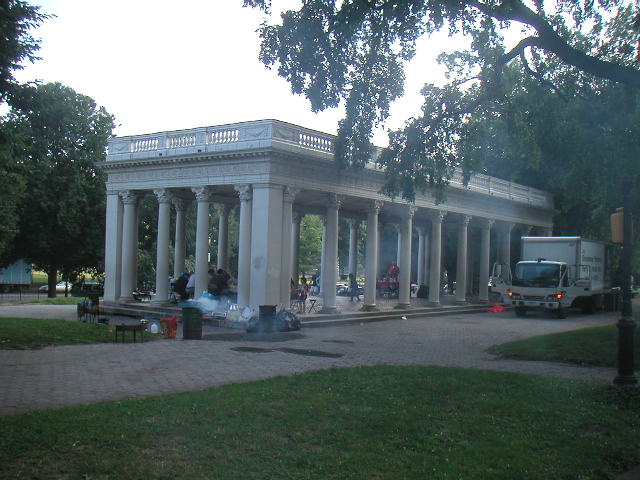
|
|||||||||||||||||||||||||||||||||||||||||||||||||||||||||||||||||||||||
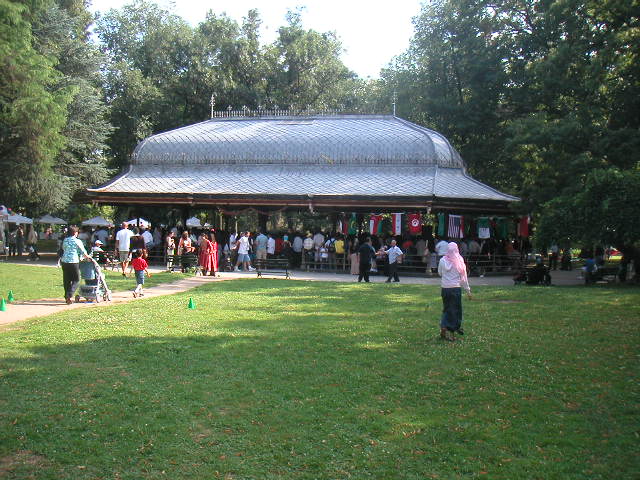
|
|||||||||||||||||||||||||||||||||||||||||||||||||||||||||||||||||||||||
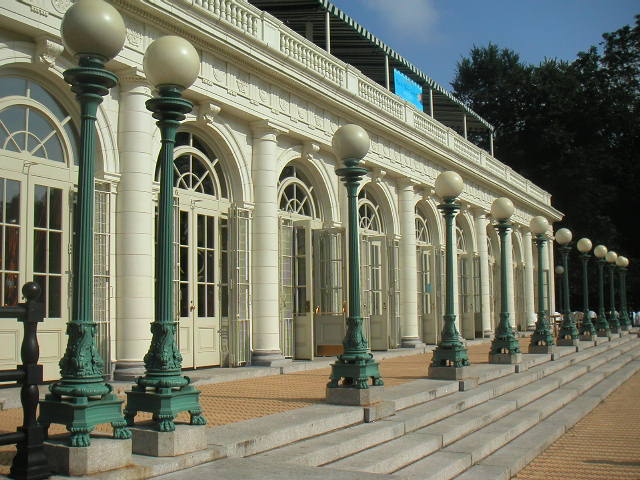
|
|||||||||||||||||||||||||||||||||||||||||||||||||||||||||||||||||||||||
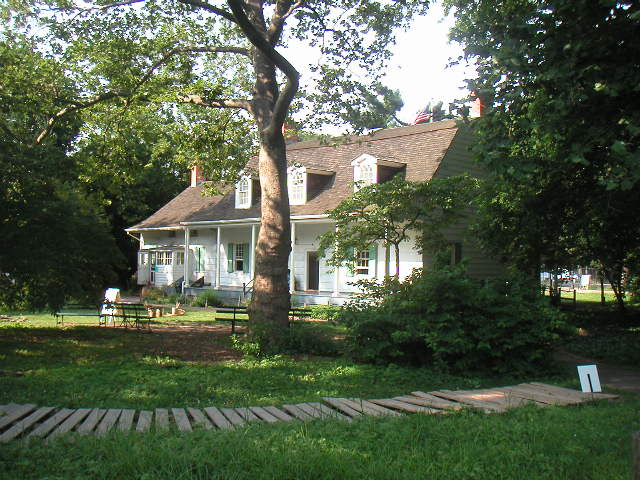
|
|||||||||||||||||||||||||||||||||||||||||||||||||||||||||||||||||||||||
|
links |
Prospect Park Alliance
Maps of Prospect Park html, flash & pdf Transportation Alternatives Car-Free Prospect Park Campaign gallery of photographs Air visit of prospect park in Photographs Brooklyn Road Runners Club: Running resources in and around Prospect Park, training for fun, races and the marathon Prospect Park Track Club - the oldest running club in the neighborhoods around the park AM New York: Full series including maps, history, virtual tours, movies, and photos. 1870 – 1880 views of Prospect Park, from the Robert N. Dennis collection of stereoscopic views, New York Public Library Prospect Park (Brooklyn) is at coordinates 40°39′41″N 73°58′13″W / 40.661433679519966, -73.97034645080566Coordinates: 40°39′41″N 73°58′13″W / 40.661433679519966, -73.97034645080566 Prospect Park at ontheinside.info Prospect Park by Clay Lancaster from "New York Architecture Images-Brooklyn" Recreational Fishing In Urban NYC Parks-Prospect Park |
||||||||||||||||||||||||||||||||||||||||||||||||||||||||||||||||||||||