|
|

 |
|
|
|
|
 |
New York
Architecture Images-Greenwich Village 19-26 Washington Square North |
|
architect |
|
|
location |
19-26 Washington Square North |
|
date |
1829-39 |
|
style |
Greek Revival |
|
construction |
brick |
|
type |
row Houses |
|
|
  |
|
images |
 |
|
In the 1840s, New York's elite established
Washington Square, far from the increasingly commercial environment of
downtown, as the address of choice. Anchored by the mansion of William
C. Rhinelander at the center of Washington Square North, "the Row" of
Greek Revival town houses on either side of Fifth Avenue presented the
unified and dignified appearance of privilege. When the epicenter of New
York society moved north after the Civil War, the houses on the square
came to represent the gentility of a bygone age. Henry James, whose
grandmother lived at 18 Washington Square North, brilliantly depictedly
this nostalgic view in his 1881 novel, Washington Square.
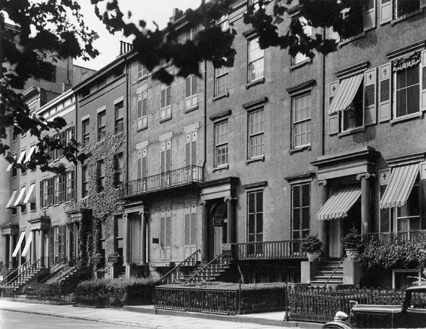
By the time Abbott photographed the venerable houses at the northwest corner of the Square, Old New York's foothold was slipping. Although not built until 1952, an apartment house was planned in 1929 for the Rhinelander properties, east of nos. 21-26, and shortly after Abbott's photograph, nos. 7-13 were gutted and renovated as apartments. The photograph documented the beauty of the old facades but also revealed incipient change. Nos. 22 and 23 (center) were shuttered with "for sale" signs affixed to them. At the west end of the block (left) was the 16-story Richmond Hill Apartments. The leaves of a tree in Washington Square Park, softly framing the left and top edges of the photograph, give a romantic air to this otherwise sharp-focused view of fading elegance. These houses now belong to New York University and conform to the stringent requirements of landmark regulations: awnings, such as those captured by Abbott, have been removed, and window air conditioners are forbidden. Special thanks to the Museum of New York, www.mcny.org |
|
|
This Federal-style home
was the first house to be built on the north side of the Washington
Parade Ground. The original structure, built in 1828 - 29 was widened in
1859, and had a fourth story added in 1880. The "Flemish Bond" brickwork
is a sign of the Federal style of construction: laying the bricks with
the ends and sides alternating to the front. This was thought to be the
only way to tie the expansive face brick to the interior bricks in the
customary twelve-inch thick walls. "Running Bond" became the practice by
the mid-nineteenth century. The Greek Revival style houses at Nos. 21-26 are what remains of a group of houses built for the social elite of the Village in the 1830s. Along with a group of houses down the road, on the other side of Fifth Avenue, they are know as "the Row". Henry James's novel Washington Square, written in 1881, had it's setting in his grandmother's house, the since demolished No. 18. |
|


