|
| |
 |
New York Architecture
Images- Lower Manhattan
WEST STREET BLDG (Formely COAL &
IRON BLDG or RAILROAD & IRON BLDG) Landmark
|
|
architect
|
Cass Gilbert |
|
location
|
90
WEST STREET |
|
date
|
1905-1907 |
|
style
|
Skyscraper
Gothic |
|
construction
|
steel structure, terra-cotta,
99,0m / 325.7ft, 23 floors
The 24-storey building has a base of
limestone facing, a vertically accentuated main facade and a top of with
terra-cotta decor. The latter is extensively sculpted in Gothic themes
above a terminal point of arcaded windows. To enhance the effect of the
decor, the top floors of the building are illuminated at night.
|
|
type
|
Office Building |
|
|
  |
|
|
  |
|
|
 |
|
|
  |
|
images
|
     |
|
|
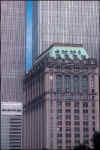
The West Street Bldg is the most successful expression of the Skyscraper Gothic, minus the Woolworth Bldg of the same talented architect Cass Gilbert, and built six years later, the first one being used as a small prototype for the second one. Lavishly adorned with french and belgian gothic ornementation, the West Street Bldg immediatly attracted
very favorable attention. Built in an area primarily devoted to transportation business, it is mainly set with expressive vertical fluted piers (seen in embryo on the shaft of the Times Bldg) upon an arcade base treatment ala Trinity Bldg, supporting a beautifully detailed multi-arcade part, finally topped by a mansarded, dormered and pinnacled six-story crown. The building is not a single trapezoidal mass, but is indented on the north side. It is interesting to know that the abstract mansard top of Cesar Pelli's One World Financial Center is a deliberate echo of the top of the West Street Bldg. On September 11th 2001, the building was seriously damaged (fire and terra-cotta failure) by the Twin Towers collapse. I hope this pure marvel will soon be repaired. |
|
|
By Barbara Veith
Enshrouded in scaffolding
and protective black netting, the 23-story Cass Gilbert skyscraper at 90
West Street stands at the southwest corner of Ground Zero, a silent
witness to the tragic events that took place on September 11, 2001 .
Built between 1905-1907,
the landmark granite and terra-cotta-sheathed steel structure sustained
massive damage when the World Trade Center's south tower collapsed.
Falling debris raked the north side of the West Street building, damaging
several large sections of the façade, piercing walls and igniting fires
on 14 floors that raged for two days. Nearly 1,000 people were safely
evacuated from the building, but tragically two perished while trapped in
an elevator. Fortunately, the building's steel skeleton and thick
terra-cotta fireproofing helped to contain the fires. Although much of the
building was gutted and the electrical and mechanical systems as well as
the copper roof were completely destroyed, some floors remained intact.
During the weeks following September 11, while the building was
structurally stabilized and weatherproofed, workers were able to salvage
some documents from the offices. It will cost between $50- to $100-million
dollars to restore the building, reported The New York Times on February
12, 2002.

Current view of 90 West Street's façade and mansard roof |
Architect Cass
Gilbert (1859-1934) was a driving force behind the development of
the skyscraper in lower Manhattan. Early in his career, he trained
at M.I.T., traveled in Europe and moved to New York City for a
year to work as a draftsman for McKim, Mead, and White. He then
moved to Minnesota, where he established his career, but later
returned to New York City after winning the competition to design
the United States Custom House (1899-1907) at Bowling Green in
1899. The Custom House is one of seven buildings designed by him
that shape the cityscape of downtown New York today.
|
Stylistically and
chronologically, the 23-story 90 West Street bridges the gap between
Gilbert's 18-story classically embellished Broadway Chambers edifice
(1899-1900) and his neo-Gothic 57-floor skyscraper, the Woolworth Building
(1910-1913). The West Street building, commissioned by General Howard
Carroll as a dockside commercial building for the shipping trade, was
Gilbert's first skyscraper. His design emulates the tripartite division of
a column, the 12-story shaft soaring upward from its base to a
capital-like mansard roof embellished with ornate neo-Gothic details.
Originally the upper floors housed an early counterpart of Windows on the
World, the Garret Restaurant, then the world's highest.
With the full support of
the present owners, the West Street building was granted individual
landmark status on May 19, 1998. In February 2000, the owners applied to
the Landmarks Preservation Commission to initiate a multi-million dollar
restoration project to restore the façades, repair ornamental stone,
terra-cotta and metalwork and scrupulously repoint the building and
restore the copper mansard roof. Sadly, at the time of the terrorist
attacks the work was over 90% completed and the building was fully rented
out. In June 2002, Diane Jackier, director of community and government
affairs at the Landmarks Preservation Commission, reported that the debris
from the twin towers was still being cleared from the building. Once this
phase is completed, the restoration of Gilbert's architectural landmark
should begin anew. |
|
notes
|
WEST
STREET BUILDING, 90 West Street and 140 Cedar Street (aka 87-95 West
Street, 21-25 Albany Street, and 136-140 Cedar Street), Manhattan. Built
1905-07; architect, Cass Gilbert.
Landmarks Preservation Commission.
Designated April 14, 1998; LP-1984
Summary
The West Street Building, one of three
major Downtown office buildings designed by Cass Gilbert, was built in
1905-07 for the West Street Improvement Corporation, a partnership headed
by Howard Carroll. Carroll was president of two asphalt companies and
vice-president of his father-in-law's Starin Transportation Company, which
had major river shipping interests. Although today separated from the
Hudson River by the landfill supporting Battery Park City, the site of the
West Street Building originally had a highly visible location facing the
waterfront along West Street. Carroll conceived of his project as a
first-class skyscraper office building for the shipping and railroad
industries. In addition to Carroll's companies, the building soon filled
up with tenants including major companies in the transportation industry.
The building's top floor was occupied by "The Garret
Restaurant," which advertised itself as the highest restaurant in New
York and boasted of its panoramic river and city views. Cass Gilbert was
one of the most prominent architects in New York in the first decade of
the twentieth century. His succession of early skyscrapers helped pave the
way for the great romantic skyscraper towers of the 1920s and beyond. His
West Street Building may be considered transitional from the
"base-shaft-capital" arrangement of the late-nineteenth-century
office buildings conceived as analogous to a classical column -- and
perhaps best epitomized by his own design for the Broadway-Chambers
Building -- to the romantic tower exemplified by his design for the
Woolworth Building. While the West Street Building is tripartite in
configuration, its upper floors are a romantic mansarded design. The
building's Gothic vocabulary is an early instance of its use in American
skyscraper design, anticipating the Woolworth Building. The clustered
piers in the tower's middle section anticipate the verticality stressed in
later skyscraper design. The West Street Building was one of many office
buildings erected in lower Manhattan during the first decade following the
consolidation of the City of Greater New York, but its handsome design set
it apart, and it won widespread critical acclaim. Today, its exterior
survives largely intact, and the building remains in commercial office
use.
STILL THERE... A Landmark & Its People
Survive. 90 West St., NY, NY.
Published soon after the WTC collapse,
this article concluded that there had been no loss of life at 90 West
Street. A reader responds with details which, sadly, don't support that
assertion and shares a brief, moving account of what it means to be a part
of the surviving community. Scroll to the bottom of this article for the
letter.
By Mike Edison of Edison
Coatings.
Member of the Restoration Trades Exchange.
Republished from the Autumn issue of Edison Coatings Update. Photo
courtesy of Edison Coatings.

(Photo courtesy of Edison Coatings.)
|
Horror, sadness and rage were shared by
civilized people around the world in reaction to the attacks on America of
September 11. But there have also been stirring images of heroism, honor
and determination, as New York City rolled up its sleeves, and went about
the business of recovery, cleaning up and preparing to rebuild. It makes
us proud to be Americans, and gives us all cause for great hope. When
things were at their worst, New York City showed us America at its very
best.
Many of us have connections to people
directly affected by the events of 9/11. For us, one connection involved
90 West Street, the Landmark terra cotta building pictured here, in the
foreground, against its former neighbors. The building was fully
scaffolded and was in the process of being restored with Edison products
at the time of the attacks.
In the wake of disaster, with phones down
and images of smoke and destruction being broadcast, we waited to learn
the fate of the people restoring the building. Three days later we got the
good news: Everyone was OK.
The building was heavily damaged. Several
holes were blown through one side. A section of the parapet fell 25
stories to the street. Six fires were extinguished by New York City
firefighters. But the 90-year-old Landmark remains structurally sound, and
soon its restoration will begin anew.
The events of 9/11 remind us that it takes
far greater dedication to preserve than to destroy. The preservation of
our Landmarks for generations to come is an act of faith, connecting the
achievements of the past with the promise of the future. We have been
attacked, and we have suffered losses. But like 90 West Street, we remain
strong at our core, we will endure, and we will go forward.
ADDENDUM: LETTER FROM 90 WEST STREET
To the Editor:
A friend e-mailed me your article on 90
West Street - a building we both used to work in. I just wanted to inform
you of a correction. Two people died in an elevator at 90 West - where the
article states "Everyone was OK". After the first plane hit, 90
West lost power. Unfortunately, only one elevator was inoperative - the
elevator with the people inside. Close friends of mine (employees of
Cushman & Wakefield), were the last to speak to [name deleted to
protect victim's privacy] alive. I'm told, after all was over, it took
firemen over three hours to get to them in the elevator. No one even knew
he was not alone until the firemen were able to gain access to the car. I
don't know the other person's name, but I'm told it was a young girl. They
both died of smoke inhalation.
But 90 West was not just a place where I
worked, it was a place where I met my best and closest friends. We
naturally were in the Trade Center every day - for lunch, shopping and
transportation. Although countless people were affected, it was like our
neighborhood. Now, a year later, I still haven't been down there. At first
I was seeking closure, but decided my mental images, my memories, were the
ones I wanted to keep.
Tom Arezzi |
|
contact
|
nyc-architecture.com
|
| |
|
|