|
|

 |
|
|
|
|
 |
New York
Architecture Images- Midtown 312 and 314 East 53rd Street Landmark |
|
architect |
Robert & James Cunningham, Builders. |
|
location |
312 and 314
East 53rd
Street |
|
date |
1866 |
|
style |
Second Empire Baroque |
|
construction |
wood frame |
|
type |
House |
|
|
|
|
images |
 |
|
|
|
|
notes |
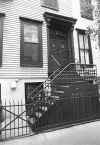
Landmarks Preservation Commission. Designated May 16, 2000; LP-2071
Summary The 314 East 53rd Street House, located on the south side of 53rd Street between First and Second Avenues, was constructed in 1866. It was built, along with its identical neighbor at 312 East 53rd Street, by Robert and James Cunningham, who were listed in directories as builders-carpenters. This small rowhouse is a significant remaining example of the wooden vernacular buildings once constructed throughout Manhattan. The 314 East 53rd Street house was one of the last wood-frame buildings constructed in the neighborhood and is a rare example of a wooden building above 23rd Street. Later in 1866, New York City fire laws prohibited the construction of wood-frame buildings in this neighborhood and many existing wooden buildings were subsequently demolished and replaced by masonry structures. Covered in clapboards, the building is two bays wide and two stories high above a brick basement. The mansard roof, dormers, bracketed wooden cornice and door hood, and molded window enframements on double-hung sash windows distinguish this house as a rare vernacular wooden building with Second Empire and Italianate details. Into the Woods Banned by the city, wood-frame houses have left Geraldo's ex, Edmund Wilson, and Fort Greene buppies burning with desire. Nineteenth-century Manhattan got hit with a Great Fire every decade or so: In 1835 alone, twenty blocks went up in smoke. Gradually, the city banned new wooden houses, replacing the tinderboxes with brownstones. In 1871, the city's inspector of buildings declared that wood homes "retard the progress of better improvements . . . and increase immeasurably the fire risks of a city." Tell that to C. C. Dyer, Geraldo Rivera's ex. After their split, she paid $6.8 million for the 1866 building at 128 East 93rd Street, one of only four clapboard houses on the Upper East Side and just eight between 23rd Street and Harlem. The Village has about two dozen, all but two retrofitted with brick façades. Dyer's 5,000-square-foot spread last sold in 1989 for just under $2.6 million but has since been restored. William B. May's Suzanne Sealy sold one at 122 East 92nd Street in 1994 for $1.2 million; 124, next door, sold for the same amount in 1996. The woodies at 312 and 314 East 53rd Street, once the homes of Lincoln Kirstein and Edmund Wilson, respectively, date to 1866. This summer, 314 survived Harry Macklowe's attempt to raze it for an apartment tower. "I used to get, 'No frame, no frame,' " says Eva Daniels, whose eponymous firm sells in clapboard-heavy Fort Greene, Brooklyn. But fire fear has receded -- she recently sold a "really quaint" 1847 wood house on Adelphi Street for $390,000: "I tell people I've seen more fires in brownstones." And though one broker remembers a deal
falling through for a wooden house because the buyers couldn't get fire
insurance, Darren Cohen of insurance agents Hiram Cohen & Son says as
long as the electrical and roof have been updated in the past ten to
fifteen years, a wood house is insurable, though "the rate might not be
as competitive as for a regular brownstone." No house can be insured
against termites, he adds. |
|
Turtle Bay: A Touch of Class BY CLAUDETTE AND BOB BLUMENSON Turtle Bay, a microcosm of New York City, contains all sorts of buildings from tenements to luxury coops and condos, as well as elegant brownstones. Its office buildings range from architectural wonders to ultra-modern glass buildings. There are several architectural
masterpieces in Turtle Bay. The Beekman Hotel , an art deco edifice
built in 1928, which recently received Landmark status, stands at 49th
Street and First Avenue. At its top is the restaurant and lounge, Top of
the Tower, which affords a spectacular view of the river and the
skyline. Within and above the Romanesque Revival building on the northwest corner of 51st Street and First Avenue (931 First Avenue), a 19-story apartment tower is being built in a renovation that will save the 1892 façade (see Of Note, p. 4). The best known is the Chrysler Building at Lexington and 43rd Street. As this building was nearing completion the architects pulled a bit of deception on the builders of 40 Wall Street, which was being built at the same time. When the Chrysler Building reached a height of 925 feet, the architects led the public to believe this was the maximum height. The builders of 40 Wall did not stop at 925 feet, but added another two feet to make sure theirs was the tallest building in the world. The architects of the Chrysler Building had secretly assembled a tall stainless-steel spire, which they raised through the top of the building and bolted in place. This added 123 feet to the building, making it, at the time, the tallest in the world. One of Turtle Bay's interesting luxury apartment buildings, Riverhouse at 437 East 52nd St., was built in 1931. It has a panoramic view of the East River, tennis and squash courts, a swimming pool, and a ballroom. At one time there was a private dock for the convenience of visiting yachts. Tudor City, a cluster of 1920s apartment
buildings in Tudor style built on abutments over First Avenue and United
Nations Plaza, boasts two parks. The enclave called Turtle Bay Gardens
comprises eleven townhouses on the south side of 49th Street and nine on
the north side of 48th Street, midblock between Second and Third
Avenues. New York socialite Charlotte Hunnewell Martin purchased the
structures in 1918 and within two years she had renovated the houses and
arranged the gardens so that each leads to a common 12-foot-wide path
down the center. Mrs. Martin then sold the houses to friends at cost.
Celebrity residents have included actors Katharine Hepburn and Tyrone
Power, composer Stephen Sondheim, jurist Learned Hand, conductor Leopold
Stokowski, Maria Bowen Chapin (founder of the Chapin School), publishing
personalities Maxwell Perkins, Henry Luce, DorothyThompson, and E. B.
White, who wrote about the neighborhood for The New Yorker. White also
wrote Charlotte's Web while living on 48th Street. Although not part of
Turtle Bay Gardens, 211 East 48th Street is a townhouse designed by the
famous architect William Lescaze as his own residence and office. It is
credited as the first modern town house in New York City. Other well-known figures who have made their homes in Turtle Bay include: Truman Capote, Johnny Carson, Walter Cronkite, Mary Lasker, Mary Martin, John O'Hara, Maxwell Perkins, Edgar Allan Poe, Andre Soltner, John Steinbeck, Kurt Vonnegut, and Thomas Wolfe. The house at 225-227 East 49th Street, built in 1926, was home to Efrem Zimbalist, renowned violinist, and his equally celebrated wife, the opera star Elma Gluck. It served as the 17th Precinct Station House in the fifties, and was later divided into apartments. A violin is carved over the door as well as a singing angel. The east side of First Avenue between 51st and 53rd Streets has hardly changed since the area was developed in the 1860s and 70s. Numbers 312 and 314 East 53rd Street are a pair of wooden townhouses, built in 1866 in the style of the French Second Empire. Number 312 has been designated a landmark, but Number 314 was denied landmark status because it now has aluminum shutters instead of the original wooden slats. The neighborhood has several parks where the public can unwind. Dag Hammarskjold Plaza Park, at 47th Street between Second and First Avenues, has become the jewel of Turtle Bay. Its latticed-domed pavillion housed the Turtle Bay Association's beautiful Christmas tree during the holidays and the park was host to the TBA cider and caroling party. The lighted fountains lend a fairyland quality at night. Also in the park: the Katharine Hepburn Garden; the "glass house," which will offer light refreshments; and possibly, come spring, a green market. Opened in August of 1999, Dag Hammarskjold Plaza Park is the gateway to the United Nations, its Secretariat, and the institution's parks and statues. Peter Detmold Park, at the eastern-most end of 51st Street, contains gardens, a dog run, and a footbridge that crosses over the East River Drive. On 49th Street just off the Drive is MacArthur playground, which is greatly enjoyed by the growing population of Turtle Bay's younger inhabitants (see story, p. 4). Between Second and Third Avenues on 51st Street is a small oasis called Greenacre Park. Standing next to the Sutton Place Synagogue, which serves the United Nations, it is one of the most used public open spaces in Manhattan. Another vest-pocket park, the James P. Grant Plaza, sits on 44th Street between Second and First Avenues. This ultra-urban area began life as Deutal Bay Farm (which surrounded a cove shaped like a bent knife blade ("deutal" in Dutch). The farm's cove was home to many turtles and the name Turtle Bay emerged. Although residents no longer feast on turtles from the bay, which fell victim to landfill in 1868, they can always avail themselves of the many fine restaurants in the neighborhood. Claudette and Bob Blumenson moved to Turtle Bay in January, 1999. Their curiosity about the neighborhood led to this article and they now say "We have moved into a truly remarkable area of New York City."
|
|


