|
notes
|
Sorry, Old Boy, the Mayor Says 'No Smoking'
By WARREN
ST. JOHN
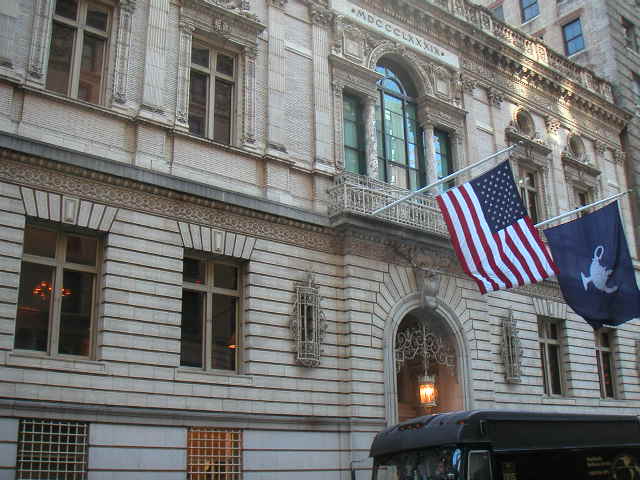
THEY are as much a part
of Manhattan's old private clubs as leather chairs, billiard tables and
investment bankers named Winthrop: oak-paneled bars, befogged with cigar
smoke.
The oak bars will remain, but as of today,
the last acrid skeins of cigar smoke are dissipating into the
chandeliers and settling onto the velvet draperies and dark red
Scalamandré fabrics of men's lounges in the city's mustiest old clubs.
The city council's smoking ban, an effort to protect employees from
second-hand smoke, has kicked in, and to the dismay of many members of
those clubs, the law applies to cigars — and it applies to them.
"The attitude at every place I know is that
this is the most asinine law they've ever heard of," said Michael M.
Thomas, a writer and a member of the Racquet and Tennis Club, on Park
Avenue. "I know of no more detested law than this."
Mr. Thomas doesn't even smoke cigars, but
that's beside the point, club members say. The basic premise of clubs is
that members should be able to go to their clubhouses and do as they
please, which should at least include the option of lazing in a big club
chair with a highball of single-malt scotch and a stinky cigar in hand.
Having that option taken away without so much as a vote from the house
committee, well, it's just very un-club-like. Steven T. Florio, the
chief executive of Condé Nast Publications, a member of the New York
Yacht Club and a man known for his love of cigars, actually quit smoking
four months ago, but that hasn't changed his opinion of the law.
"This is way over the line," he said. "If
you're a member of any private club and they have a designated area
where you can smoke a cigar, I think that should be allowed. It's one of
those nice things you can do with your buddies."
Part of the dismay over the cigar ban among
some club members comes from the fact that it has been championed by one
of those buddies — Michael R. Bloomberg. Until he became mayor, and
standard bearer for the stogie police, Mr. Bloomberg was on the inside.
In 2001, just before embarking on his mayoral campaign, Mr. Bloomberg
resigned from four clubs — the Harmonie; the Century Country Club in
Purchase, N.Y.; the Brook Club; and the Racquet and Tennis Club — but he
kept memberships at 10 others, including the New York Yacht Club and the
Harvard Club, both of which are now subject to the cigar ban. (Back in
1998, Mr. Bloomberg, then merely a mogul and not a politician, took a
more laid-back approach to the issue, holding his daughter's 16th
birthday at a joint called the City Wine and Cigar Company.) The cigar
ban hasn't endeared the mayor to his fellow club members.
"I was a little shocked that with
everything that's happening in New York City that the mayor has decided
that this is how he'll be remembered," Mr. Florio said. "It really,
really makes me miss Rudy."
Part of the members' frustration surely
also stems from the fact that the law — all 21 pages of it — doesn't
give the clubs much wiggle room. The law bans smoking "in all enclosed
areas within public places," and among the definition of public places,
it lists, explicitly, "membership associations," or clubs. Even covered
outdoor spaces of clubs are off limits to smokers. So while it's legal
to smoke a cigar on the terrace of the Knickerbocker Club on Fifth
Avenue, which is open to the heavens, it is illegal to puff on the loge
of the Racquet and Tennis Club, which is recessed into the building, and
therefore, technically, covered.
Cigar smoking is a touchy subject for
members of many private clubs. In 1998, federal agents arrested a
manager of the Racquet and Tennis Club under the Trading With the Enemy
Act, for having Cuban cigars in the on-premises humidor. After that
incident, which was splashed across the pages of the city's tabloids,
members of exclusive clubs learned that in a pinch they could not count
on sympathy from the very public they were excluding. So in the spirit
of good citizenship, most clubs are quick to report that they plan to
comply with the law.
"It doesn't allow smoking in the
clubhouse," said Winthrop Rutherford, the president of the Racquet and
Tennis Club. "So no smoking in the clubhouse."
There are a few narrow exceptions, though. One is for clubs
that have no employees — which gave some members of the Union Club, on
East 69th Street, an idea: why not create a special class of membership
for the employees, to get around the law? When other members raised the
specter of busboys on the squash courts, the idea was quickly scrapped.
Another option seemed to be the creation of
a single room for smoking, legal so long as it was sealed off from the
rest of the club, vented outdoors and off-limits to employees. The idea
of a hermetically sealed smoker's tank had its downsides — it's
expensive to build, unsightly and, since no employees could enter the
room, members would have to pick up after themselves. But that option
was taken away on March 26, when Gov. George E. Pataki signed an even
tougher state law banning smoking in public places. The tougher law goes
into effect in just under four months. That's too bad for the Century
Association on West 43rd Street, which recently spent around $10,000 on
duct work to create a smokers' room for its cigar puffers. The room will
soon be obsolete.
"What must be, must be," said Louis
Auchincloss, the novelist and the president of the Century Association.
The Brook Club, on East 54th Street,
recently held a final smoke-out. After toying with letting in the
rabble, the Union Club has given up its search for loopholes. The
Harvard Club, which designated part of its downstairs lounge for cigar
smoking — the area roughly from the oil portrait of President Theodore
Roosevelt 40 feet to the head of an elephant mounted on the wall —
doesn't see a way around the law and will ban smoking.
But what about all those humidors and
private cigar lockers? Most clubs haven't figured out what to do with
those yet. Charles H. Townsend, the chief operating officer of Condé
Nast and the rear commodore of the New York Yacht Club, recently donated
a humidor to the club, "with a brass plaque and everything," he said.
"I don't know whether I get it back," Mr.
Townsend said. "I'm not going to go over there and snatch it."
A good, well-sealed humidor might be
exactly what Mr. Townsend and his cigar-smoking buddies need to keep
their stogies fresh until the anti-smoking fervor subsides. At least, he
said, that's the hope.
"The tide goes in and the tide goes out,"
Mr. Townsend said. "Who knows how long this regulation is going to be
around?"
nyt
|