|
|

 |
|
|
|
|
 |
New York
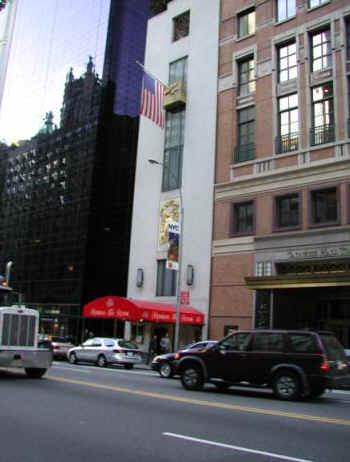
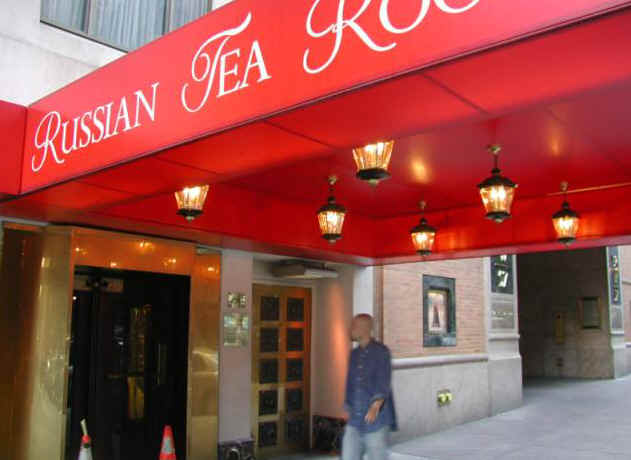
Architecture Images- Midtown Russian Tea Room |
|
architect |
facade 1873, John G. Prague, altered 1927 and 2000, Harma, Jablin Architects. |
|
location |
150 W57, bet. Sixth and Seventh Aves. |
|
date |
1873 |
|
style |
Art Deco |
|
construction |
|
|
type |
Restaurant |
|
|
 |
|
images |
  |
|
|
 |
|
notes |
A Great New York Landmark Dies Again
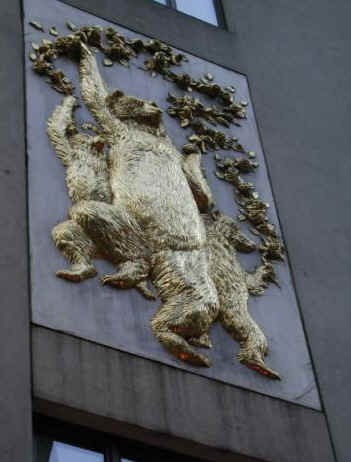
The Russian Tea Room closed yesterday, but Warner LeRoy killed it a long time ago. I'm mourning because it's like a double death. It was bad enough when LeRoy — who bought the place from Faith Stewart Gordon — shut down the Russian Tea Room at the end of December 1995. I was there for lunch on the last Friday it was served and sat in one of the miniature front booths across from the bar with my old pal, Mara Buxbaum. It was a bittersweet afternoon. Ona, the no-nonsense Oprah-like hostess who ran that room with military skill and precision, was hugging everyone who came in. Sydney Pollack, Tony Randall, Sam Cohn — it was the end of an era, and everyone knew it. No one had any expectation of the place being revived. LeRoy, who is now dead, promised a spectacular new Russian Tea Room when he brought it back. In the four-year interval, he also promised that David Bouley, the famed downtown chef, would take over the new room. That, like many other pie-in-the-sky LeRoy plans, fell apart. Then, when LeRoy did reopen, the results were simply horrifying. The main dining room on the ground floor was like a shopping mall version of the original. All the beautiful sconces and paintings, the old fashioned red wallpaper and banquets were gone. There was a gigantic Lucite bear filled with live goldfish standing on a platform on the second floor. The décor on the same floor and the one above could only be described as nausea-inducing. No matter how much you might have loved Warner LeRoy, he killed the Russian Tea Room — and he did it years ago. But oh, the old, real Russian Tea Room was so great at lunchtime. Theater, movie and book agents all chowed down together. Producers — names that appeared in the credits for good productions — dotted the room. Famous people swept in and became instant royalty. There was a sense as you gave your coat in on the left and queued up at the maitre d's stand that many important things might happen while you had your blinis with caviar, omelette or Borscht. At the time of the Tea Room's last great run in the 80s, the old Le Cirque was also a happening spot — but for society types, and it was quite small. The Four Seasons had the power lunch in the Grill Room. '21' was for moguls. But the RTR was show business. (You could see the almost comparable group much later, at dinner at Elaine's.) You might not make a billion dollar deal at the RTR, but you'd come away with a great story. One of the best came from the legendary press agent, John Springer. John had represented all the best actors, and knew everyone important in the business. He was surprised one afternoon to find director/producer Sydney Pollack lunching with Dustin Hoffman's wife and another more middle-aged woman. Of course, the woman turned out to be Hoffman himself, trying out his Tootsie costume. A similar scene would later be famously filmed for the movie at the Tea Room, putting the eatery on the map forever. Maybe it was an apocryphal story, but the Tootsie anecdote became a legend overnight. Back when I interviewed John Springer at the Tea Room circa 1993, we were briefly interrupted. Helen Gurley Brown, the elegant editor of Cosmopolitan magazine and wife of producer David Brown, stopped by our table. John introduced us, and Helen — not realizing that I'd been to the restaurant hundreds of times — still wanted to be gracious. She sort of curtseyed, and said, extending her hand: "Welcome to our world." It felt as though I'd been knighted. And so it's gone now, like the Stork Club and El Morocco, the Latin Quarter and Schrafft's, the Automats and the old Hamburger Train on West 54th St., Bickford's and Lamston's and dozens of other New York institutions. You can only imagine what hideous drug store or suburban clothing chain will take over the space next to Carnegie Hall. The beautiful women in great clothes and heavy French perfume, the agents working the tables and making approaches to the power booths that lined the room — all vanished forever. We used to say, 'What's with this food?' and 'Where did they get that painting? That can't be real.' But it was all part of the ambience of that world, and we'll never forget it.
Judy Collins 7/29/02 I am writing this the morning after my last dinner at the Russian Tea Room, the restaurant The New York Times called "that preserve of infused vodka, glinting caviar and buttery blini." For forty years I called the Russian Tea room a home away from home, eating and celebrating in its glorious, painting-filled, elegant, samavor-studded, red, gold, light-filled palace, an ante-room to all the glamour and gifts, sizzle and pulse, art, intelligence and determination of this great city, my home for the same forty years I have reveled in its golden rooms. Except for the four years it was closed for renovations, I was faithful to the food, the people, and the golden samovars of the Russian Tea room. My Russian Tea Room celebrations started in 1962 after my very first performance at Carnegie Hall, the famed next-door-neighbor to the Tea Room, a few steps to the right from the brilliant red awning. After that first Carnegie concert, when I was the guest of Theo Bikel, actor and singer, there were dozens of post-Carnegie parties at the Tea Room, where the conversation, the celebrities and the vodka flowed late into the night. I took my mother and father to the Tea Room
on their first trip to the city in 1962. I often ate lunch there, and
usually saw Sam Cohen at his special front table, when I dined with
record producers, managers, and other friends. The glorious spot was the
place to go-for a date, for a hoot, for a lift. My husband Louis's first
Tea Room meal, 24 years ago, was take-out, their famous pre-Warner LeRoy
Lamb Karski, bulgar wheat and a Caesar salad served up in a plastic
plate covered with foil, in a Russian Tea Room shopping bag, and taken
home after my own meal to my new lover, who was working late.
Russian Tea Room sold for $16 million -
United States Gold Association makes purchase
Real Estate Weekly, Dec 11, 2002 The world famous Russian Tea Room at 150 West 57th St., frequented for years by VIPs and celebrities, has been sold for $16 million to the United States Golf Association (USGA). The Association plans to re-configure the property as a dining room and museum in which to showcase its extensive collection of golf memorabila. Richard Baxter and Yoron Cohen of Insignia/ESG's Capital Advisors Group arranged the high-profile transaction. The Russian Tea Room has garnered a flurry of media attention over the past ten years from its original sale to the late Warner Leroy, the $32 million renovation, grand reopening and eventual closing and bankruptcy filing following his death. The $32 million renovation, included the new construction of a 4-story building with approximately 26,000 SF running through the block from 56th to 57th Street just east of Seventh Avenue. The building was designed and finished to the elaborate specifications of Leroy, and included extraordinary ceiling heights, several state of the art kitchens, and elaborate decor to mimic turn of the century St. Petersburg. Leroy's business ventures include the country's most successful restaurant, Tavern on the Green, and he had hoped to bring the same success to the Russian Tea Room. Unfortunately, Leroys failing health and eventual demise, the decline in restaurant revenue caused by the economy and Sept. 11 and the debt service to cover the costs of construction, crippled operations at the Russian Tea Room and resulted in the bankruptcy filing in the summer of 2002. Subsequently, at the direction of bankruptcy counsel Squire Sanders, Alan Garmise, the president of Leroy Ventures, interviewed a number of Manhattan commercial brokerage firms in order to select an agent to sell 150 W. 57th St. While interviewing the various brokers, Garmise and counsel stressed the need to find a qualified buyer who could adhere to the stringent requirements of the bankruptcy proceedings which would be required to close the deal. Attorneys Andrew Jagoda and Jordan Kroop of Squire Sanders represented the sellers, and the buyer was represented by Marc Abrams of Wilke Farr & Gallagher. |


