|
|

 |
|
|
|
|
 |
New York
Architecture Images-Seaport and Civic Center New York County Courthouse Landmark |
|
architect |
John Kellum |
|
location |
52 Chambers St. |
|
date |
1861-1881 |
|
style |
Neo-Classicism 2 |
|
construction |
limestone |
|
type |
Government Courthouse |
 |
|
|
|
  |
|
|
 |
  |
|
  |
|
  |
|
  |
|
  |
|
|
notes |
"Tweed Courthouse" is located on the north side of City Hall Park, behind City Hall, on Chambers Street. This building was designed and built for use as the New York County Courthouse. According to the Guide to New York City Landmarks, it was New York City's second permanent government building, following the 1811 City Hall. At the time, the north end of City Hall Park was crowded with buildings, and a large almshouse was demolished to make room for this courthouse. It took 20 years to build,
from 1861 to 1881, with the Civil War and political corruption
contributing to delays, and is estimated to have cost between $11
million and $12 million. Political boss William Marcy Tweed and his
"Tweed Ring" used the construction of the courthouse to embezzle large
sums of money. The longer construction went on, the more money they
took. After the Tweed Ring was broken up, work stopped on the building
from 1872 to 1876. Tweed was tried in 1873 in an unfinished courtroom in
his own County
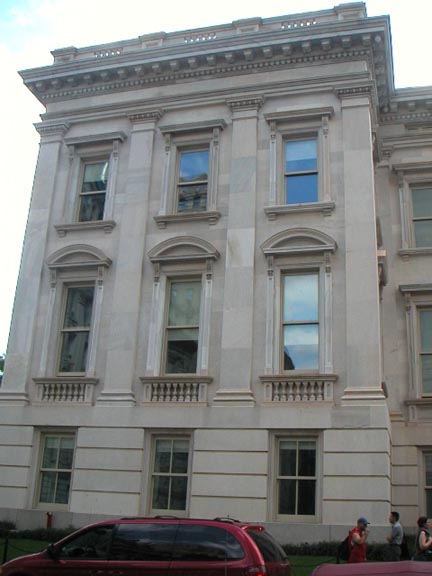
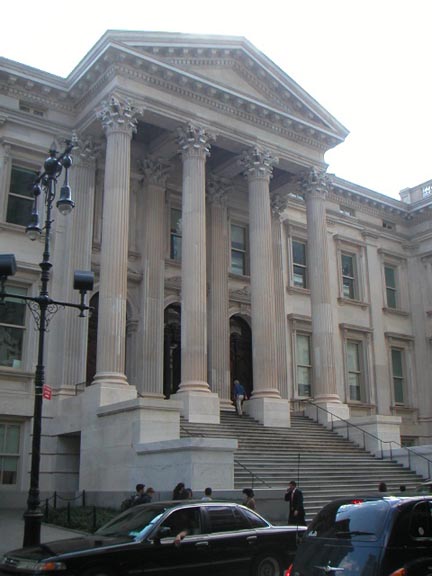
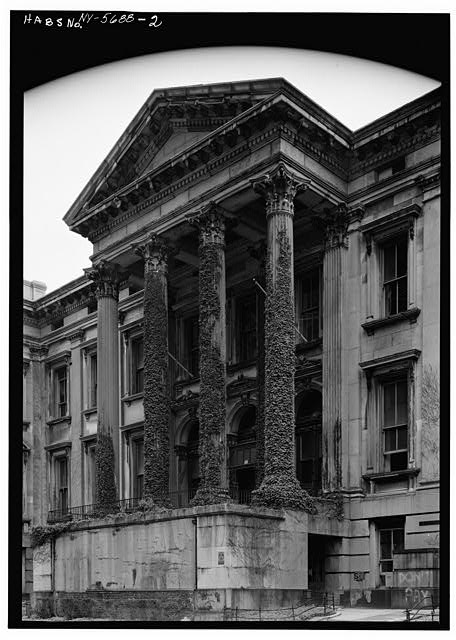
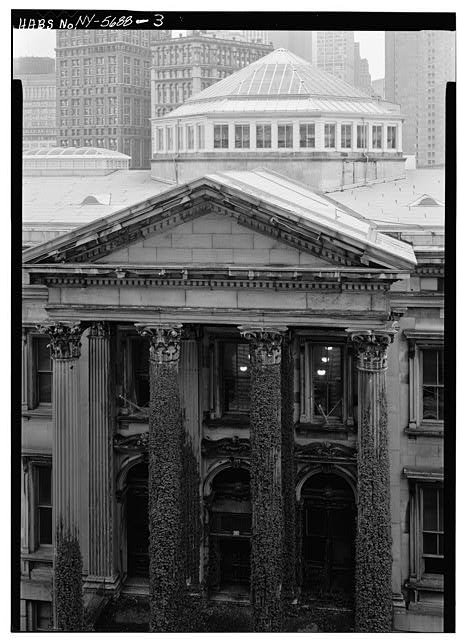
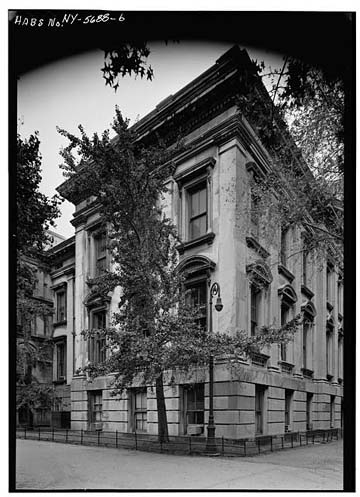
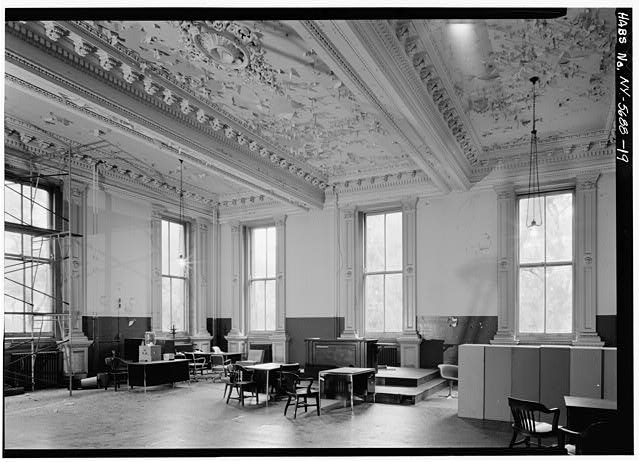
The three and one half story marble courthouse sits on a low granite curb with a rusticated marble basement. The building is composed of a central section with two projecting wings, with an addition in the center on the south facade. The entrance is marked by a pedimented portico supported by four Corinthian columns. The windows have arched and flat stone pediments. There is a massive stone cornice and an octagonal skylight at the roof, replacing a planned dome. John Kellum was the building's primary architect. After he died in 1871, Leopold Eidlitz was hired to finish the building. Thomas Little, a member of the New York City Board of Supervisors, was given credit along with Kellum on a small box placed beneath the cornerstone, but it is believed that the major design credit belongs to Kellum. John Kellum began his career as a house carpenter, studying architecture on his own. He formed the firm King & Kellum in 1846 with Gamaliel King, architect of Brooklyn Borough Hall. The firm designed commercial buildings, including the landmarked Cary Building at 105-107 Chambers Street, one of the earliest cast-iron-fronted buildings in New York City. Kellum started his own practice in 1860, and designed several buildings for Alexander T. Stewart, including his department store at Broadway and 10th Street, which burned down in 1956, and the plan for Garden City on Long Island. Leopold Eidlitz, best known for his work on the New York State Capitol, was hired in 1876 to finish the courthouse. Eidlitz supervised its completion and was responsible for the south wing, which contains the spectacular medieval style stone second floor courtroom, and for part of the rotunda.
A recent two-year restoration
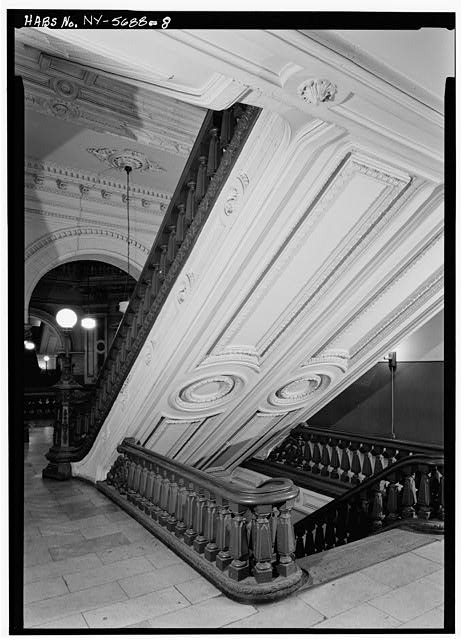
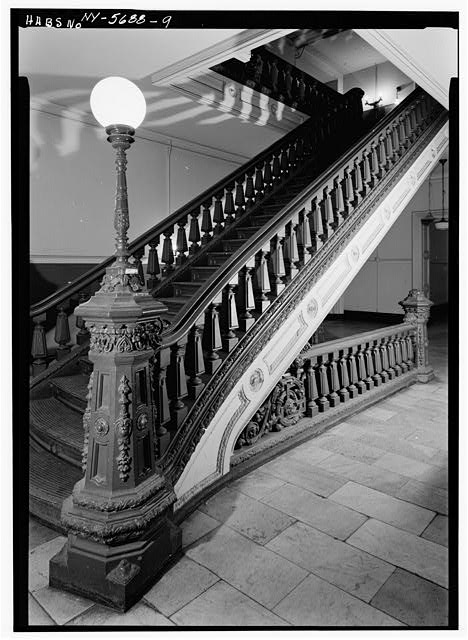
of the Tweed Courthouse has replaced or restored splendid interior and
exterior detail. Outside, marble cornices were replaced and leaf detail
on the Corinthian columns was rebuilt. A new roof was designed to
replicate the original, which was discovered to have been made of metal,
and skylights were restored. The grand entrance stairway on the north
side was rebuilt, with the addition of 17 new Vermont granite steps. The
stairway had been removed during World War II in 1944, for the widening
of Chambers Street. In 2002, Tweed became the new home of the
Department of Education. In addition to offices, the building houses an
educational and demonstration center called City Hall Academy. The
Academy hosts short-term "residencies" for elementary and middle school
classes, and leadership and scholarship programs for high school
students. It will also serve as a center for professional development
for teachers, facilitating the transfer of best practices, and an
educational center for family and public programs.
|
|
links |


 The
building was designated as a New York City Landmark in 1984. It is also
listed on the New York State and National Registers of Historic Places.
The
building was designated as a New York City Landmark in 1984. It is also
listed on the New York State and National Registers of Historic Places.