|
|

 |
|
|
|
|
 |
New York
Architecture Images- Williamsburg Brooklyn Williamsburg Art and Historical Society /originally Kings County Savings Bank |
|
architect |
King &
Wilcox. William H. Wilcox. |
|
location |
135 Broadway, NE cor. Bedford Ave, Williamsburg |
|
date |
1868 |
|
style |
Second Empire Baroque |
|
type |
Bank |
|
images |
  |
|
|
  |
 |
|
 |
|
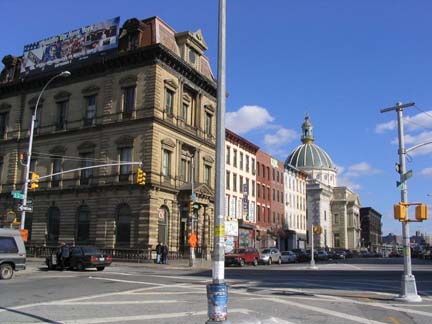
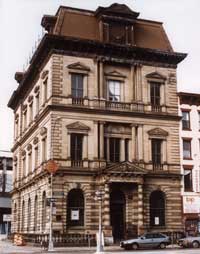
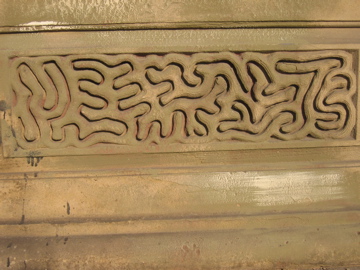
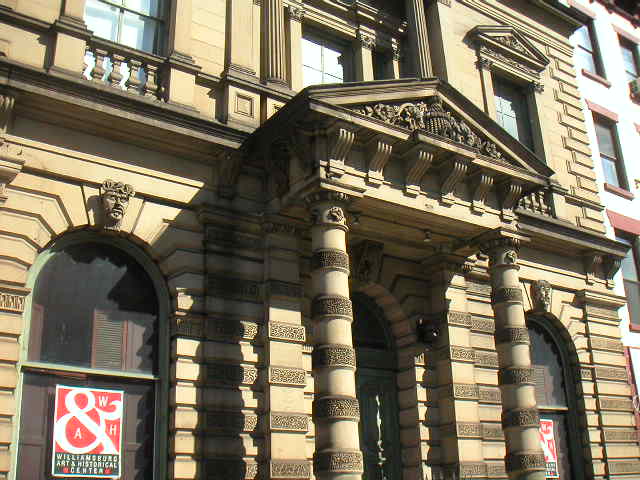
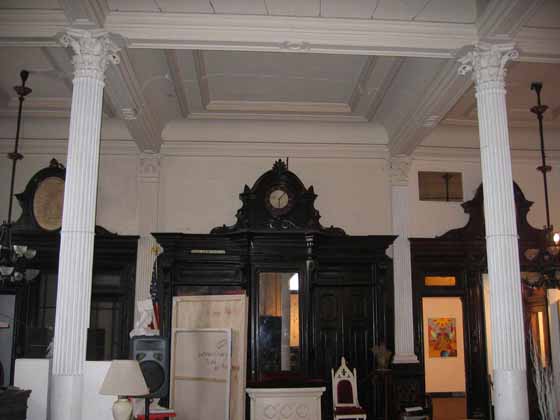
| Bands of smooth and vermiculated Dorchester stone and slender Ionic and Corinthian columns alternate to enliven the exterior of the banking floor of this splendid Second Empire masterpiece. Victorian at its best, even the interior is carefully preserved, the gaslit chandeliers all present (but wired for electricity). Look at the plaited Indian hut in the entry pediment. | |
|
This splendid building, the Kings County Savings Bank, was designed by the New York Architectural firm of King and Wilcox. Gamilial King was a prominent architect in the New York area whose most memorable works were designed in conjunction with John Kellum. King and Kellum designed such noteworthy buildings as the Brooklyn Borough Hall (1851), the Friends Meeting House in Gramercy Park (1859) and the Cary Building in Lower Manhattan (1856). Williams H. Wilcox became partners with King late in King's career, and unfortunately nothing further is known about Wilcox at this time. The Kings County Savings Bank is an outstanding example of French Second Empire architecture, displaying a wealth of ornament and diverse architectural elements. A business building of imposing grandeur, the Kings County Savings Bank "represents a period of conspicuous display in which it was not considered vulgar, at least by the people in power, to boast openly of one's wealth...From its scale and general character there is nothing on the outside, that would distinguish the Kings County Savings Bank from a millionaires mansion."* In the post-Civil War period in the United States opulent Second Empire palaces like this bank building were quite common. The buildings designed in this style were tall, boldly modeled, and emphatically three dimensional in shape. The Kings County Savings Bank, though studded with classical moldings, pedimented windows and molded surrounds, does not take on the frivolous qualities often associated with this "flamboyant" style. On the contrary, the Kings County Savings Bank, through the dramatic use of rusticated stone and emphasis on horizontality, expresses the qualities of solidity, dependability and permanence — qualities much more appropriate for a banking institution. The Kings County Savings Institution was chartered April 10, 1860, with business being carried on for the first seven years in the eastern part of Washington Hall, a civic building located at Bedford Avenue and South 7th Street. In 1868, a lot was bought on the corner of Broadway and Fourth Street (now Bedford Avenue) and the fine Second Empire building of Dorchester stone was erected at a cost of $100,000. In 1921, the name of the bank was officially changed from the Kings County Savings Institution to the Kings County Savings Bank. On January 1, 1969, the United Mutual Savings Bank was formed by a merger of Union Square Savings Bank and the Kings County Savings Bank. Later the bank became the American Savings Bank, which continued through the 1980s. The building was used as a bank until the late 1989 after which it remained vacant, except for occasional non-banking occupants. In October 1996, recognizing a lack of exhibit or performing space locally in Williamsburg Brooklyn, one of the largest art communities in New York, Yuko Nii founded the Williamsburg Art and Historical Center (WAH Center), based upon her "Bridge Concept". a multifaceted, multicultural art center whose mission is to coalesce this diverse artistic community, and create a bridge between local, national and international artists, emerging as well as established artists of all disciplines. The electiveness of Yuko's leadership and her strategic implementation of concept is dramatic. Borough President Howard Golden said that the WAH Center's activities have resulted in "tremendous cultural and economic activity throughout northern Brooklyn." The racially and ethnically diverse working population here has taken new pride in community and keep it clean, safe and presentable to visitors. In 1996 Governor George Pataki congratulated Yuko on "turning the historic Kings County Savings Bank into a multi-purpose art center that serves the needs of artists and art aficionados of diverse backgrounds." In 1998 Yuko Nii was named one of Brooklyn's "Women of the Year" by Borough President Howard Golden for her "unparalleled devotion to her art and commitment to the artist community of Williamsburg/Greenpoint.And in March 2001 Yuko was named a "Woman of Excellence, Vision and Courage" by New York State Governor George Pataki for creating a significant new cultural institution for the pole of New York and battling to preserve this great architectural heritage. The restoration of the Kings County Savings Bank clock tower, undertaken in 1999, is nearly complete, thanks to the generosity of the New York City Landmark Commission and the New York City Landmark Conservancy, However, we lack the funds to move forward to complete restoration of the exterior of the building which is in a critical state of deterioration. We ask that you give generously to support restoration of one of New York's greatest pieces of architecture. We currently need to raise $800,000. PLEASE HELP. * Harmon H. Goldstone and Martha Darymple, History Preserved: New York City Landmarks and historic districts (New York: Simon and Schuster, 1974), p. 414. |
|
| with thanks to "The AIA Guide to New York", | |
|
links |
http://wahcenter.net |


