|
PROJECT OVERVIEW
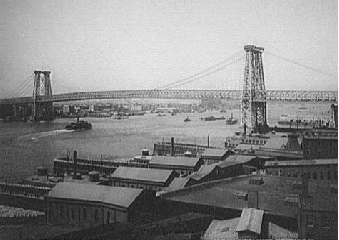
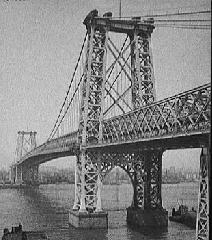
WILLIAMSBURG BRIDGE
Compiled by Dave "The Bridge Man"
Frieder
Construction Commenced -- Nov. 7th 1896
Construction of Main Cables Commenced-- Aug. 11th 1901
Opened To Traffic-- Dec. 19th 1903 6:00 a.m.
Bridge Commissioner at the Time-- Gustav Lindenthal *
* same person who built Hell Gate Bridge and Queensborough Bridge
[originally known as Blackwells Island Bridge.]
Total length of Bridge-- 7308 feet
Length of Suspended Span-- 1600 feet . 4 feet 6 inches longer than the
Brooklyn Bridge.
Side Spans length each-- 596' 6"
Height of Steel Towers above Mean Water Height-- 332' 9"
Towers sunk to Bedrock by Pneumatic Caisson Method, same as Brooklyn
Bridge
Center of Roadway above Mean Water Height 135 feet
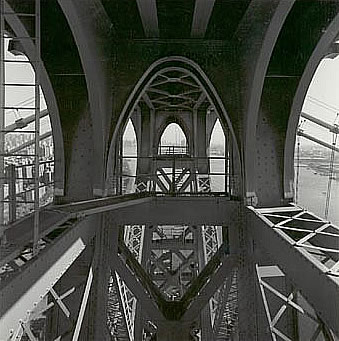
Stiffening Truss-- 40 feet high, Lattice "Town Type" Truss.
Main Cables-- 4. Wires per cable 8112. Strands per Cable 39. Wires per
Strand 208.
All wires in Main Cables are of the Non-Galvanized Type.
Cable Diameter-- 18 6/10 inches including wrapping.
Length of each of the four cables--3224 feet.
Total length of wire in the four cables--23,132 Miles.
Total Weight of Steel in Bridge and Approaches 47,800 Tons.
Approximate cost of construction, in 1903-- $24,188,090.00
When first opened in 1903, Williamsburg
Bridge had four surface or trolley tracks(Streetcars) and two elevated,
or regular train tracks. Regular train service did not cross bridge
until 1908. Now, the bridge, has two inner and two outer vehicular
roadways and two subway tracks. Also two 17' wide foot walks.
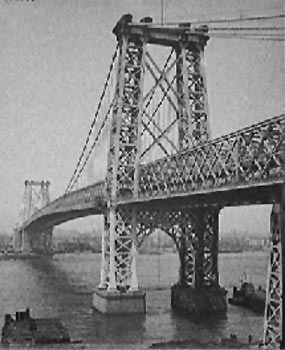
The Williamsburg was the first all steel, large scale, suspension bridge.
Leffert Lefferts Buck, chief engineer. Born in Canton, New York.
Buck felt it was not necessary to galvanize main cable wires. Side spans
not suspended, rather supported by steel viaducts. Originally one
support per side span, in 1913 two extra supports per span were added
due to increased traffic loads. Total of three supports per side span.
Williamsburg Brooklyn was named after
Colonel Jonathan Williams a U.S. engineer and a a grand nephew to Ben
Franklin. Area was incorporated as a village in 1827. In 1998 Brooklyn
will 100 years as a borough of the City of New York. The original Dutch
spelling of Brooklyn is BREUKELEN.
The Williamsburg Bridge is one of three bridges to use Non-flexible type
of towers. The other two bridges are, the Brooklyn Bridge and the George
Washington Bridge. The main cables of the Williamsburg bridge were
spun by John A. Roebling Sons inc. Same company spun cables for the
magnificent Manhattan Bridge and the great George Washington Bridge.
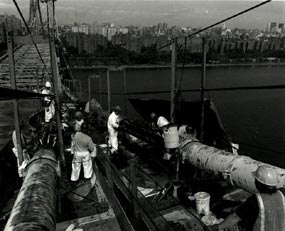
Since the wires in the main cables in the Williamsburg Bridge are not
galvanized the bridge engineers have had a problem in terms of
protecting them from corrosion. Recent modern methods have been used to
repair and protect the cables.
The Williamsburg
Bridge
Information From the
Library of Congress
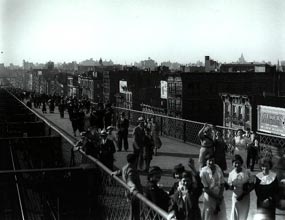
On December 19, 1903, New Yorkers
celebrated the opening of the Williamsburg Bridge, the second of three
steel-frame suspension bridges to span the
East River. Designed by Leffert L. Buck and Henry Hornbostel, it had
taken over seven years to complete. Built to alleviate traffic on the
Brooklyn Bridge and to provide a link between Manhattan and the
Williamsburg section of Brooklyn, the 1,600 foot Williamsburg Bridge was
the world's longest suspension bridge until the 1920s.
Originally open to horse-drawn carriages,
bicycles, and pedestrians, the Williamsburg Bridge soon became a vital
transportation route for trolleys and trains, spurring the growth of
Brooklyn's working-class neighborhoods. In the 1920s, the bridge was
reconfigured to accommodate eight lanes of traffic. Today, it carries
over 140,000 vehicles per day and some 100,000 subway riders.
On hand to film the opening of the
Williamsburg Bridge were cameramen James Blair Smith and
G.W. "Billy" Bitzer. Their films,
Opening of New East River Bridge, produced by the Thomas
Edison Company, and
Opening the Williamsburg Bridge, produced by the American
Mutoscope and Biograph Company, contain footage of the bridge and
close-ups of the dignitaries and press in attendance. Note the large
wooden "box" cameras carried by the press photographers.
- See more photographs of the Williamsburg
Bridge. Search on Williamsburg Bridge in these collections:
"Considered from the
aesthetic standpoint, the (Williamsburg) Bridge is destined always to
suffer by comparison with its neighbor, the (Brooklyn) Bridge. Whatever
criticism has been made against the conservative features of the latter
structure, it has always been conceded to be an extremely graceful and
well-balanced design. It is possible that, were it not in existence, we
would not hear so many strictures upon the manifest want of beauty in
the later and larger (Williamsburg) Bridge, which is destined to be
popular more on account of its size and usefulness than its graceful
lines. As a matter of fact, the (Williamsburg) Bridge is an engineer's
bridge pure and simple. The eye may range from anchorage to anchorage,
and from pier to finial of the tower without finding a single detail
that suggests controlling motive, either in its design or fashioning
other than bald utility." - Scientific American (1903)
No poetry has been written about it, as
Hart Crane did with the Brooklyn Bridge. No songs have been written
about it, as Paul Simon and Art Garfunkel did with the 59th Street
(Queensboro) Bridge. No one ever attempted to sell this bridge. Indeed,
before it was ever completed, the span was described by John DeWitt
Warner as a "surrender of the City Beautiful to the City Vulgar." While
not renowned for its beauty, the Williamsburg Bridge has fulfilled its
original mission to relieve traffic congestion on the Brooklyn Bridge,
and to serve as an important link between Manhattan and the Williamsburg
section of Brooklyn.
PLANNING THE SECOND EAST RIVER SPAN:
As early as the late 1860's, John Roebling, the designer of the
Brooklyn Bridge, anticipated the need for additional bridges across the
East River to keep up with population growth in the cities of New York
and Brooklyn. One bridge was proposed between the Lower East Side of
Manhattan and the Williamsburg section of Brooklyn. Throughout the
1880's, leaders in Williamsburg battled officials in New York City and
powerful ferry interests who did not want the bridge. Although
legislative approval had been obtained from Albany for construction of
the bridge, the bill was not followed up by appropriations.
In 1892, Frederick Uhlmann, who sought to extend his Brooklyn elevated
railways across the East River into Manhattan, planned two new rail
lines: one serving the West Side manufacturing districts, and the other
serving the Wall Street area. He also planned two bridges: a suspension
bridge for trains, carriages and pedestrians at the present site of the
Williamsburg Bridge, and a cantilever bridge exclusively for trains just
north of the present site of the Manhattan Bridge. In March 1892, the
New York State Legislature approved a bill that founded the East River
Bridge Company.
Stymied by legal battles between Uhlmann and the elevated railway
interests in Manhattan, leaders in Williamsburg lobbied Albany for the
creation of a new body, the New East River Bridge Commission, and in May
1895, the new commission purchased Uhlmann's charter for $200,000.
CONSTRUCTION OF THE
WILLIAMSBURG BRIDGE: Leffert L. Buck, the newly appointed chief
engineer, first announced plans for the Williamsburg Bridge in an 1896
issue of Engineering News. The cost of the proposed bridge was
originally estimated at $7 million, less than the $15 million cost of
the Brooklyn Bridge. Construction began in November of that year.
From the onset, economic considerations
strongly influenced the design of the Williamsburg Bridge. The decision
to have the cables come down straight from the towers to the anchorages
and not support the side spans meant that shorter and lighter cables
could be used. Employing less expensive, lighter steel towers meant that
foundations could be made smaller and that towers could be built taller.
Steel was also used for the approaches, cutting the time and expense of
constructing masonry-arch approaches.
The 1,600-foot-long main suspension span for the Williamsburg Bridge
exceeded the previous record-holder, the Brooklyn Bridge, by four and
one-half feet. Compared to the main span, the 300-foot-long side spans
are relatively short. However, the side spans are supported not by
suspender cables, but from steel arches from below. From approach to
approach, the bridge was 7,200 feet long.
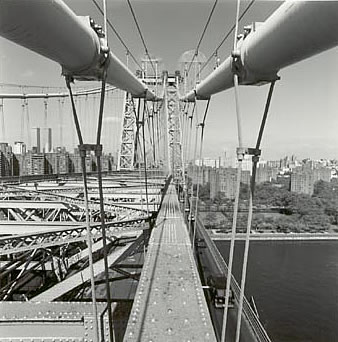
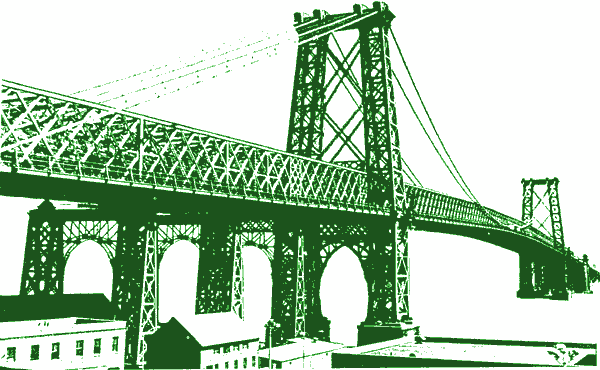
The 310-foot-tall towers, the first all-steel towers to be employed for a
suspension bridge, support four main cables, which are carried on
saddles atop the towers. Each of the 4,344-ton main cables, which
measure 18¾ inches in diameter, is comprised of 37 strands of 208 wires.
Unlike those found on other New York bridges, the wires on the
Williamsburg Bridge were not galvanized, making them less susceptible to
hydrogen embrittlement. (However, the wires do have the problem of
rusting due to the absence of a commonly applied zinc coating.) Nearly
17,500 miles of wire are used in the cables that suspend the bridge 135
feet above the East River.
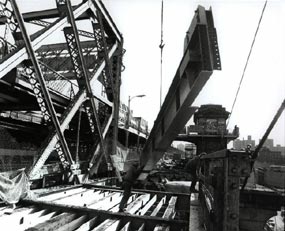
The 40-foot-deep stiffening trusses were designed not only to withstand
high winds, but also to support rail traffic on the deck. Originally,
the design had the above-deck truss shift below the deck at the side
spans. Later, the design was changed such that the stiffening truss was
above the deck from anchorage to anchorage.
Despite the technological advances, doubts were raised about the bridge
after a fire in November 1902. The fire, which started in a worker shack
atop one of the towers, spread to the cables and foot walks. However,
damage to the structure was minimal. Proving the bridge's strength, the
Roebling Company, which provided the wire rope and woven the cables,
simply spliced new wires into the burned-out section.
When noted bridge designer Gustav Lindenthal took over as chief engineer
of the Williamsburg Bridge in 1902, he had serious reservations about
the design and appearance of the bridge. Nevertheless, with the bridge
nearing completion, he continued the project. Upon the completion of the
Williamsburg Bridge, Lindenthal avoided references to its design,
emphasizing instead that it was twice as strong as the Brooklyn Bridge.
THE SECOND EAST RIVER BRIDGE OPENS:
The Williamsburg Bridge opened on December 19, 1903 to horse-drawn
carriages, bicycles and pedestrians. However, due to complications
between Greater New York and the privately owned railway companies,
elevated trains did not run on the bridge until 1908. The final cost of
the bridge and its approaches was $24.2 million, more than three times
the original cost estimate.
For a brief period, the Long Island Rail Road (LIRR) ran passenger service
along an elevated extension across the Williamsburg Bridge into
Manhattan. The LIRR spur split from the existing Atlantic Avenue line
northwest onto the Broadway elevated line (today's J, M and Z subway
lines), crossed the Williamsburg Bridge, and continued south to Chambers
Street.
The bridge not only served the traffic needs of a growing population, but
also greatly affected migration patterns of ethnic groups. Before the
bridge opened, first- and second-generation Irish and German settlers
(who called the enclave "Kleine Deutschland") lived in the Williamsburg
section of Brooklyn. When it opened, an influx of Jewish settlers from
the overcrowded Lower East Side crossed the "Jews' Bridge" into
Williamsburg. In turn, long-time residents moved out to Queens.
In 1910, the City of New York removed the toll on the Williamsburg Bridge
after it passed a law prohibiting the use of tolls to finance bridge
construction and maintenance
Type of
bridge……………………………………..……………... Suspension
Construction started……………………………………………... November 7, 1896
Opened to traffic…………………………………………………. December 19, 1903
Length of main span…………………………………………….. 1,600 feet
Length of side spans……………………………………………. 300 feet
Length, anchorage to anchorage……………………….……… 2,200 feet
Total length of bridge and approaches…………………..…….. 7,308 feet
Number of traffic lanes…………………………………………... 8 lanes
Number of subway tracks……………………………………….. 2 tracks
Height of towers above mean high water…………………..….. 310 feet
Clearance at center above mean high water………………..... 135 feet
Number of cables…………………………………………………. 4 cables
Length of each of four cables……………………………..…….. 2,985 feet
Diameter of each cable………………………………………….. 18¾ inches
Total length of wires…………………………….……………….. 17,500 miles
Weight of cables and suspenders…………………………….... 4,344 tons
Structural material………………………………………………... Steel
Tower material……………………………………………………. Steel
Deck material……………………………………………………... Steel
Cost of original structure………………………………………... $24,200,000
|
|
An XXXcellent Bridge
by Greg Ayres
New
York has its mutated mountain range of buildings and
landmarks, but more than just the visible structures,
there are layers upon layers of phantom architecture in
the form of past occupancies,aborted projects and
popular \fantasies that provide completely different
images to the New York that exists now.
|
|
Like Willie
Wonka's infamous jaw-breaker, NYC is made up of layer
upon layer of distinctly different flavors, stacked
snugly one on top of the other. Rem Koolhaas says that
New York is fated to a "Cyclic restatement of a single
theme: creation and destruction irrevocably interlocked,
endlessly reenacted. Barbarism giving way to
refinement." So if it's worth sucking away at some of
the layers, then we might as well eat our way to the
very historical core, when Mother Nature's wild children
roamed the lush hills, valleys and marshlands of New
York. It was 1609 when the Mohican tribes lost the land
that was originally their birthright to Henry Hudson and
the parade of "civilized", white culture which closely
followed. The old world (Europe and Eastern
civilization) was becoming over crowded and people were
looking to the west - towards the promised land.
Millions of Christians were ready to cross their
arresting geographical barrier into the unknown, new
world of America. "North American barbarism insidiously
giving way to European refinement." Sometime in the mid
1620's, New Amsterdam (the original name for New York)
was colonized and the whole aboriginal race was plucked
by the stem and uprooted. FAST FORWARD: ABOUT TWO
HUNDRED YEARS It's the early 1800's and humans have
congregated in unprecedented densities in Manhattan.
Richard Woodhill begins to offer a ferry service
departing from Corlear's Hook in Manhattan. The
destination: his recently purchased 13 acre parcel of
land - which he named Jonathan Williams. The ferry docks
at the foot of what is now N.2nd Street in Brooklyn. He
was hoping to develop a domestic refuge for the masses
working in the city; alas, Woodhill's plans never came
to fruition. Then, in 1818, David Dunham succeeded where
Woodhill had not, becoming the father of Williamsburgh.
In 1852, with the population just brimming at 31
thousand, Williamsburgh incorporated as a city,
consolidated with Brooklyn, and dropped the "h" to
become Williamsburg. The community, which was
agriculturally based, rapidly became what might be
called North America's first suburb. Skirting the
world's greatest industrial carnival, it was inevitable
that people would seek cover from life's laborious
storm, in the waiting arms of Williamsburg. Sanctuary
was just a boat ride across the East River.
|
|
Then in 1883,
Brooklyn officially consummated its relationship to
Manhattan, with the completion of the Brooklyn Bridge.
The Culture of Congestion. New York architecture is a
model for the exploitation of congestion. Between 1890
and 1940 a new culture selected manhattan as a
laboratory - where the invention and testing of a
metropolitan lifestyle and its attendant architecture
could be pursued as a collective experiment in which the
entire city became a factory of man made experience.
Here, the splendor and misery of the metropolitan
condition combine to formulate hyper density. The recipe
alchemizes innovation with absurdity, and a strange brew
bubbles over. Peoples' attitudes were on the cusp of
daring adventure. It is the turn of the century - the
gay nineties. There is an air of the fantastic
surrounding everything and anything is possible. MAKING
NUMBER TWO By 1900, the population of Williamsburg had
escalated to 105 thousand. Under pressure from Senator
Patrick McCarren, the powers that be in Albany,
grudgingly appropriated funds for the building of the
Williamsburg Bridge. The building committee commissioned
Lefert L. Buck to design what was provisionally called,
"No. 2". It was the beginning of a new age - that of the
machine - brightly lit by the industrial dawning of
steel. Buck put himself at the epicenter of this
innovation by erecting two steel towers - looming 325
feet over the East River. The bridge was criticized from
the moment the plan was unveiled, for its graceless form
and bald utility. Built as an alternative to the
overcrowded Brooklyn Bridge, it was the longest and
heaviest suspension bridge in the world. Buck reinforced
his behemoth creation with steel lattice work, called
stiffening trusses. The structures which extend between
the anchorages, (and give the bridge great strength)
were not aesthetically favored by citizens at large. The
design could have been a response to Alexendre Gustav
Eiffel, who had become famous for his tower - built in
1889. It's even possible that the two prodigious
architects could have met previously when they were both
building railways in South America, circa late 1870's.
But there was something Buck was doing that Eiffel had
not; he was using steel. Favored or not, Buck was
clearly at the forefront of this particular
architectural revolution. Consistent with its cycle of
destroying the old to make way for the new, the city
went about auctioning off homes that stood in the
unfortunate way of progress.
|
 |
|
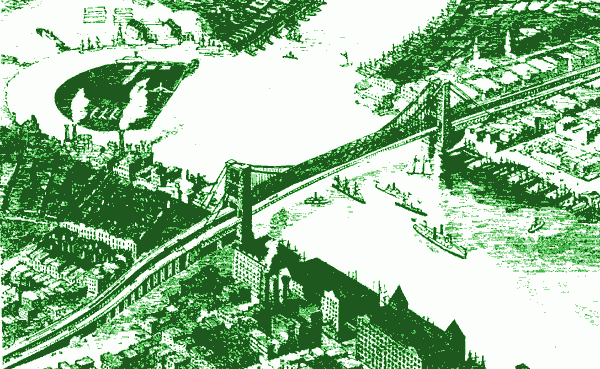
The bridge was certainly no respecter of private
property. The process was ruthless; as dwellings,
churches and theaters were rapidly destroyed to make
room for the entranceways on either side of the River.
In Manhattan and Brooklyn together, almost 20 thousand
people were displaced. Homes and landmarks were not the
only casualties of advancement - thirty-one men lost
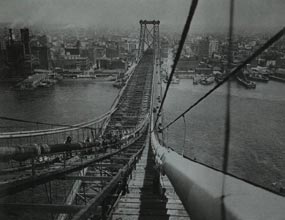
their lives while building the bridge. Construction, was
in and of itself a perilous feat. Men seemingly hung in
mid-air, perched on a "false bridge" (wooden
scaffolding) or dangled from a precarious pulley system
as they ran the incredibly heavy cables back and forth.
One of the most treacherous jobs was digging the
foundations which would hold the anchorages. The men who
dug were called sand hogs, and once they got down to a
depth of 70-90 feet they were paid an astounding $3.25
per hour. Lack of oxygen and exhaustion allowing only a
few hours of work at a time for each man. Originally
scheduled to take five years to build, construction was
set back by a disastrous fire in 1902. A rivet stove
near the very top of the false bridge was tipped over by
a weary worker and the wooden framework went up like a
match. Fire fighters arrived at the scene, only to watch
helplessly as the flames blazed over three hundred feet
above their heads. Miraculously, the damage was minimal
and construction resumed at an even more furious pace.
Finally, on a cold and hazy morning. a gray, yet
luminous veil hung over the East River and blanketed the
seven thousand, three hundred and twenty-five foot long
passageway. It was December 19, 1903, the official
opening day of the Williamsburg Bridge. It had taken
seven years, 15 million dollars and thirty one lives to
create what most people were calling a monstrous
eyesore. Now as the sun rose and the fog lifted, the
Williamsburg Bridge came into full visibility. The Mayor
of New York City, Seth Low stood at the entrance-way to
the Manhattan side of the bridge. J. Edward Swanstrom,
president of the Borough of Brooklyn, stood at the
opposite end. At 2:30 pm the two men walked onto the
bridge and a few minutes later, just east of the exact
center, shook hands. It was a gesture which represented
the manifestation of a dream called The Greater New York
Area - the greatest city in the world. The same year
that the WB opened, Frederick Thompson opened Luna Park,
an amusement pavilion to rival Coney Island. |
|
He said, "It's
marvelous what you can do in the way of arousing
human emotions by the use you can make
architecturally of simple lines." When the bridge
opened officially to the public on December 20th,
people had been waiting in the cold, winter darkness
since midnight, to be among the first on the bridge.
Potential record setters crowded at the entrance
ways on both ends. The first man to make a round
trip - Wally Owens, did so in a shiny, red,
horseless carriage. Nearly mowing down several
police officers, he made the trip in six minutes and
fifty seconds. As the day wore on, many other
records were set. The first couple to kiss; the
first one-legged man to stump across. A bicyclist,
rode backwards, with much difficulty. And at 6:20pm
the first dog trotted across. The most noteworthy
record was set by a nameless maverick - who brought
a flask along - to be the first person to get drunk
on the bridge. The Williamsburg Bridge was seen as a
passageway to a new life by thousands of Jewish
immigrants fleeing the slums of the Lower East Side.
They and others flocked to the latest addition of
Greater New York like over-worked Manhattan-ites
escaping reality at the latest amusement park. In
1917 Williamsburg had the most densely populated
blocks in the city and by 1920 the population was
soaring at 260 thousand. The numbers continued to
climb, as the thirties brought refugees evading the
dark blanket of Nazism which was spreading at an
alarming rate. Bessie Smith's A Tree Grows in
Brooklyn (pub. 1943), tells the story of Francie,
growing up in the neighborhood before WWI. Francie
looks at the bridge from her roof and sees it as a
means of escape from her dull domestic life. Later,
when she finally crosses it, she is disillusioned by
Manhattan. The Bridge still seems like a means for
escape, but for escaping from Manhattan rather than
to it. When enough people finally escape, then
perhaps the cycle of destroying the old to make way
for the new will begin again. Perhaps it¹s sad to
think of another really cool layer of life getting
covered up. But a neighborhood can't truly live if
it's living in the past. So the culture of
congestion will continue consuming history to make
room for itself. The flavor keeps changing. And
really isn't that what makes our city so great. So
keep sucking on that gobstopper. Change is
ultimately best when embraced lovingly. Why resist?
The next thing you taste just might be the
transformation of a lifetime.
|
 |
|
|
 |
|
|
|
|
|
special thanks to
www.11211magazine.com
|