|
|

 |
|
|
|
|
 |
New York
Architecture Images-Greenwich Village First Presbyterian Church Landmark |
|
architect |
Joseph C. Wells (chapel 1894 McKim, Mead and White) |
|
location |
48 Fifth Ave., bet. W11th and W12th Streets. |
|
date |
1846 |
|
style |
Gothic Revival |
|
construction |
|
|
type |
Church |
|
|
|
|
|
|
images |
 |
|
|
 |
|
First Church has been a landmark both architecturally
and intellectually since its origins on Wall Street in 1716. “Old First”
has a rich tradition of being at the forefront of religious and social
activism, often with controversy.
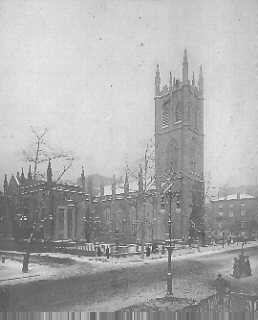
As the “Church of the Patriots,” the pulpits and pews of First Church have been filled with passionate voices that have paralleled the nation’s growth. To keep pace with that growth, a decision was made in the 1840s to move uptown to its present location on Fifth Avenue and 12th Street. The present Gothic revival building, dedicated in 1846, proved to be an enduring home for First church’s remarkable growth during the twentieth century. The merger in 1918 of First Presbyterian, University Place Presbyterian, and Madison Square Presbyterian provided a pulpit for Harry Emerson Fosdick, one of the nation’s best known liberal preachers. First Church’s reputation for progressive thought and action has continued to the present. |
|
|
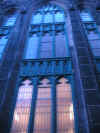
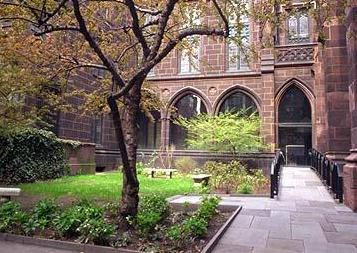
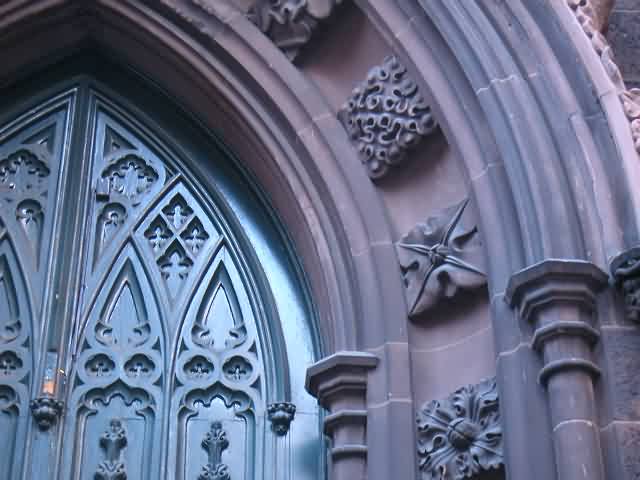
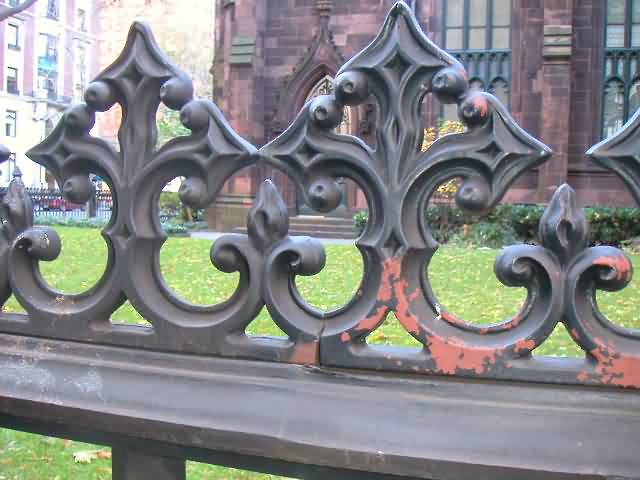
Architecture First Church moved from its original Wall Street location to its current site on Fifth Avenue in the mid-1840s. The building committee had decided on the Gothic style, and selected Joseph C. Wells, an English immigrant who was one of the founders of the American Institute of Architects, as architect and J. G. Pierson as builder for the new church. It is said that First Church is modeled on the Church of St. Saviour at Bath, England, and the crenellated central entrance tower on the Magdalen tower at Oxford. The dressed ashlar tower of brownstone is embellished with a Gothic Revival tracery of quatrefoils. A reporter in the New York Herald, January 12, 1846, described the interior of the finished church building: The interior of the edifice presents a novel and yet a very agreeable and impressive aspect. It is of the perpendicular Gothic Style, without columns to sustain the long extending arch, which makes the seats in a remarkable degree available and unobstructed. This is a new feature in modern architecture. The slips [pews] are of black walnut of native growth, most beautifully and tastefully carved…. The ceiling is formed by a system (if it may be so called) of groined arches, with intersecting ribs and pendants forming the keystone of this massive structure. Several additions have been made to the church since its construction. In 1893, a south transept was added by McKim, Mead & White, and a chancel was added in 1919. The chancel’s stained blue glass rose window was the gift of Robert W. de Forest, the founder of the American Wing of the Metropolitan Museum. Also in 1919 the reredos, painted by Taber Sears in 1917, was moved to the new west wall of the chancel and repainted. It has as its theme the Te Deum Laudamus, an ancient canticle of the Christian church. In 1937 the Alexander Chapel, decorated with the Scottish symbols of thistle, heather, and ivy, was completed in one of the rooms of the South Wing. The chapel’s three stained glass windows depict the cathedral on the isle of Iona, the Ionic cross of St. Martin set against a Hebridean landscape, and a young Crusader setting forth from his Scottish homeland. The need for more space for First Church’s program activities led to the construction of the new Twelfth Street church house in the late 1950s. Architect Edgar A. Tafel, a pupil of Frank Lloyd Wright, designed a modern building that harmonizes with the Gothic style of the church. The exterior of the building was done in Roman brick, colored to match the brownstone of the church. A balcony facing Fifth Avenue and a pseudo-balcony above it feature a quatrefoil design that is the same as that on the church building. In 1960, the church house won an architectural award from the Fifth Avenue Association. In the 1990s a major restoration of the South Wing was undertaken, and the interior spaces were redesigned to accommodate new church programs. First Church occupies an entire block on Fifth Avenue between 11th and 12th streets. The site is ringed by an ornamental fence, made partly of cast iron and partly of wood. Sources: Bergman, Edward F. The Spiritual Traveler: New York City: The Guide to Sacred Spaces and Peaceful Places. HiddenSpring Books, 2001 Fowler, Dorothy Ganfield. A City Church: The First Presbyterian Church in the City of New York, 1716-1976. The First Presbyterian Church in the City of New York, 1981. Willensky, Elliot, and Norval White. AIA Guide to New York City. Third Edition. New York: Harcourt Brace Jovanovich, 1988. The Merging of Three Churches Old First, Madison Square and University Place Presbyterian Churches. The decision to consolidate Old First, University Place and Madison Square Presbyterian Churches in 1918 evolved partly out of a situation at the Madison Square Church. The neighborhood around the church had been a residential one since its founding in 1853, but by the turn of the century had changed to a business district. Membership had declined and the senior Pastor, Dr. Charles H. Parkhurst, was retiring. In addition, the Metropolitan Life Insurance Company, which had erected a large office building across the street from the church, was offering to buy up the property for further expansion. The church was faced with a decision to either remain on the site, or move and combine with another congregation. A similar situation with respect to the pastorate existed at Old First and University Place Presbyterian Churches. Howard Duffield, senior pastor at Old First since 1891, was at retirement age, and George Alexander, senior pastor at University Place, was too. Both these congregations had been experiencing financial difficulties and were in serious discussions concerning a merger, when the Trustees at Madison Square Church approached them. The confluence of these three congregations in 1918 formed at once a strong and vital church. University Place had a fairly large membership, Old First had a long history and a sizable building at a prime location, and Madison Square, with the sale of its valuable property, contributed a hefty endowment. This unique consolidation also brought together, for a brief time, a collection of five eminently talented pastors. Dr. Charles Parkhurst had been regarded as one of the most powerful and influential preachers of his time. A colleague remembers, “I vividly recall hearing him preach in later years - his full gray beard, his bespectacled but piercing eyes, his close reading of his manuscript, the utter absence in his delivery of any trick of the orator, and yet his strange fascination which kept his audience fairly on the edge of their pews.” His chief notoriety, however, came in the early 1880s as a crusader against a corrupt New York City government - Tammany Hall. On Sunday, February 14, 1892, he began his crusade from the pulpit of Madison Square Church. He attacked the city administration, charging it of allowing saloons to operate on Sunday, against the excise law, and of not shutting down houses of prostitution. Dorothy Fowler, in A City Church, writes, “He [Parkhurst] then declared that the municipal government was rotten and that the officials blocked all efforts at reform by protecting owners of saloons and houses of prostitution. He declared the officials were a lying, perjured, rum-soaked, and libidinous lot.” Fowler further states: “He denied bringing politics into the pulpit. It was not the concern of the church what administration was in power but it was the concern of the church to strike at iniquity.” Parkhurst was not without his critics. The World, The Sun and The New York Times all supported the administration. The congregation at Madison Square, however, supported Parkhurst's continuing efforts at exposing corruption. His crusade spanned a period of about fifteen years. Rev. George Alexander Dr. George Alexander had begun his pastorate at University Place Presbyterian Church in 1883. He was to replace the retiring minister, Rev. Robert R. Booth, who had been in poor health. Alexander had been pastor at a mission church in a “disreputable suburb” of Schenectady, as well as Professor of Logic and Rhetoric at Union College. In her book, Fowler reports that the committee charged with selecting the new pastor “reported that he [Alexander] was a man of fine appearance, had a good voice and his sermons were not too long.” One of his colleagues at First Church, Harry Emerson Fosdick, later wrote, “Dr. George Alexander was one of the most admirable and lovable men I ever knew and my relationships with him were completely satisfying,” adding, “Dr. Alexander was a great personality, more conservative than I in his theological opinions, but devoted to a large-spirited, inclusive Christianity.” The vast majority of parishioners at University Place, and later at First Church, would have concurred. Like that of the Madison Square Church, the area around University Place Church had become, by the early part of the century, increasingly mercantile. In 1916, however, a young assistant minister from Baltimore, by the name of Thomas Guthrie Speers, had been appointed. Shortly thereafter, in March of 1917, Speers left to become a chaplain in the United States Army. About a year later, however, he returned from service in France to join the newly consolidated congregation. Dr. Howard Duffield had been called to Old First in September of 1891 from Detroit. Dorothy Fowler reports that Duffield “belonged to an old Presbyterian ministerial family; an ancestor, Dr. George Duffield, had been a prominent patriot during the Revolution and his father was a professor at Princeton. The new minister was a graduate of both Princeton University and the Seminary. Initially he declined the call to First Church having heard it was not unanimous since the trustees were unwilling to assume the burden of paying a salary of $8,000. Finally Miss Rachel Lenox Kennedy promised to contribute half of the salary. He was installed December 10; he was to remain until the consolidation in 1918.” “In his sermon Parkhurst said that all three merged churches were dead.” The first service of the combined churches was held November 3, 1918, with Dr. Parkhurst preaching. The other pastors present were Dr. Duffield and Dr. Alexander. In his sermon Parkhurst said that all three merged churches were dead. “There were three parents in this case,“ he said, “and they all died giving birth to this church-the New First Presbyterian Church.” All three pastors were of retirement age, and two of them, Duffield and Parkhurst, retired soon afterward. A search was on for a new pastor. At a meeting on January 8, 1919, of the committee appointed to select a new pastor, it was told to those present that Dr. John Timothy Stone of Fourth Presbyterian Church in Chicago had declined, saying that he did not want to attend to administrative duties. He had only wanted to preach. The realization came that no one pastor could manage all the duties required for such a large and vital congregation. Fowler reports, “They also told those at the meeting that Harry Emerson Fosdick had declined their invitation. He had preached several times at First Church (and his sermons had been enthusiastically received) but he did not feel he wanted to leave his teaching post at Union Theological Seminary to take on the heavy administrative responsibilities that would be entailed with the newly consolidated congregation.” In his article, "Fosdick at First Church", for The Journal of Presbyterian History, former First Church pastor John B. Macnab writes, “The three pastors of the former churches, all of retirement age, resigned willingly, and the search for a new pastor of the consolidated church began. While the committee established for this purpose was working, Harry Emerson Fosdick, D.D., was invited, as were others, to preach at services of worship. Dr. Fosdick was a professor at Union Theological Seminary in New York and a Baptist. He had joined the faculty at Union in 1915, after serving for eleven years as minister of the Baptist Church in Montclair, New Jersey. Since 1908 he had been a part-time lecturer at the Seminary on Baptist principles and polity and an instructor in homiletics.” An unusual arrangement was then proposed by the committee. George Alexander was to be Senior Pastor, with Fosdick and Speers as Associate Pastors. Fosdick would preach at Sunday morning services, while keeping his position at Union Seminary. Speers was to preach at Sunday evening services and to carry on many of the administrative duties. Interestingly, there was a distinct spread of years between the three men: Speers was just 28 years old, Fosdick was 41 and Alexander was 74. In his autobiography, Fosdick writes, “It was very attractive, I had had four years at large without a parish, the thought of having again my own congregation, with an opportunity for consecutive ministry and the chance to combine the two vocations I had always cared for most, teaching and preaching, was alluring. I told the church that I knew nothing about Presbyterian law, that they must take full responsibility on that score, but that if such an arrangement as they suggested were permissible, I would accept.” With Alexander and Speers, Fosdick reports that “we made a harmonious team.” Macnab further writes, “The unusual strategy was approved wholeheartedly by the congregation and by the Presbytery of New York. The creative plan that made Fosdick the permanent occupant of First Church's pulpit indicates the enthusiasm members of the new congregation felt for his preaching. His sermons found sympathetic ears, and the capacity attendance at his services were assuring confirmation to those who had conceived of the plan of a multiple, interdenominational ministry.” As a result of the merger, and in large measure due to Fosdick's dynamic preaching, by 1924 the membership at First Church swelled to 1,800, the highest it had ever been. A Brief History of First Church Special thanks to http://www.fpcnyc.org/about.html |
|
|
links |
http://www.fpcnyc.org/about.html |


