|
|

 |
|
|
|
|
 |
New York
Architecture Images-Lower East Side
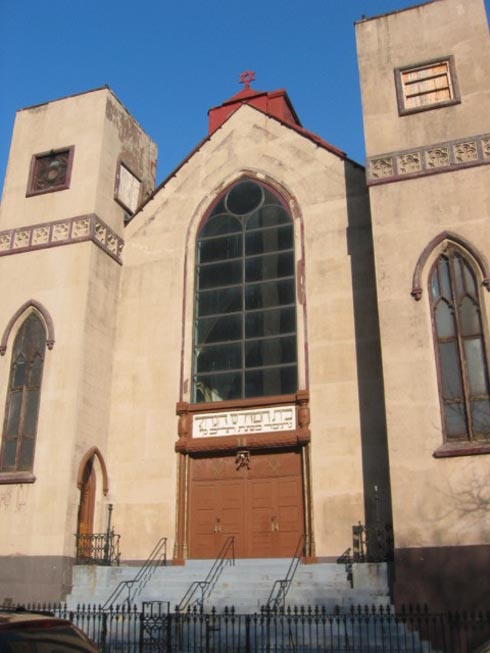
Congregation Beth Hamedrash Hagodol (Synagogue) |
|
architect |
Schneider & Herter |
|
location |
60-64 Norfolk St. |
|
date |
1850 |
|
style |
Gothic Revival |
|
construction |
|
|
type |
Synagogue formerly Church |
|
|
|
|
images |
 |
|
|
 |
|
notes |
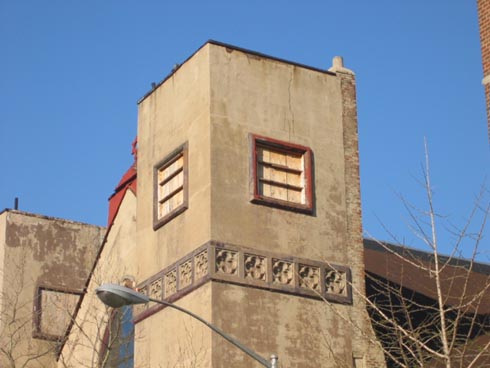
Historic Lower East Side synagogue lost roof in fire Architectural and Historical Significance:
Building Condition and Repair Costs:
Community Outreach:
Contact Information: Rabbi Yehuda Oshry Beth Hamedrash Hagodol 60 Norfolk Street New York, NY 10002 (845) 426-3110, Ext. 103 Jewish Heritage Report
|
|
Eighth St. Shul is evicted - will be residential units By: Lincoln Anderson November 29, 2000 From left, artist Pete Missing, Ralph Feldman and Judy Josephs stand outside E. Eighth St. Shul during shul’s eviction last Wednesday.The day before Thanksgiving, a New York City deputy sheriff evicted a handful of protestors from the Eighth St. Shul between Avenues B and C. It was the apparent end of a court battle by the shul to get some kind of ownership of the building - the last remaining synagogue in Alphabet City - and to keep the original congregation from regaining possession. "It's not a synagogue. They turned it into a flophouse," said Sidney Turkeltaub, 78, the president of Congregation Bnei Moses Joseph Zauechast and Zausmer, the name on the sign that still hangs above the shul's door, as he arrived with East Village real-estate developer Bob Perl last Wednesday morning before the deputy sheriff. The synagogue has existed since the turn of the century. Turkeltaub has been the congregation's president since 1959. Perl plans to buy the building from the congregation for $425,000 and convert it into a one- or two-family residence, possibly with some commercial use. All the money will go to charities, Turkeltaub said. A month ago an eviction order was issued, but a last-minute stay was granted. Then, a second eviction order was issued prior to last Wednesday's eviction. As the deputy entered, a woman holding a white poodle and gold menorah identified herself: "I'm the chairperson of the Eighth St. Shul. I have been for the last eight years." "That's fine, you guys have to leave," the deputy said. "You have to give me a break to get my stuff together," said one of the men. "I live here." "No I don't," the deputy, Steven Burdman, said gruffly and the group of five shuffled out onto the sidewalk. A burning cigarette dangling from his lips as he left the shul, his possessions slung over his shoulder, artist Pete Missing, 37, said he was hired to restore the synagogue's paintings and has been living there for four months. He said a month ago a court order put a stop on his work. Ralph Feldman, 65, a retired fireman who lives next door, and who put a new roof on the shul and installed "over 100 beams" to keep it standing and new plumbing, was hovering on the sidelines. "They abandonned it," Feldman said, referring to the original congregation. Asked why he decided to fix up the shul, Feldman said, "I got inspired by God." Feldman added that he kept kosher while a prisoner of war for 18 months during the Korean War. "I didn't eat any rats," he said. The shul's chairperson, Judy Josephs, an accountant who lives on St. Marks Pl., said, "the congregation owns it. Now we're the congregation. We davin [pray] here. We've been working on keeping a minyan. We're asking the buyer, who is Jewish, where is he davining? We wouldn't have a building if not for the current interest." Josephs said the building is called a "stiebel shul - it means it's like in an old house." For the last three years, Josephs said, her group has been running "interim minyans" when they managed to gather the required 10-person quorum, and Rosh Hashanah and Chanukah services. Joshua Whalen, a local tenant activist, got in a face-off with Perl. "You're a whore!" he yelled in Perl's face. "You're a moron!" Perl yelled back. "Are you going to re-open the shul?" Whalen asked. "I'm not answering," Perl said. "He wants to demolish it and put up one of those abortions on the site - luxury housing," Whalen said, nodding to a new apartment building being developed by Paul Stallings just east of the shul. Rabbi Isaac Fried, a Brooklyn rabbi who said his grandfather's brother had been the Eighth St. synagogue's rabbi, has been the squatter shul's rabbi for the past few years. Fried got in Turkeltaub's face. "You should be ashamed of yourself," Fried said. "I should be ashamed?" Turkeltaub shot back. "What right do you have to go in there?" "Here's an old synagogue, over 100 years old," Fried said, speaking to a reporter. "It's an historical place, with a hand-carved ark [the cabinet where the Torah is contained]. There are Hebrew astrology mosaics on the walls. The shul's been serving the needs of people, providing emergency housing. We've put 20 people in housing around here." Jim Sim, 40, Joseph's boyfriend, said when the Dos Blocos squat on E. Ninth St. was evicted two years ago, the shul sheltered 12 of the squatters. Monday night Narcotics Anonymous meetings are held there. "My grandfather's brother was the rabbi here," Fried said. "I felt a destiny, a calling, to help this synagogue survive. It's the last surviving synagogue in Alphabet City. We don't care who really owns the synagogue. We want it to continue functioning as a synagogue. They left the building abandoned for so long. All the elements, the rain, the snow were coming in. Now the neighborhood is gentrifying." Fried said the shul is New York's only "tenement synagogue," meaning it was built as a residential apartment building and a new front was added to make it a synagogue. Fried accuses Perl and the original congregation of "pulling a fast one" by not telling the state Attorney General that the building housed a functioning synagogue. The A.G. must approve all sales involving religious properties. Josephs said the shul's fate reflects changes in the neighborhood. "In the East Village, we pride ourselves on being kind of unusual," she said, "and these newcomers are really straight. The shul's not as structured as we would've liked it to be. But at least we had an opportunity. Now it's lost." The case of possession of the shul, which was bogged down in court delays for years, is currently at the Appellate Division. Fried says they'll take the case to federal court if need be. But Perl says the shul's lawyers have been disorganized and he feels the battle is over. Fried earned notoriety and the nickname "The Pot Rabbi," last February when he was arrested and charged with selling marijuana in Borough Park. He's out on bail and awaiting trial. Fried says he was set up. "I was [only] an advocate for the medical use [of marijuana]," he said, stressing his arrest has no bearing on the shul issue. After the Eighth St. Shul's members had drifted off, Perl's workers carted out furniture and other items - a mattress a lamp, a Camel cigarettes clock - which will be kept free of charge in storage for the shul, Perl noted. Turkeltaub lives on the Lower East Side in the Grand St. Coops where he was head of maintenance for many years. He walked around inside the synagogue, shaking his head at its state. The women's gallery upstairs was piled with junk. "Does this look like a place to hold services?" he asked. Downstairs, a groove had been carved down the side of one of the Hebrew zodiac murals for a thin water pipe and faucet. "A water faucet, here?" he asked. He disdainfully picked up dusty Torah covers that had been piled haphazardly on a pew. "Strewn around like garbage," he said in disgust. Prayer shawls were casually draped over the backs of the pews. There was no Torah in the arc. Turkeltaub recalled when the synagogue used to pack in 400 people. But older members passed on or moved to Florida and their children moved to the suburbs, he said. "I was the president, I was the janitor, everything," he said. "Believe me, I put my heart and soul into this for 45 years. In the 1960s, we used to have services here three times a day. Believe me, if this was a legitimate congregation I'd have no qualms whatsoever." In a prime spot just a half block away from Tompkins Sq. Park, the shul will likely be converted to residences, like the far larger Cristadora House on E. Ninth St. and Avenue B, a former settlement house that was converted to luxury apartments. Perl said because of zoning laws and height limits, he would actually lose space in the building's rear if he demolished the existing four-story structure and rebuilt, so it's more practical - as with many old buildings on the Lower East Side - to convert the existing shul to residential use. "It was an attempted theft of a piece of property. And it was a scam," Perl said of the squatter shul. Perl wasn't moved by arguments that it is Alphabet City's last remaining synagogue. "We're running out of pierogi shops, too," he said. "Things change." ©The Villager 2003 |
|
|
links |


