|
|

 |
|
|
|
|
 |
New York
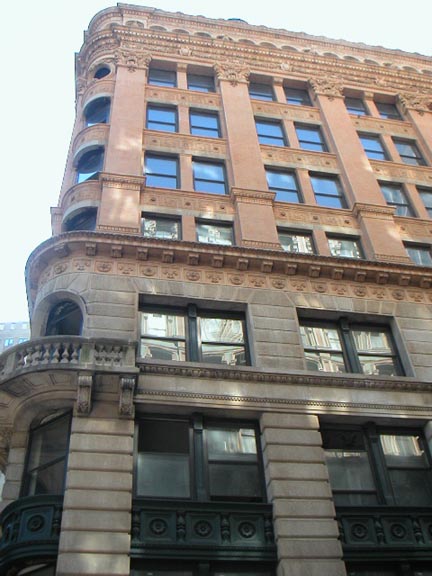
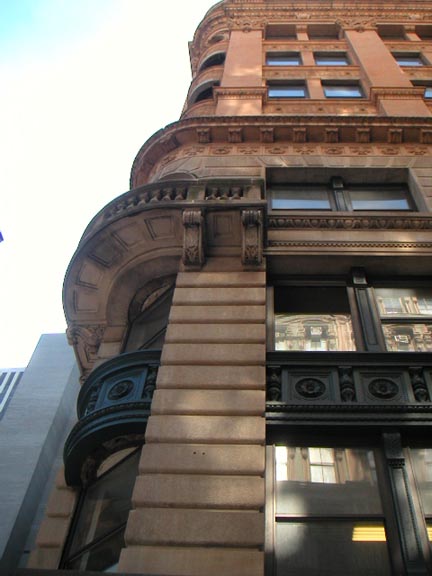
Architecture Images-Seaport and Civic Center Fulton Building |
|
architect |
Delemos and Cordes |
|
location |
87 Nassau St. |
|
date |
1893 |
|
style |
Renaissance Revival |
|
construction |
|
|
type |
Office Building |
 |
|
 |
|
 |
|
|
notes |
Watching Out for Old New York The Trust joins other organizations to push for preservation in the rebuilding of Lower Manhattan. By Rachel Adams In the months after the terrorist attacks of Sept. 11, 2001, much of Lower Manhattan—both the World Trade Center site itself and the blocks around it—became a focus for rebuilding. At the same time, preservationists grew concerned about the fate of the area's many historic structures: With large-scale, multimillion-dollar construction on the horizon, they worried, significant architecture would be threatened. In response, a consortium of five preservation associations—the World Monuments Fund, the Preservation League of New York State, the Municipal Art Society, the New York Landmarks Conservancy, and the National Trust—formed the Lower Manhattan Emergency Preservation Fund to help restore historic properties damaged in the attacks and prevent unnecessary demolition. In February of this year, the fund published a brochure, "Building the Future, Saving the Past," listing more than 300 at-risk buildings in the square-mile area surrounding the Trade Center site, 75 percent of which are not protected by state or local landmark designation. Three specific "corridors of concern" are identified: the Fulton Street area, the eastern side of West Street between the Trade Center site and Battery Park, and most of Greenwich Street south of the site. The Fulton Street corridor, peppered with richly detailed Victorian commercial buildings, has drawn the most attention so far. In August 2002, the city announced plans to construct a $750 million transit hub near the intersection of Fulton and Broadway. This above- and below-ground nucleus linking subways, commuter trains, and buses, scheduled to open in 2007, spells almost certain destruction for several historic structures. Among them is the 1889 Corbin Building, a terra-cotta-embossed, eight-story Renaissance revival office structure designed by celebrated New York architect Francis H. Kimball. "Fulton Street has some of the oldest commercial architecture in the country," says Marilyn Fenollosa, senior program officer for the Trust's northeast regional office. "Developers need to keep in mind the whole downtown landscape, not just the potential for new construction." The West Street and Greenwich Street corridors, though less publicized in the fund's recent efforts, are also at risk. West Street, lined with early-20th-century commercial buildings, has been eyed for new housing. The Greenwich Street area, directly south of the Trade Center site, contains some of the city's earliest residential buildings. A four-story 1810 Georgian mansion at 67 Greenwich, for example, lacks city landmark designation, making it especially vulnerable. In addition to publishing the brochure, the Lower Manhattan Emergency Preservation Fund has led tours of the targeted zones and proposed preservation-friendly construction options, advocating the sort of adaptive use approach that helped revive the downtown business district during the 1990s. Also, amassing $250,000 in contributions from private citizens, the fund has provided more than $100,000 in grant money toward restoring buildings damaged in the attacks. "Historic areas of downtown Manhattan were saved before, and can be saved now," says Fenollosa. "Of course, since September 11, the city has concentrated heavily on the human loss and the recovery efforts, and we never wanted to minimize the importance of the people involved in that day. This is a worthwhile cause as well, though." News of the Preservation Fund's undertakings, as well as an annotated map of the historic buildings in jeopardy, can be found at http://www.nycpreservation911.org/. |
|
links |


