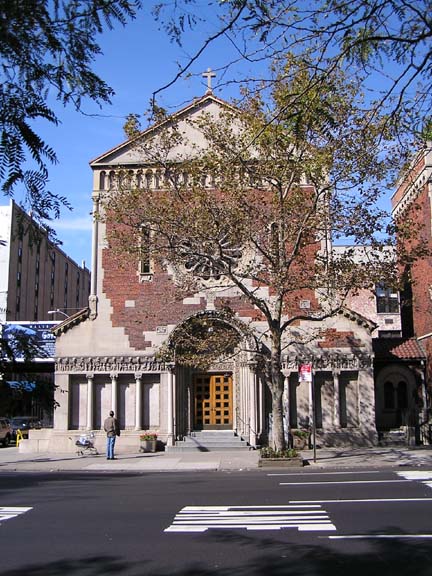
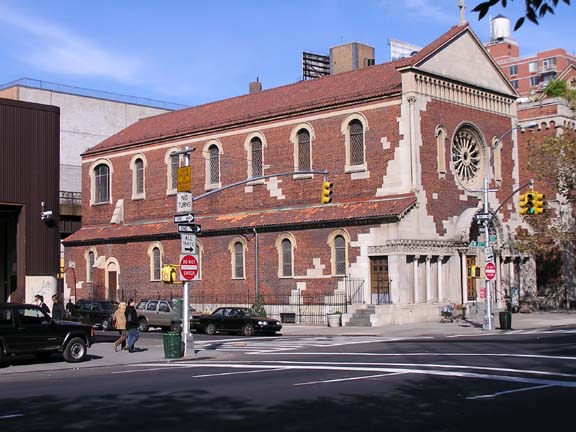
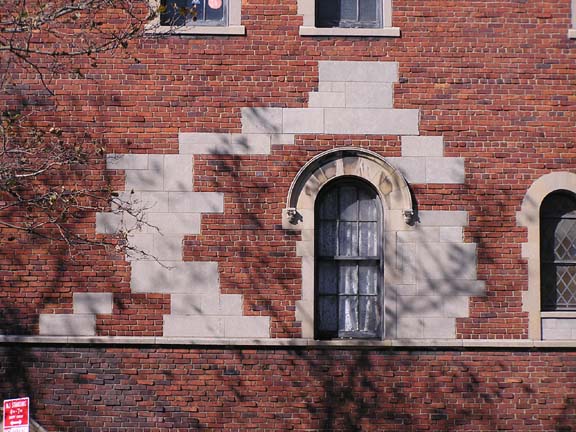
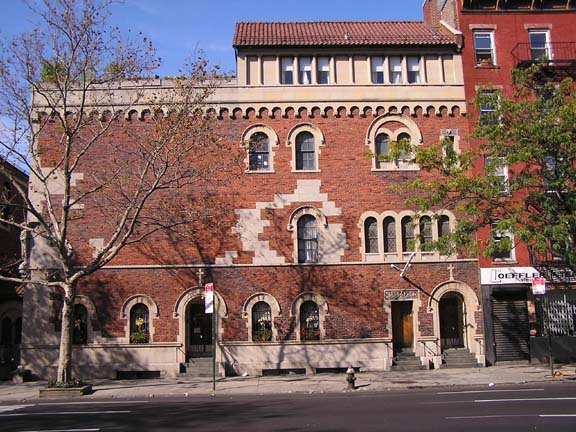
"The church's simple brick and limestone
Southern Sicilian Romanesque facade merges with the Tuscan village forms
of auxiliary buildings to the north in a well- related group." (AIA
Guide to NYC, p.175)
History
Early historians of medieval art followed a similar pattern. To them, the
great climax was the Gothic style, from the thirteenth century to the
fifteenth. For whatever was not-yet-Gothic they adopted the label
Romanesque. In doing so, they were thinking mainly of architecture.
Pre-Gothic churches, they noted, were round-arched, solid, and heavy, as
against the pointed arches and the soaring lightness of Gothic
structures. It was rather like the ancient Roman style of building, and
the term "Romanesque" was meant to convey just that. In this sense, all
of medieval art before 1200 could be called Romanesque insofar as it
shows any link with the Mediterranean tradition.
Architecture
The most conspicuous difference between Romanesque architecture and that
of the preceding centuries is the amazing increase in building activity.
An eleventh century monk, Raoul Glaber, summed it up well when he
triumphantly exclaimed that the world was putting on a "white mantle of
churches." These churches were not only more numerous than those of the
early Middle Ages, they were also generally larger, more richly
articulated, and more "Roman-looking." Their naves now had vaults
instead of wooden roofs, and their exteriors, unlike those of early
Christian, Byzantine, Carolingian, and Ottonian churches, were decorated
with both architectural ornament and sculpture. Geographically,
Romanesque monuments of the first importance are distributed over an
area that might well have represented the world- the Catholic world
Interesting Facts
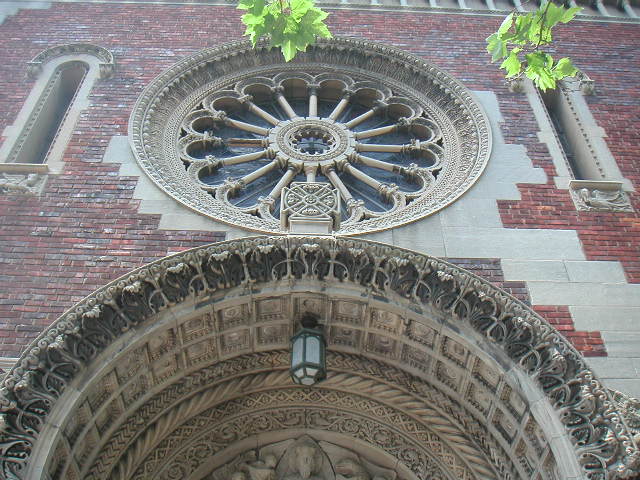
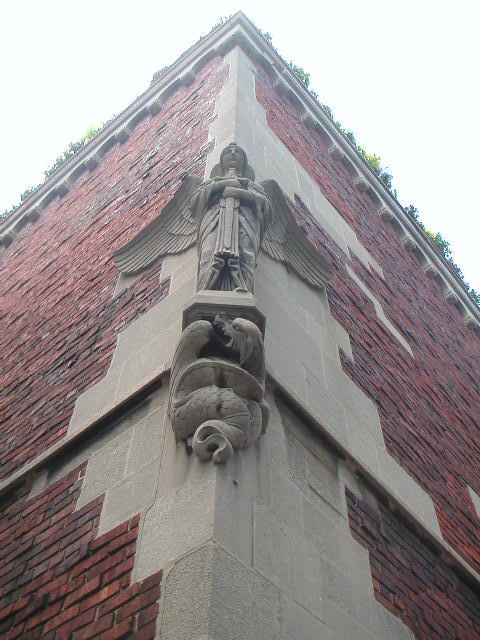
- The Church of the Guardian Angel is
reminiscent of the early Romanesque sculpture at the abbey of Moissac.
Both churches have a scalloped profile that seems to incorporate a bit
of Moorish influence. Both the human and animal forms are treated with
the same incredible flexibility. The purpose of this carefully
illustrated art work is not only decorative but expressive. They embody
dark forces that have been domesticated into guardian figures or
banished to a position that holds then fixed for all eternity.
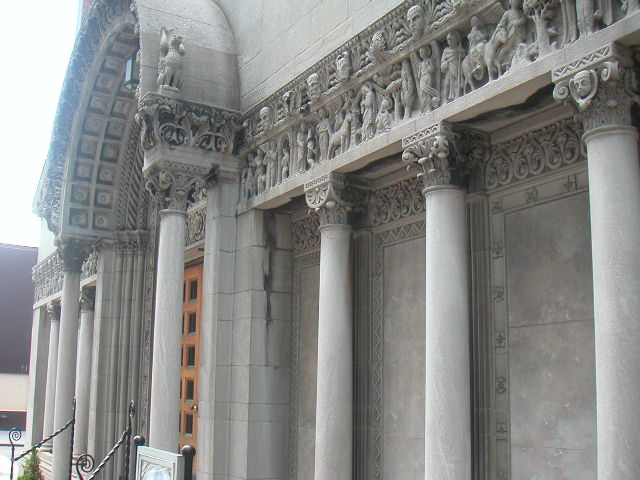
- The portal proper at the church is
preceded by a deep porch, with lavishly sculptured sides. It is adorned
with events from the early life of Christ. Only the proportions of the
bodies and the size of the figures vary with the architectural context.
What matters is the vividness of the narrative, rather than consistency
of treatment.
- The Church of the Guardian Angel was
built in the 1930s by John Van Pelt.
Works Cited
- The Dictionary of Art.
Edited by Jane Turner. Volume #23. Macmillan, New York, 1996.
- AIA Guide to New York City.
Elliot Willensky and Norval White. 3rd Edition. Harcourt
Brace Jovanovich Publishers: New York, 1988.
by Wendy Plaut
plaut@murray.fordham.edu
|