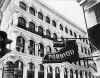
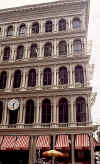
15 Union Square West- interesting makeover with layers peeled off.

Timeline

1870- Tiffany building built at 15 USW. Steel and brick structure with cast iron facade (designed by John Kellum).
1903- Tiffany moved out. Building used as warehouse.
1925- Amalgamated Bank moved in.

1953- pedestrian killed by falling piece of cast iron. Cast iron facade stripped and building reclad in brick.

2008- 1953 brick cladding removed to reveal original steel staunchion structure beneath. The work at 15 Union Square West proceeds under black netting.

Steel staunchion structure.

————-

They didn’t demolishing all of 15 USW, but rather stripping off the entire facade which was added in the 1950s over the original 1870s Tiffany building — and then adding-on / re-doing for the “new” 12-story 185′ tall residential building.

Brack Capital Real Estate USA acquired the six-story, 80,000-square foot Amalgamated Bank Building at 15 Union Square West on the southwest corner at 15th Street for $80 million in 2006.

In an article in the July 2, 2006 edition of The New York Times, Christopher Gray wrote that “the politest thing to say about the blocky white blob of a building at the south corner of 15th Street and Union Square West is that it’s homely,” adding that “buried beneath the 1953 façade is the 1870 building of Tiffany & Company,” a cast-iron building designed by John Kellum. Tiffany moved from this location in 1903 to 401 Fifth Avenue at 37th Street and is now at 57th Street and Fifth Avenue.

The resultant interiors were quite impressive.

A giant 31-by-21-foot room with 16-foot ceilings and 17-foot low-iron impeccably clear windows overlooking Union Square would normally be enough to overwhelm your real estate senses. But then you’d see the 15-foot cast-iron stanchions. Left over from the building’s first life as the Tiffany & Co. headquarters, they curve toward the high ceilings like your own personal Roman aqueduct.Eran Chen, the architect and Brack Capital Real Estate, the developer, decided to highlight the stanchions, making them the focal point of the apartments on the building’s first five floors.

Chen, then with Perkins Eastman and now running his own firm, ODA, enveloped the stanchions in a glass structure, constructing a building within a building fronted by low-iron Austrian glass.
Chen also created a series of sky villas on top of the original building. Almost all of them have huge terraces with park views.

With interiors by New York’s Vicente Wolf, the homes have exquisite details like 2-inch-tall horizontal air slits, uniform shades that come down from the top and up from the bottom, claw-foot bathtubs, limestone and oak foyers and shagreen finishes – made of shark skin – under the master bathroom sinks. (Shagreen perfectly absorbs bathroom moisture and is easy to clean. Perfected by the master leather worker for France’s King Louis XV.)

The exterior of the building has recieved mixed reviews- some people believe that the new glass facade was too cudely detailed and that it didn’t expose the old Victorian structure well enough.
However, I believe that this building has the typical New York innovative flair that we all love.

———

Hidden beneath decades of modernization, the physical past often re-emerges to tell its story of old New York.

By DAVID W. DUNLAP

Rarely does it come with an aura of robin’s egg blue.

But construction at 15 Union Square West has revealed part of the cast-iron facade of the five-story building that housed Tiffany & Company during the glittering end of the 19th century.

“Just when you think the past is consumed, it rears its lovely head,” said Stephen E. v. Gottlieb, an architect who was among the first to recognize the Tiffany cast iron.

Don’t go looking for diamonds. All you will find is a white-brick building under black-shrouded scaffolding. However, there is a sliver of original architecture to be seen along the 15th Street side, where the 20th-century brickwork has been removed.

Perhaps most recognizable from the Tiffany era are the gently curving third-floor windows.

Tiffany, founded in Lower Manhattan in 1837, moved to Union Square in 1870 to keep pace with the seat of fashion. It built in cast iron, The New York Times reported at the time, “as a preventive of fire, in consideration of the vast treasures” within.

While the company was at Union Square, Charles Tiffany bought the 287.42-carat gem that came to be known as the Tiffany Diamond. But the store carried more than rocks.

“Wandering through Tiffany’s spacious galleries in Union Square,” The Times said in 1873, “and stopping to admire the marble or bronze copies of the antique, a piece of majolica, a Limoges enamel, or a superb set of Henry Deux brass work, it is difficult to realize the fact that one is actually in a place of business and that each and every one of the beautiful objects of art can be your own, if you only have the cash wherewith to pay for it.”

(That was a big “if” then. It is a big “if” today.)

Feeling that Union Square had coarsened, Tiffany decamped in 1905 for Fifth Avenue and 37th Street. Twenty years later, the Union Square building was taken over by the Amalgamated Bank. In 1953, after a passer-by was fatally injured by a piece of loose cast iron, Amalgamated had the structure stripped and reclad.

According to city permits now posted at the construction site, the plan is to remove the facade entirely, add seven floors and convert the building to apartments.

So keep your eye on 15 Union Square West. More will undoubtedly be revealed. This is New York City. More will always be revealed.

Copyright 2007 The New York Times Company

Share
This entry was posted in Construction, Heritage, Restoration, Landmarks, Historic Victorian, Modern Minimalist, Residential. Bookmark the permalink.

Leave a Reply